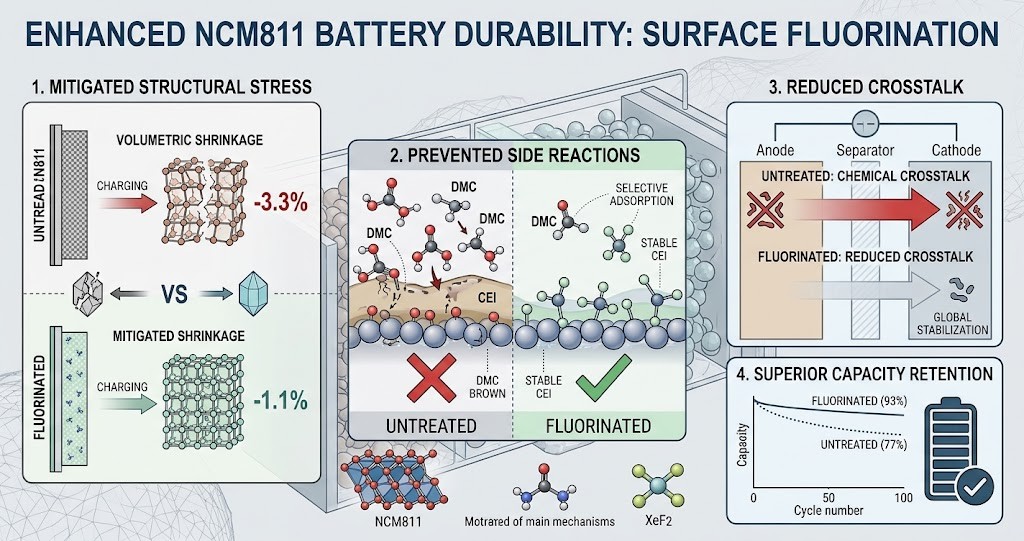
EV(電気自動車)などに用いられる高容量リチウムイオン電池の正極材料として、Ni(ニッケル)の割合を高めた「NCM811」が注目されています。しかし、高電圧充電時に結晶構造が大きく収縮する現象や、正極表面での電解液の分解反応によって劣化が進む点が実用上の大きな課題でした。
本研究では、フッ化キセノン(XeF2)を用いた気体反応により正極表面の近傍を適切にフッ素化することで、構造変化と副反応を同時に防ぎ、電池の寿命を飛躍的に延ばすメカニズムを解明しました。
1. 表面フッ素化がもたらす4つの効果
- 結晶構造の変形抑制: 高電圧充電時における格子の体積収縮率が、未処理の「-3.3%」から「-1.1%」へと緩和。相転移(H2→H3)に伴う急激な構造破壊が抑えられます。
- 界面での副反応を防止: 電解液成分(ジメチルカーボネイト: DMC)の吸着状態を選択的に変えることで、正極表面での過剰な分解反応と正極界面被膜(CEI)の不要な増厚を抑制します。
- 電極間のクロストーク低減: 正極の安定化効果が負極側へも波及し、両極間での不要な化学反応(化学的クロストーク)が大幅に低減します。
- 圧倒的な容量維持率: 黒鉛負極と組み合わせたセルによるテストで、100サイクル充放電後の容量維持率が未処理の「77%」から「93%」へ大幅に向上しました。
【関連情報】Niリッチ正極開発のトレンドと本研究の位置づけ
次世代リチウムイオン電池におけるNiリッチ化の潮流
航続距離の延伸を求める車載電池市場では、コバルトの使用量を減らしつつ高エネルギー密度化を図る「Niリッチ層状酸化物(NCM811やNCM90など)」の導入が急速に進んでいます。 しかし、ニッケル比率を高めるほど高電圧時の構造不安定性や熱暴走リスク、サイクル寿命の低下が著しくなるため、材料表面を保護・修飾する技術の開発が世界中で熾烈を極めています。
従来の「ドーピング・コーティング」と本研究の違い
これまでも元素ドープやコーティングによる表面保護策は研究されていましたが、プロセスが複雑であったり、内部への過剰な拡散によって伝導性が落ちる問題がありました。
- 本アプローチの特長: フッ化キセノン(XeF2)を用いた「固体 – 気体反応」を採用し、時間を厳密に制御することで、粒子の最表面近傍だけにピンポイントでフッ素を配置することに成功しました。
- 学術的貢献: 「単に物理的な保護層を作る」のではなく、電解液分子(DMC)の吸着状態そのものを分子レベルでコントロールし、両極間のクロストークまで抑えるという包括的な安定化機序を解明した点が極めて画期的です。
今後の実用化に向けた期待と課題
- 汎用プロセスの確立: 気体反応によるフッ素化は均一な処理に適している反面、工業的な量産ラインで安全かつ低コストにXeF2処理を行えるプロセスの確立が今後の鍵となります。
- 全固体電池や他系材料への応用: 液体電解液を使うリチウムイオン電池だけでなく、固体電解質との界面抵抗が課題となる全固体電池の正極被覆・安定化技術への応用展開も期待されます。
出典:https://eetimes.itmedia.co.jp/ee/articles/2608/28/news050.html
Simultaneously Preventing Structural Degradation and Side Reactions in NCM811: Cathode Surface Fluorination Technology via Gas-Phase Reaction
NCM811, which features an increased proportion of nickel (Ni), is attracting significant attention as a high-capacity cathode material for lithium-ion batteries used in applications such as electric vehicles (EVs). However, severe lattice contraction during high-voltage charging and degradation driven by electrolyte decomposition on the cathode surface have remained major practical challenges. In this study, by appropriately fluorinating the region near the cathode surface via a gas-phase reaction using xenon difluoride (XeF2), researchers elucidated a mechanism that simultaneously prevents structural changes and side reactions, dramatically extending battery lifespan.
- Four Key Benefits of Surface Fluorination
- Suppression of Lattice Deformation: The volume contraction rate of the crystal lattice during high-voltage charging was mitigated from -3.3% in untreated samples to -1.1%. Rapid structural breakdown associated with the phase transition (H2 to H3) is suppressed.
- Prevention of Interface Side Reactions: By selectively altering the adsorption behavior of the electrolyte component (dimethyl carbonate: DMC), excessive decomposition reactions on the cathode surface and unnecessary growth of the cathode electrolyte interphase (CEI) are suppressed.
- Reduction of Inter-Electrode Crosstalk: The stabilizing effect on the cathode extends to the anode side, significantly reducing undesirable chemical reactions between the two electrodes (chemical crosstalk).
- Outstanding Capacity Retention: In tests using full cells paired with graphite anodes, the capacity retention rate after 100 charge-discharge cycles improved significantly from 77% in untreated cells to 93%.
Related Information: Trends in Ni-Rich Cathode Development and the Positioning of This Research Trends Toward Ni-Rich Chemistries in Next-Generation Lithium-Ion Batteries Driven by the automotive battery market’s demand for longer driving ranges, the adoption of Ni-rich layered oxides (such as NCM811 and NCM90) is accelerating to increase energy density while reducing cobalt usage. However, higher nickel content increases structural instability at high voltages, thermal runaway risks, and cycle-life degradation, triggering intense global research into materials surface protection and modification.
Differences Between Conventional Doping/Coating and This Approach While surface protection methods using element doping or coating have been previously studied, they often suffered from complex processes or impaired conductivity due to excessive internal diffusion.
- Features of This Approach: By adopting a solid-gas reaction using xenon difluoride (XeF2) and strictly controlling the reaction time, the team successfully introduced fluorine with high spatial precision near the primary surface of the particles.
- Academic Contribution: Rather than simply creating a physical protective layer, this work is groundbreaking in elucidating a comprehensive stabilization mechanism that controls the adsorption state of electrolyte molecules (DMC) at the molecular level, suppressing chemical crosstalk between both electrodes.
Expectations and Challenges for Future Commercialization
- Establishing Versatile Manufacturing Processes: While gas-phase fluorination is well-suited for uniform treatment, establishing safe and cost-effective XeF2 treatment methods on industrial mass-production lines will be key moving forward.
- Expansion to Solid-State Batteries and Other Material Systems: Beyond liquid-electrolyte lithium-ion batteries, this approach holds promise for application to cathode coating and stabilization technologies in all-solid-state batteries, where interface resistance remains a primary challenge.

コメント