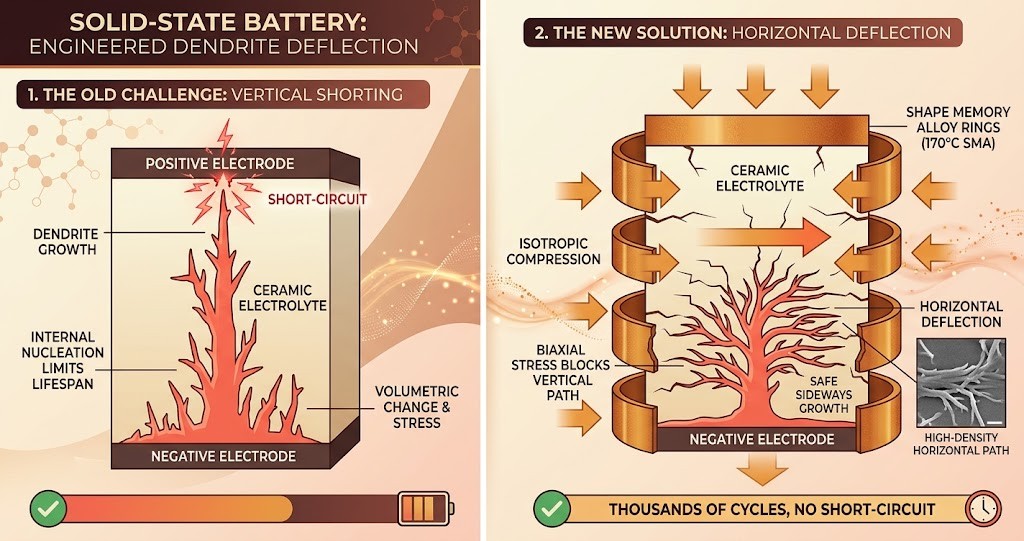
これまで全固体電池の開発では、充電時に発生して電解質を突き破る金属リチウムの枝状結晶「デンドライト」を「いかに発生させないか」というアプローチが主流でした。しかし今回の研究では、発生を前提としつつ、「向きを横に曲げて電極への到達を防ぐ」という工学的なアプローチにより、充放電を繰り返しても短絡しない構造が実証されました。
1. デンドライト発生と短絡のメカニズム
- 従来の課題: 充電時に負極側で金属に戻るリチウムが、セラミック電解質内部の微小な欠陥や細孔に入り込んで成長します。硬いセラミックは亀裂が入ると応力が集中しやすいため、低速充電であっても枝が縦方向(正極方向)へ一気に伸びて短絡を引き起こします。
- 新たな発見: デンドライトはサイクル初期の表面からの侵入だけでなく、長期サイクルの後には電解質の内部(結晶粒界など)からも新たな核として湧き出ることが確認されました。このため、表面の平滑化などの界面対策だけでは寿命の頭打ちを避けられないことが明確になりました。
2. 形状記憶合金リングによる「二軸圧縮」技術
- 仕組み: 170 degree Cに加熱した形状記憶合金(SMA: Shape Memory Alloy)のリングを電解質に装着し、電極面と平行な2方向から圧縮力(二軸応力: biaxially stressed)を加えました。
- メカニズム: 縦方向に伸びようとする亀裂の面は両側から強力に押し合わされて閉じられます。一方で、電極面と平行な横向きの割れ目は圧力を受けないため開いたままとなり、リチウムは抵抗の少ない横方向へ曲がって成長します(偏向: deflection)。
- 結果: 過去に例を見ない高密度でデンドライトが発生したものの、数千回の充放電を通じても短絡は一切起きませんでした。枝を「消す」のではなく「電極に届かせない」ことで電池を防護できることが示されました。
【関連情報】研究の背景と今後の量産化へのロードマップ
業界のトレンド:電気化学から「機械的応力」の活用へ
2025年末から2026年にかけて、デンドライトに関する重要論文が連続して発表されています。
- 原因の解明:
- MIT(2026年7月): 結晶粒界の空間電荷層が発生源になると報告。
- マックス・プランク研究所(2026年4月): リチウムの静水圧がセラミック側に引張応力を与えて破壊を進めるメカニズムを解明。
- 応力の活用:
- Brown大学(2025年12月): 温度勾配による内部圧縮応力を利用し、デンドライトの浸透自体を抑止(臨界電流密度を3倍に向上)。
- SLAC / スタンフォード大学(2026年7月/8月): 二軸圧縮を利用し、侵入したデンドライトを横方向へ無害化。
現在、全固体電池の開発は「電流密度や材料組成などの電気化学的なアプローチ」だけでなく、「機械的な応力(締め付けや温度制御)」を電池設計の変数として組み込むフェーズへ移行しています。
実用化・車載化に向けた今後の検証課題
トヨタ自動車が2027-2028年に全固体電池搭載EVの限定投入を計画するなど、2030年の本格量産に向けた動きが進んでいます。今回実証された技術を車載セルへ応用するためには、以下の検証が必須となります。
- 大面積セルでの再現性: セルが大型化・大面積化すると電解質内の欠陥数が増加するため、面全体へ均一に二軸圧縮をかけ続けられる設計が必要です。
- 異種電解質への適用: 実験で使用されたガーネット型(Li6.6La3Zr1.6Ta0.4O12)以外の固体電解質でも同様の偏向効果が得られるかの確認。
- 長期的な圧縮保持: 車両の稼働に伴う振動、温度変化、長期の充放電サイクルを経ても、パック構造として必要な圧縮力を維持し続けられる機構の開発。
出典:https://xenospectrum.com/solid-state-battery-dendrite-deflection/
Overcoming the All-Solid-State Battery Barrier with Shifted Thinking: Biaxial Compression Technology to Deflect Dendrites Horizontally
In the development of all-solid-state batteries, the mainstream approach has been figure out how to prevent the formation of dendrites—branch-like structures of metallic lithium that grow during charging and penetrate the electrolyte. However, this study demonstrated a short-circuit-free structure across repeated charge-discharge cycles by using an engineering approach that accepts dendrite formation while deflecting their growth horizontally to prevent them from reaching the counter electrode.
- Mechanism of Dendrite Formation and Short-Circuiting Conventional Issue: During charging, lithium converted back into metal at the negative electrode enters micro-defects and pores inside the ceramic electrolyte and grows. Because hard ceramics are prone to stress concentration once a crack forms, the branches grow rapidly in the vertical direction (towards the positive electrode), causing short circuits even under low-rate charging. New Finding: It was confirmed that dendrites not only penetrate from the surface during early cycles, but also nucleate from within the electrolyte (such as at grain boundaries) after long-term cycling. This clarifies that interface-focused countermeasures, such as surface smoothing, cannot prevent the eventual degradation of battery lifespan.
- Biaxial Compression Technology Using Shape Memory Alloy Rings Mechanism: Shape memory alloy (SMA) rings heated to 170 degrees C were fitted around the electrolyte, applying compressive force from two directions parallel to the electrode surface (biaxially stressed). Deflection Process: Crack surfaces attempting to extend vertically are strongly pressed together from both sides and closed. In contrast, horizontal cracks parallel to the electrode surface receive no compressive stress and remain open, allowing lithium to bend and grow laterally along the path of least resistance (deflection). Result: Despite dendrites forming at unprecedented densities, no short circuits occurred over thousands of charge-discharge cycles. This demonstrates that batteries can be protected by preventing the branches from reaching the counter electrode rather than eliminating them.
Related Information: Research Background and Future Roadmap for Mass Production Industry Trend: Shift from Electrochemistry to the Utilization of Mechanical Stress Between late 2025 and 2026, several key papers on dendrites were published back-to-back:
Elucidating the Causes:
- MIT (July 2026): Reported that the space-charge layer at grain boundaries serves as the origin of dendrite formation.
- Max Planck Institute (April 2026): Elucidated the mechanism where hydrostatic pressure from lithium entering cracks exerts tensile stress on the ceramic, accelerating brittle fracture.
Utilizing Stress:
- Brown University (December 2025): Utilized internal compressive stress generated by temperature gradients to suppress dendrite penetration itself (increasing the critical current density by 3x).
- SLAC / Stanford University (July/August 2026): Utilized biaxial compression to neutralize intruding dendrites by deflecting them horizontally.
Currently, all-solid-state battery development is transitioning beyond purely electrochemical approaches (such as current density and material composition) into a phase that incorporates mechanical stress (clamping and thermal management) as key design variables.
Future Verification Challenges for Automotive Applications and Commercialization With Toyota planning a limited rollout of EVs equipped with all-solid-state batteries in 2027-2028, momentum toward full-scale mass production by 2030 is building. Applying the technology demonstrated in this study to automotive-grade cells requires verifying the following:
- Reproducibility in Large-Area Cells: As cells become larger, the number of defects in the electrolyte increases, requiring designs that can continuously apply uniform biaxial compression across the entire surface.
- Application to Different Electrolytes: Confirming whether the same deflection effect can be achieved with solid electrolytes other than the garnet-type (Li6.6La3Zr1.6Ta0.4O12) used in the experiment.
- Long-Term Compression Retention: Developing mechanisms capable of maintaining the necessary compressive force within the battery pack structure despite vehicle vibrations, temperature fluctuations, and extended charge-discharge cycling.
コメント