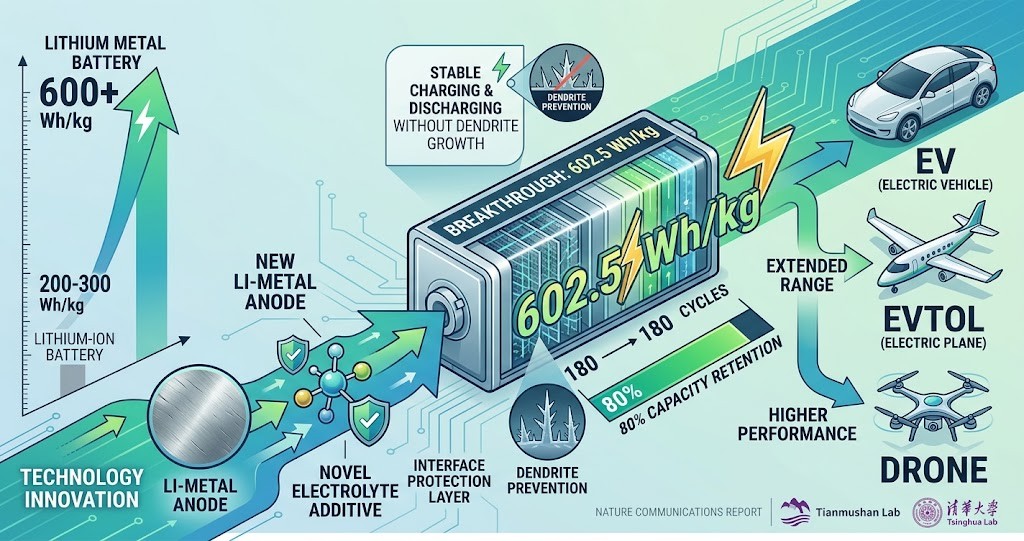
中国の天目山実験室と清華大学の研究チームは、科学誌『Nature Communications』にて、エネルギー密度が600Wh/kgを超える高安定なパウチ型リチウム金属電池の開発に成功したと発表しました。この数値は、現在市販されている一般的なリチウムイオン電池(約200〜300Wh/kg)の約2倍に相当し、電気自動車(EV)や電動航空機の性能を著しく引き上げる可能性を秘めています。
技術の革新点と実験結果
- 負極材料の刷新現行のリチウムイオン電池で主流となっている黒鉛(グラファイト)負極ではなく、理論容量が極めて高い純リチウム金属を負極に使用しています。
- 電解質添加剤による界面保護高電圧下での電解液劣化や、短絡・発火の原因となるリチウム結晶(デンドライト)の発生を防ぐため、強い配位能力を持つ独自の新規電解質添加剤を開発しました。これにより、正極・負極表面に薄く耐久性に優れた保護膜が形成され、高電圧充放電における安定性とイオン輸送効率が大幅に改善しています。
- 試作セルの性能
- 高ニッケル正極材との組み合わせ: 10Ahのパウチセルで550.7Wh/kgのエネルギー密度を記録し、180サイクル充放電後も80%の容量を維持。
- リチウム・マンガン過剰(LMR)正極材との組み合わせ: エネルギー密度602.5Wh/kgを達成。
技術的背景と応用展望
現行技術の限界
従来のグラファイト負極を用いるリチウムイオン電池は、理論上のエネルギー密度限界である約350Wh/kgに接近しており、これ以上の航続距離増加や重量削減は困難とされています。
応用分野
- 低空経済(ドローン・eVTOL): バッテリー重量の制約が厳しい電動垂直離着陸機(eVTOL)や長距離ドローンにおいて、飛行時間を劇的に延ばすキーテクノロジーとなります。
- 次世代電気自動車(EV): 車両の軽量化と、1回当たりの充電による航続距離の大幅な伸長(約50%以上の向上)が期待されます。
商業化に向けた課題
- 研究室レベルからのスケールアップ: 大量生産プロセスの確立および製造コストの削減。
- 長期耐久性の確保: 自動車用途などで要求される千回単位のサイクル寿命の達成と、実使用環境(高温・低温、衝撃など)における安全性検証。
業界の競合・関連動向
- CATL(寧徳時代)の動き: 同社はeVTOL向けにエネルギー密度約500Wh/kgの凝縮体(コンデンスト)電池を開発中であるほか、理論限界が極めて高いリチウム空気電池(理論値最大12,000Wh/kg)の基礎研究も並行して進めています。
Chinese Research Team Develops Ultra-High-Energy-Density Lithium Metal Battery Exceeding 600 Wh/kg
A research team from Tianmushan Laboratory and Tsinghua University in China announced in the journal Nature Communications that they have successfully developed a highly stable pouch-type lithium metal battery with an energy density exceeding 600 Wh/kg. This figure is roughly double that of typical commercially available lithium-ion batteries (approx. 200–300 Wh/kg) and holds the potential to significantly boost the performance of electric vehicles (EVs) and electric aircraft.
Key Technological Innovations and Experimental Results
- Anode Material Overhaul Instead of the graphite anodes mainstream in current lithium-ion batteries, pure lithium metal—which possesses an extremely high theoretical capacity—is used as the anode.
- Interfacial Protection via Electrolyte Additives To prevent electrolyte degradation under high voltage and the formation of lithium crystals (dendrites) that cause short circuits and fires, the team developed a novel electrolyte additive with strong coordination capability. This forms a thin yet durable protective film on the cathode and anode surfaces, greatly improving stability during high-voltage charge/discharge cycles and enhancing ion transport efficiency.
- Prototype Cell Performance
- Paired with High-Nickel Cathode: A 10 Ah pouch cell achieved an energy density of 550.7 Wh/kg and retained 80% of its capacity after 180 charge-discharge cycles.
- Paired with Lithium- and Manganese-Rich (LMR) Cathode: Achieved an energy density of 602.5 Wh/kg.
Technological Background and Application Outlook
Limitations of Current Technology Conventional lithium-ion batteries using graphite anodes are approaching their theoretical energy density limit of around 350 Wh/kg, making further increases in driving range or weight reduction difficult.
Application Fields
- Low-Altitude Economy (Drones & eVTOLs): Serves as a key technology to dramatically extend flight times for electric vertical takeoff and landing (eVTOL) aircraft and long-range drones, where battery weight constraints are severe.
- Next-Generation Electric Vehicles (EVs): Expected to enable vehicle weight reduction and a substantial extension of driving range per charge (over 50% improvement).
Challenges Toward Commercialization
- Scaling Up from Laboratory Level: Establishing mass production processes and reducing manufacturing costs.
- Ensuring Long-Term Durability: Achieving the thousands-of-cycles lifespan required for automotive applications, along with safety verification under real-world operating conditions (high/low temperatures, impacts, etc.).
Industry Competitors and Related Trends
- Moves by CATL: CATL is developing a condensed battery with an energy density of around 500 Wh/kg for eVTOLs, while concurrently conducting basic research on lithium-air batteries with extremely high theoretical limits (up to 12,000 Wh/kg).

コメント