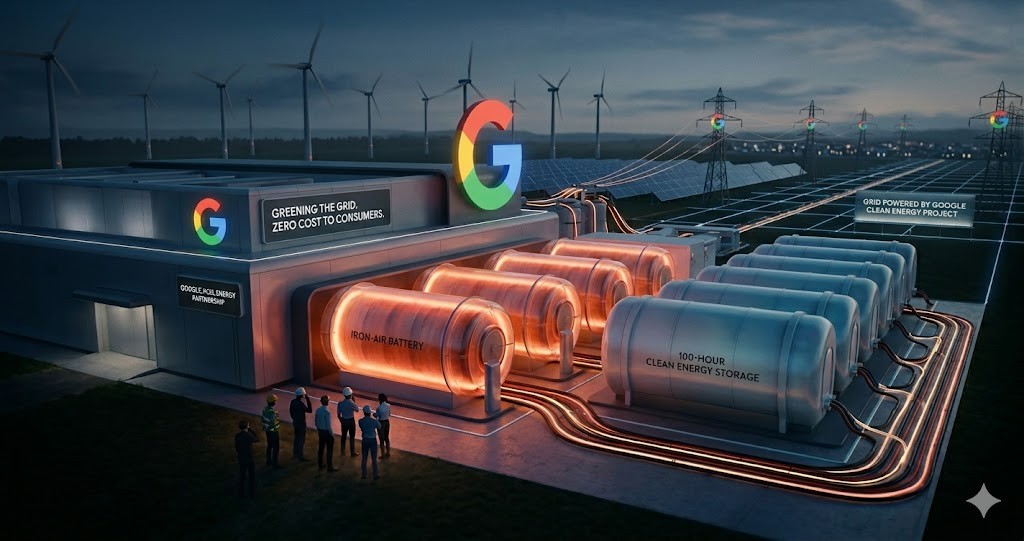
インターネット社会の急成長に伴い、データセンターが消費する電力の爆発的な増加が世界的な課題となっています。その中でGoogle(グーグル)は、地域の一般顧客にコストを転嫁せず、自ら追加費用を負担して電力網をグリーン化する新しいビジネスモデルを打ち出しました。本まとめでは、米国ミネソタ州で始動する世界最大級のクリーンエネルギープロジェクトと、それを支える革新的な「鉄空気電池」の技術について解説します。
1. プロジェクトの概要と新料金制度
Googleは、米国ミネソタ州パインアイランドに建設予定の新しいデータセンターにおいて、大手電力会社Xcel Energy(エクセル・エネルギー)と約1GW(ギガワット)規模の電力供給契約を結びました。
- 一般顧客への配慮: データセンターの莫大な電力需要によるインフラ追加費用を一般の電気利用者に転嫁しないよう、「CEAC(Clean Energy Accelerator Charge:クリーンエネルギー導入加速負担金)」という新制度を設計。Googleがすべての追加コストを負担します。
- 調達する電源の内訳: 風力発電1400MW(メガワット)、太陽光発電200MW。さらに、これらを補完する出力300MW・容量30GWh(ギガワット時)の長時間蓄電設備を導入します。
【関連情報】データセンターの電力危機
生成AIの普及などにより、データセンターの消費電力は2026年までに2022年比で約2倍に達すると予測されています。民間企業が自らの費用で地域全体の送配電網(グリッド)を強化する今回の取り組みは、今後のデータセンター開発の先行モデルとして注目されています。
2. 世界最大の「鉄空気電池」とその仕組み
今回のプロジェクトで最も注目されているのが、米スタートアップのForm Energy(フォームエネルギー)が開発した「鉄空気電池システム」の採用です。容量30GWhは、発表済みの蓄電池プロジェクトとして世界最大となります。
- 可逆的な錆び(さび)の利用: 鉄が酸素と反応して酸化鉄(錆び)に変化するときに放電し、電気を加えることで元の鉄に還元(充電)するというシンプルな仕組みです。
- 100時間対応の強み: 現在主流のリチウムイオン電池(数時間の蓄電が得意)とは異なり、最大100時間(約4日間)もの長時間にわたって電力を供給できます。これにより、天候によって数日間無風や曇天が続いた場合でも、再生可能エネルギーを安定して供給できます。
| 蓄電池の種類 | 主な材料 | 得意な用途 | コスト・資源リスク |
| リチウムイオン電池 | リチウム、コバルトなど | 短時間の急速な充放電、EV、スマホ | レアメタルのため高価、供給懸念あり |
| 鉄空気電池 | 鉄、水、空気 | 数日間にわたる大容量・長時間のバックアップ | 地球上に豊富にあり非常に安価 |
※鉄空気電池はリチウムイオン電池を置き換えるものではなく、短時間はリチウム、長時間(数日単位)は鉄空気電池という「補完関係」で電力網を支えます。
3. 地域電力網の強靭化への貢献
Googleは再エネの購入だけでなく、地域の送配電網そのものを強化するために追加の投資を行います。
- プログラムへの拠出: Xcel Energyの「Capacity Connect Program(電力供給力強化プログラム)」に5000万ドル(約75億円以上)を拠出します。
- 分散型のアプローチ: この資金により、電力システム全体に小規模な蓄電池を分散配置し、地域全体の需給調整能力と災害時の強靭性を高めます。
- 脱炭素の加速: Xcel Energyはすでに電源構成の70%をカーボンフリー(CO2を排出しない)電力に転換していますが、今回のGoogleとの提携により、地域の脱炭素化がさらに前進します。
急増するデータセンターの電力需要を単なるお荷物とするのではなく、その巨大な需要をレバー(梃子)にして地域の電力インフラを最先端のクリーンエネルギー網へ作り変えていく、という「逆転の発想」がこのプロジェクトの根底にあります。なお、この契約の実行にはミネソタ州公益事業委員会の正式な承認が必要となります。
出典:https://project.nikkeibp.co.jp/ms/atcl/19/feature/00003/051900226/?ST=msb&P=1
Google Adopts World’s Largest Iron-Air Battery: Decarbonization Project Advances in Minnesota
The explosive growth in power consumption by data centers has become a global challenge alongside the rapid expansion of our internet-driven society. In response, Google has launched a new business model to green the power grid by bearing the additional costs themselves, rather than passing them on to local retail customers. This summary explains the world’s largest-class clean energy project launching in Minnesota, USA, and the innovative “iron-air battery” technology that supports it.
Summary of News and Related Information
1. Project Overview and New Tariff System
Google has entered into an approximately 1GW (gigawatt) power supply agreement with major utility company Xcel Energy for its new data center to be built in Pine Island, Minnesota, USA.
- Consideration for Retail Customers: To ensure that the infrastructure costs from the data center’s massive power demand are not passed on to general electricity users, the two companies designed a new system called CEAC (Clean Energy Accelerator Charge). Google will bear all additional costs.
- Breakdown of Procured Power: 1400MW (megawatt) of wind power and 200MW of solar power. Furthermore, to complement these, a long-duration energy storage facility with an output of 300MW and a capacity of 30GWh (gigawatt-hour) will be introduced.
[Related Information] The Data Center Power Crisis
Driven by the widespread adoption of generative AI and other factors, data center power consumption is projected to roughly double by 2026 compared to 2022 levels. This initiative, where a private corporation finances the strengthening of the entire regional transmission and distribution grid, is drawing attention as a pioneering model for future data center development.
2. The World’s Largest “Iron-Air Battery” and How It Works
The most notable aspect of this project is the adoption of the “iron-air battery system” developed by US startup Form Energy. Its 30GWh capacity makes it the largest announced battery project in the world.
- Utilizing Reversible Rusting: The mechanism is simple. The battery discharges electricity when iron reacts with oxygen to turn into iron oxide (rust), and reverses the process (recharging) back to iron when electricity is applied.
- The Strength of 100-Hour Capability: Unlike currently mainstream lithium-ion batteries, which excel at short-duration storage of a few hours, iron-air batteries can supply power for up to 100 hours (about 4 days). This allows for a stable supply of renewable energy even when calm or cloudy weather persists for several days.
| Battery Type | Key Materials | Ideal Use Case | Cost & Resource Risks |
| Lithium-ion Battery | Lithium, cobalt, etc. | Short-duration rapid charging/discharging, EVs, smartphones | Expensive due to rare metals; supply concerns exist |
| Iron-air Battery | Iron, water, air | Large-capacity, long-duration backup spanning multiple days | Extremely inexpensive and abundantly available on Earth |
Note: Iron-air batteries are not meant to replace lithium-ion batteries. Instead, they support the power grid through a complementary relationship, where lithium is used for short durations and iron-air is used for long durations (on a multi-day scale).
3. Contribution to Regional Grid Resilience
In addition to purchasing renewable energy, Google will make further investments to strengthen the regional transmission and distribution grid itself.
- Contribution to Program: Google will contribute 50 million dollars (over 7.5 billion yen) to Xcel Energy’s “Capacity Connect Program”.
- Decentralized Approach: This funding will be used to distribute small-scale batteries throughout the entire power system, enhancing regional demand-supply adjustment capabilities and disaster resilience.
- Accelerating Decarbonization: Xcel Energy has already transitioned 70% of its power mix to carbon-free (non-CO2 emitting) electricity. This partnership with Google will push the region’s decarbonization efforts even further.
Rather than viewing the skyrocketing power demand of data centers purely as a burden, the core philosophy of this project is a “reverse approach”: leveraging that massive demand as a mechanism to rebuild the regional power infrastructure into a state-of-the-art clean energy grid.
コメント