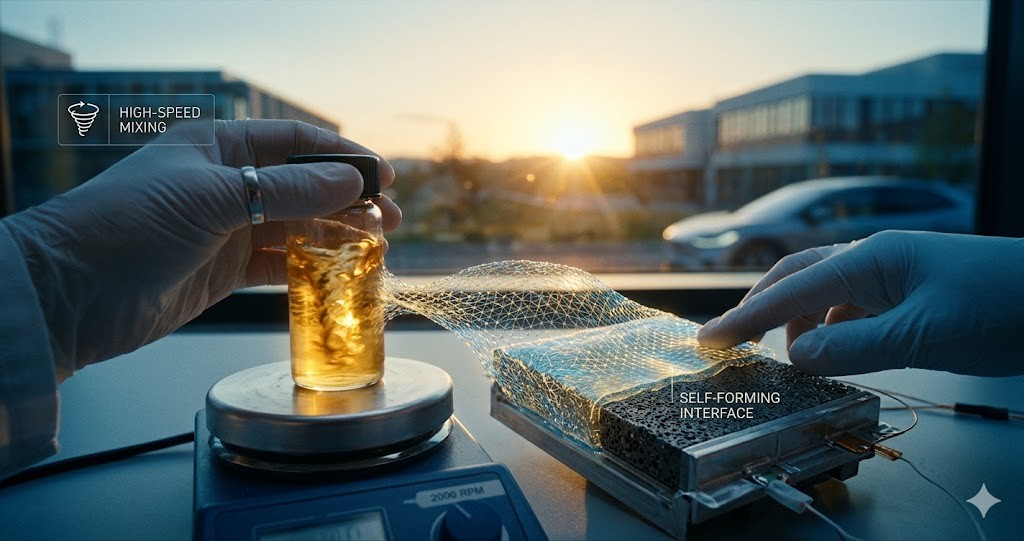
米アルゴンヌ国立研究所(ANL)とシカゴ大学の研究チームは、全固体リチウム硫黄電池の材料を高速で撹拌(かくはん)することで、理想的なイオン伝導界面が自発的に形成される現象を発見しました。
1. 研究の背景:界面抵抗という「壁」
- 従来のリチウムイオン電池: 液体電解質を用いるため、電極との接触は容易ですが、発火リスクとエネルギー密度の限界が課題でした。
- 全固体電池の難題: 固体電解質と固体電極を密着させる必要があり、これまでは精密なナノコーティングや、数十 MPa(メガパスカル)という巨大な外部圧力をかけ続ける手法が主流でした。
- 新たな問い: 外部圧力や複雑な加工に頼らず、材料自体の性質を利用して「自己組織化」的に界面を作ることはできないか、という視点から研究が始まりました。
2. ブレイクスルー:メカノケミカル反応と「ハロゲン化物の偏析」
- 手法: 電池材料を毎分 2000 rpm で5時間激しく撹拌する「高速混合」を実施。
- 現象: 物理的なストレスと摩擦熱により、リチウム原子と結合した塩素(Cl)や臭素(Br)などのハロゲン元素が、自発的に固体電解質と正極の「界面」へ移動・濃縮する現象(偏析)を確認しました。
- 効果: 形成されたハロゲン化物層が、リチウムイオンの高速な通り道(パス)になると同時に、電池劣化の原因となる副反応をブロックするシールドとして機能します。
3. 性能の劇的な向上
新しい手法を用いた全固体電池は、室温環境下で圧倒的なパフォーマンスを示しました。
| 指標 | 従来の手法(未処理) | 新手法(ハロゲン化物偏析型) |
| サイクル寿命 | 数十回で急激に低下 | 450サイクル後も容量 80% 以上を維持 |
| エネルギー密度 | 理論値の半分以下 | 理論限界に迫る高い密度を達成 |
| 動作環境 | 高温加熱が必要な場合が多い | 室温で動作可能 |
| 界面の安定性 | 膨張・収縮で接触不良が発生 | 自己組織化層により安定した接触を維持 |
4. 今後の課題と展望
- スケールアップ: 実験室レベルの小型セルから、電気自動車(EV)用の大容量セル(100 Ah クラス)へ製造規模を拡大した際に、均一な反応が起こせるかの検証が必要です。
- 長期信頼性: 自動車に求められる 10年・10万 km 以上の過酷な使用環境(-20度 から 60度 以上)において、この自己組織化した層が安定して維持されるかを確かめる試験が今後の焦点となります。
関連情報:全固体電池とメカノケミカル反応の補足
メカノケミカル反応(Mechanochemical Reaction)とは
機械的エネルギー(摩擦、圧縮、剪断力)によって化学反応を引き起こす手法です。通常、化学反応には「加熱」が必要ですが、この手法では物質をすり潰したり混ぜたりする際のエネルギーを利用するため、溶媒を使わない環境に優しいプロセスとして注目されています。
硫黄(S)系正極のメリット
今回の研究で焦点となった「リチウム・硫黄(Li-S)電池」は、以下の特徴を持ちます。
- 低コスト: 硫黄は地球上に豊富に存在し、安価です。
- 高容量: 従来のリチウムイオン電池に使用される正極材料に比べ、理論上数倍のエネルギーを蓄えることが可能です。
- 課題の克服: 硫黄系電池は寿命が短いことが最大の弱点でしたが、今回の「自己組織化シールド」はその弱点を克服する鍵となります。
出典:https://www.science.org/doi/10.1126/science.adt1882
Breaking the Barrier of Interfacial Resistance with “Mechanochemical Reactions”: A New Dimension for All-Solid-State Battery Energy Density
A research team from Argonne National Laboratory (ANL) and the University of Chicago has discovered a phenomenon where an ideal ion-conductive interface forms spontaneously by high-speed stirring of all-solid-state lithium-sulfur battery materials.
1. Research Background: The “Wall” of Interfacial Resistance
- Conventional Lithium-ion Batteries: These use liquid electrolytes, making electrode contact easy, but they face challenges regarding fire risks and energy density limits.
- The Challenge of All-Solid-State Batteries: It is necessary to maintain tight contact between solid electrolytes and solid electrodes. Previously, the main methods involved precise nano-coatings or applying continuous, massive external pressure of several tens of MPa (megapascals).
- A New Question: This research began with the perspective of whether an interface could be created through “self-assembly” by utilizing the inherent properties of the materials themselves, without relying on external pressure or complex processing.
2. Breakthrough: Mechanochemical Reactions and “Halide Segregation”
- Method: “High-speed mixing” was performed by vigorously stirring battery materials at 2000 rpm for 5 hours.
- Phenomenon: Physical stress and frictional heat caused halogen elements such as chlorine (Cl) and bromine (Br), bonded with lithium atoms, to spontaneously migrate and concentrate at the interface between the solid electrolyte and the cathode (segregation).
- Effect: The formed halide layer functions as a high-speed path for lithium ions while simultaneously acting as a shield to block side reactions that cause battery degradation.
3. Dramatic Performance Improvement
All-solid-state batteries using this new method showed overwhelming performance in room-temperature environments.
| Metric | Conventional Method (Untreated) | New Method (Halide Segregation Type) |
| Cycle Life | Drops rapidly after several dozen cycles | Maintains over 80% capacity after 450 cycles |
| Energy Density | Remains less than half of theoretical value | Achieves high density approaching theoretical limits |
| Operating Environment | Often requires high-temperature heating | Operable at room temperature |
| Interface Stability | Contact failure occurs due to expansion/contraction | Maintains stable contact via self-assembled layer |
4. Future Challenges and Outlook
- Scaling Up: Verification is needed to see if uniform reactions can be achieved when increasing production scale from small laboratory cells to large-capacity cells (100 Ah class) for electric vehicles (EVs).
- Long-term Reliability: A major focus will be testing whether this self-assembled layer remains stable under harsh operating conditions required for automobiles (from -20 degrees to over 60 degrees Celsius) over a lifespan of 10 years and 100,000 km.
Related Information: Supplement on All-Solid-State Batteries and Mechanochemical Reactions
What is a Mechanochemical Reaction?
This is a method of triggering chemical reactions using mechanical energy (friction, compression, shear force). While chemical reactions usually require “heating,” this method utilizes the energy generated when materials are ground or mixed, drawing attention as an eco-friendly, solvent-free process.
Benefits of Sulfur (S) Cathodes
The “Lithium-Sulfur (Li-S) battery,” which was the focus of this research, has the following characteristics:
- Low Cost: Sulfur is abundant on Earth and inexpensive.
- High Capacity: Theoretically, it can store several times more energy than cathode materials used in conventional lithium-ion batteries.
- Overcoming Challenges: Short cycle life was the biggest weakness of sulfur-based batteries, but this “self-assembled shield” is the key to overcoming that weakness.


コメント