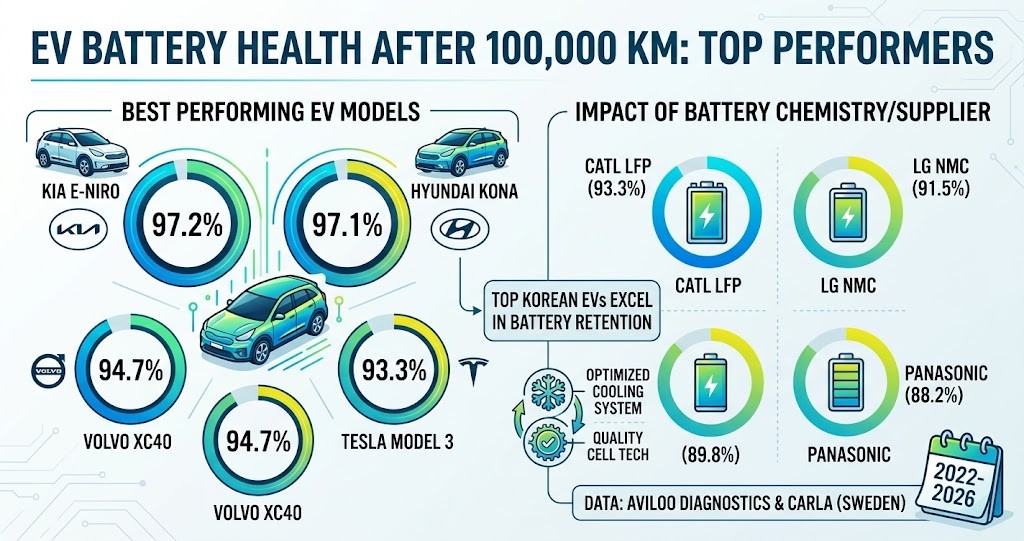
スウェーデンのEVマーケットプレイスCarlaが、AVILOO診断システムを用いて2022年から2026年に収集したデータを基に、10万km(6万2000マイル)走行後の実効バッテリー保持率(State of Health)を比較分析しました。
調査の結果、Kia e-NiroやHyundai Konaといった韓国メーカーの量販EVが97パーセント超の最高保持率を記録し、テスラや欧州プレミアムブランド(アウディ、BMW、フォルクスワーゲン等)を上回る耐久性を示しました。
主要ランキングのハイライト(10万km走行後)
- Kia e-Niro (64kWh): 97.25 %
- Hyundai Kona (64kWh): 97.18 %
- Kia EV6 (77.4kWh): 95.95 %
- Volvo XC40 Recharge (69kWh, CATL): 94.70 %
- Polestar 2 (78kWh, CATL): 94.35 %
- Tesla Model 3 (60.5kWh, CATL LFP): 93.34 %
- Audi e-tron 55 (95kWh): 92.93 %
- Volkswagen ID.4 (77kWh): 92.77 %
車両ブランドよりもバッテリー化学・サプライヤーが耐久性を左右
本調査で注目される点は、同一モデルであっても搭載されているバッテリーセルメーカーや正極材の化学組成によって保持率に大きなひらきが生じている点です。
Tesla Model 3におけるサプライヤー/化学組成別の保持率比較
- CATL (LFP / リン酸鉄リチウム): 93.3 %
- LG Energy Solution (NMC / ニッケル・マンガン・コバルト): 91.5 %
- Panasonic (77.8kWh): 89.8 %
- Panasonic (52.4kWh): 88.2 %
LFP(リン酸鉄リチウム)電池は、三元系(NCM/NCA)と比較してエネルギー密度は劣るものの、結晶構造が堅牢で充放電サイクル特性や耐熱性に優れるため、長寿命化に寄与していることが確認できます。
韓国勢が高い耐久性を実現した背景と技術的要因
上位を独占したKiaやHyundaiの第1世代・第2世代EV(e-Niro, Kona, EV6)が高数値を記録した要因として、以下の技術的背景が挙げられます。
- 水冷式熱管理(BMS)の最適設計: 充放電時のセル温度偏析を抑える精密な液冷システムと、北欧のような低迷地域における低温制御(プレコンディショニング)の調整が機能しています。
- 使用可能容量(Usable Capacity)の設定マージン: 韓国メーカーはセル劣化を防ぐため、バッファー(過充電・過放電を防ぐマージン域)を安全側に設定しており、実走行における劣化進行速度を抑制しています。
- セルの品質管理: 搭載されているSK OnやLG Energy Solution製の高密度三元系セルにおいて、不純物排除や電極コーティング技術の最適化が進んでいます。
中古EV市場および業界への影響
- 従来のブランド序列の変化: エンジン開発で優位に立っていた欧州高級ブランドや、ソフトウェア先行のテスラに対し、バッテリー管理技術においては韓国メーカーの信頼性が実証されました。
- 残価率(リセールバリュー)への波及: バッテリー性能低下への懸念が和らぐことで、中古EV市場における韓国製EVの査定評価や流動性が向上すると見込まれます。
- サプライチェーン選定の重要性: 車輪・ボディ設計だけでなく、どのセルサプライヤーからどの化学組成のパックを調達するかが、車両全体のライフサイクルコストに直結することが裏付けられました。
Outperforming Tesla and European Luxury Brands! South Korean EVs Take Top Two Spots in Swedish 100,000 km Battery Durability Test
Swedish EV marketplace Carla conducted a comparative analysis of battery State of Health (SoH) after 100,000 km (62,000 miles) of driving, based on data collected between 2022 and 2026 using the AVILOO diagnostic system.
The study revealed that mass-market EVs from South Korean manufacturers, such as the Kia e-Niro and Hyundai Kona, recorded the highest retention rates at over 97 percent, demonstrating durability that surpasses Tesla and European premium brands including Audi, BMW, and Volkswagen.
Key Ranking Highlights (After 100,000 km)
- Kia e-Niro (64 kWh): 97.25 percent
- Hyundai Kona (64 kWh): 97.18 percent
- Kia EV6 (77.4 kWh): 95.95 percent
- Volvo XC40 Recharge (69 kWh, CATL): 94.70 percent
- Polestar 2 (78 kWh, CATL): 94.35 percent
- Tesla Model 3 (60.5 kWh, CATL LFP): 93.34 percent
- Audi e-tron 55 (95 kWh): 92.93 percent
- Volkswagen ID.4 (77 kWh): 92.77 percent
Battery Chemistry and Supplier Impact Durability More Than Vehicle Brand
A notable finding of this study is that even within the same vehicle model, battery capacity retention varies significantly depending on the cell manufacturer and cathode chemistry.
Retention Comparison by Supplier / Chemistry in Tesla Model 3
- CATL (LFP / Lithium Iron Phosphate): 93.3 percent
- LG Energy Solution (NMC / Nickel Manganese Cobalt): 91.5 percent
- Panasonic (77.8 kWh): 89.8 percent
- Panasonic (52.4 kWh): 88.2 percent
Although LFP (Lithium Iron Phosphate) batteries have lower energy density compared to ternary chemistries (NCM/NCA), their robust crystal structure provides superior charge-discharge cycle performance and thermal stability, contributing directly to longer battery lifespan.
Technical Factors Behind the High Durability of South Korean EVs
The exceptional results achieved by first- and second-generation EVs from Kia and Hyundai (e-Niro, Kona, EV6) can be attributed to several key engineering factors:
- Optimized Water-Cooled Thermal Management (BMS): Precise liquid cooling systems minimize cell temperature variance during charging and discharging, combined with effective low-temperature control (preconditioning) tailored for cold climates like the Nordic region.
- Conservative Usable Capacity Buffers: South Korean automakers set safer buffer margins for overcharging and deep discharging, effectively suppressing the rate of degradation during real-world operations.
- Cell Quality Control: Advanced process optimization—such as impurity elimination and uniform electrode coating—is applied to high-density ternary cells supplied by SK On and LG Energy Solution.
Impact on the Used EV Market and Industry Trends
- Shift in Traditional Brand Hierarchy: While European luxury brands held dominance in internal combustion engine development and Tesla led in software, South Korean automakers have proven superior reliability in battery management technology.
- Positive Effect on Residual Values: Alleviating consumer concerns over battery degradation is expected to improve valuation and liquidity for used South Korean EVs in the secondary market.
- Importance of Supply Chain Selection: The findings confirm that beyond chassis and body engineering, the choice of cell supplier and chemistry configuration directly determines total vehicle life-cycle value.

コメント