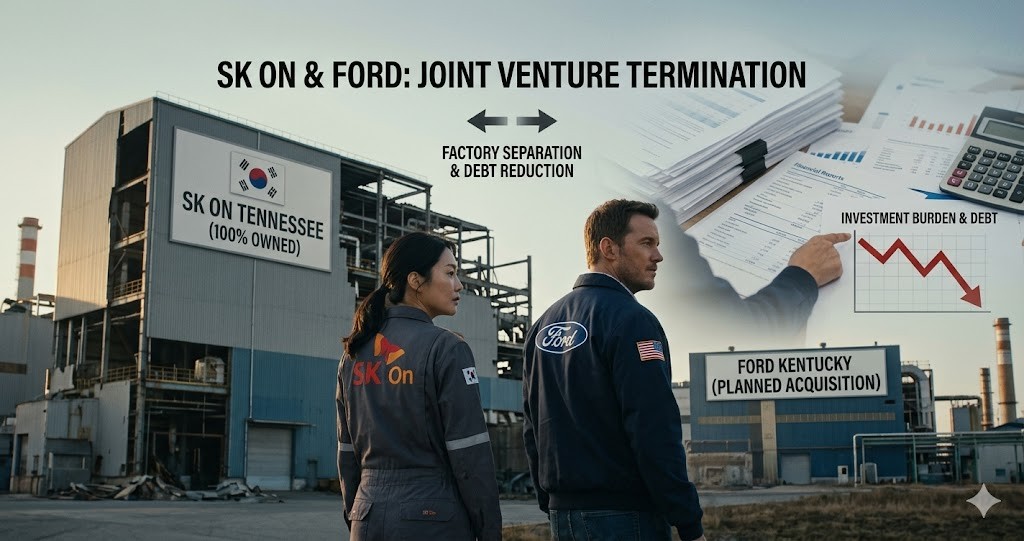
ジョー・バイデン前政権下で推進されたインフレ抑制法(IRA)を追い風に、韓国のバッテリーメーカーは米国の自動車大手(ビッグ3)と次々に合弁会社を設立し、巨額の投資を進めてきました。しかし、ドナルド・トランプ大統領の就任以降、EV購入補助金の見直しや環境規制の緩和など、政策の不確実性が急速に高まっています。
さらに、世界的なEV需要の伸び悩み(キャズム現象)が顕在化する中、巨額の投資負担と高い金利はバッテリーメーカーの経営を大きく圧迫する要因となりました。このような市場環境の激変を背景に、韓国のSKオン(SK On)と米フォード・モーター(Ford Motor)は、当初の共同投資路線から「単独運営・財務健全化」へと舵を切る組織再編を完了させました。
SKオンとフォードの合弁事業解消の概要
2026年5月21日に発表された、SKオンとフォードによる米国バッテリー合弁事業(旧ブルーオーバルSK)の解消にまつわる主な内容は以下の通りです。
1. 工場所有権の分離と再編
- テネシー工場: SKオンが100%単独で所有・運営します。施設名は「SKオン・テネシー(SK On Tennessee)」へと改名され、すでに独立操業を開始しています。
- ケンタッキー工場: ケンタッキー州にある2つのバッテリー工場については、フォードが個別に所有・運営を引き継ぐ予定です。
2. 合弁解消に要した期間
両社が合弁事業の解消計画を公表した2025年12月から、約5か月をかけて今回の組織再編が完了しました。この合弁事業は、EV市場への強い期待を背景に2022年に設立されたものでした。
3. SKオン側の財務的メリット
この解消により、SKオンは投資負担を大幅に軽減し、財務体質を劇的に強化することに成功しています。
- 債務負担の削減: 約5兆4000億ウォン(36億米ドル)の削減
- 利払い費の削減: 年間約1億8000万米ドルの利払い費を削減
- 減価償却費の削減: ケンタッキー工場の手放しに伴い、年間約3300億ウォンの減価償却費を削減
関連情報・市場における重要性(背景の補足)
1. トランプ政権によるEV政策の不確実性
バイデン前政権が主導した米国内でのEVサプライチェーン構築(バイ・アメリカン政策)は、トランプ大統領の登場によって大きな向かい風を受けています。トランプ政権は伝統的な内燃機関(ガソリン車)やハイブリッド車(HEV)を重視する姿勢を示しており、EV購入者への税制優遇措置(最大7500米ドル)の縮小・廃止や、排出ガス規制の緩和をちらつかせています。この「政策の不確実性」が、自動車メーカーおよびバッテリーメーカーに投資のブレーキをかけさせ、合弁解消の決定的な引き金となりました。
2. EV需要の減速(キャズム)と雇用の調整
米国におけるEV市場は、アーリーアダプター(初期購買層)への普及が一巡し、キャズム(一般的な普及に至る深い溝)に直面しています。高金利や充電インフラの整備遅れも手伝い、消費者のEV離れが進行しました。 これに先立ち、SKオンは2026年3月に米国ジョージア州にある単独の既存バッテリー工場において、968人の従業員解雇(レイオフ)に踏み切っています。今回の合弁解消およびジョージアでの人員削減は、いずれも需要低迷に対応するための徹底的なコストカット策の一環です。
3. 今後のバッテリー・自動車産業への波及効果
SKオンは今回の再編により、北米市場の変化に柔軟に対応できる体制を整えたと表明しています。フォードにケンタッキー工場を委ね、テネシーに集中することで、過剰投資リスクを回避する狙いがあります。
一方、フォード側もEV戦略を減速させ、ハイブリッド車の生産ラインを拡大する動きを見せており、今回の合弁解消は両社にとって「身軽になり、激変する米国市場を生き抜くための現実的な最適解」であったと言えます。他の韓国勢(LGエナジーソリューションやサムスンSDI)と米自動車大手の合弁事業の動向にも、今後大きな影響を与える可能性があります。
出典:https://en.yna.co.kr/view/AEN20260521011400320
US Battery Joint Venture “BlueOval SK” Dissolved: Relaunched as SK On Tennessee
Buoyed by the Inflation Reduction Act (IRA) promoted under the former Joe Biden administration, South Korean battery manufacturers aggressively set up consecutive joint ventures with major US automakers (the Big Three) and pursued massive investments. However, since the inauguration of President Donald Trump, policy uncertainty has risen sharply due to potential revisions of EV purchase subsidies and the relaxation of environmental regulations.
Furthermore, as the global slowdown in EV demand (the chasm phenomenon) becomes more evident, the heavy burden of capital expenditure and high interest rates have put severe pressure on the management of battery manufacturers. Against the backdrop of these drastic changes in the market environment, South Korea’s SK On and US-based Ford Motor have completed a corporate restructuring, shifting from their initial joint investment strategy toward “independent operation and fiscal consolidation.”
Overview of the Dissolution of the SK On-Ford Joint Venture
Announced on May 21, 2026, the key points regarding the dissolution of the US battery joint venture (formerly BlueOval SK) between SK On and Ford are as follows:
1. Separation and Restructuring of Factory Ownership
- Tennessee Plant: SK On will own and operate the facility 100 percent independently. The site has been renamed “SK On Tennessee” and has already commenced independent operations.
- Kentucky Plants: Ford will individually assume full ownership and operation of the two battery factories located in Kentucky.
2. Timeline of the Dissolution Process
The restructuring was finalized over a span of approximately five months, counting from December 2025 when both companies first made their dissolution plans public. The joint venture was originally established in 2022 amid high growth expectations for the EV market.
3. Financial Benefits for SK On
Through this dissolution, SK On has successfully alleviated its investment burdens and significantly strengthened its financial health.
- Reduction of Debt Burden: A reduction of approximately 5.4 trillion won (3.6 billion US dollars).
- Reduction of Interest Expenses: An annual reduction of roughly 180 million US dollars in interest payments.
- Reduction of Depreciation Costs: An annual reduction of about 330 billion won in depreciation expenses by parting with the Kentucky plants.
Related Information and Market Significance (Supplementary Background)
1. EV Policy Uncertainty Under the Trump Administration
The establishment of a domestic US EV supply chain (the Buy American policy) led by the previous Biden administration is facing a severe headwind with the arrival of President Trump. The Trump administration has signaled a strong preference for traditional internal combustion engine (ICE) vehicles and hybrid electric vehicles (HEVs), hinting at the reduction or elimination of tax credits for EV buyers (up to 7500 US dollars) and the relaxation of exhaust emission regulations. This “policy uncertainty” has forced automakers and battery manufacturers to put the brakes on investments, acting as the decisive trigger for the dissolution of this joint venture.
2. Slowdown in EV Demand (The Chasm) and Employment Adjustments
The US EV market has moved past the initial phase of adoption by early adopters and is currently facing a “chasm”—a deep gap before reaching the mass adoption stage. Coupled with high interest rates and delays in charging infrastructure development, consumers have increasingly turned away from EVs. Prior to this, in March 2026, SK On executed a layoff of 968 employees at its standalone, existing battery plant in Georgia, USA. Both the current joint venture dissolution and the workforce reduction in Georgia are part of a thorough cost-cutting strategy designed to cope with stagnant demand.
3. Future Ripple Effects on the Battery and Automotive Industries
SK On has stated that this restructuring allows the company to establish a framework that can flexibly adapt to shifts in the North American market. By leaving the Kentucky plants to Ford and concentrating on Tennessee, the company aims to avoid the risk of overinvestment.
Meanwhile, Ford is also slowing down its EV strategy and moving to expand production lines for hybrid vehicles. This joint venture dissolution can be seen as a realistic, optimal solution for both companies to shed heavy assets and survive the turbulent US market. This move could also significantly influence the future direction of joint ventures between other South Korean players (such as LG Energy Solution and Samsung SDI) and major US automakers.
コメント