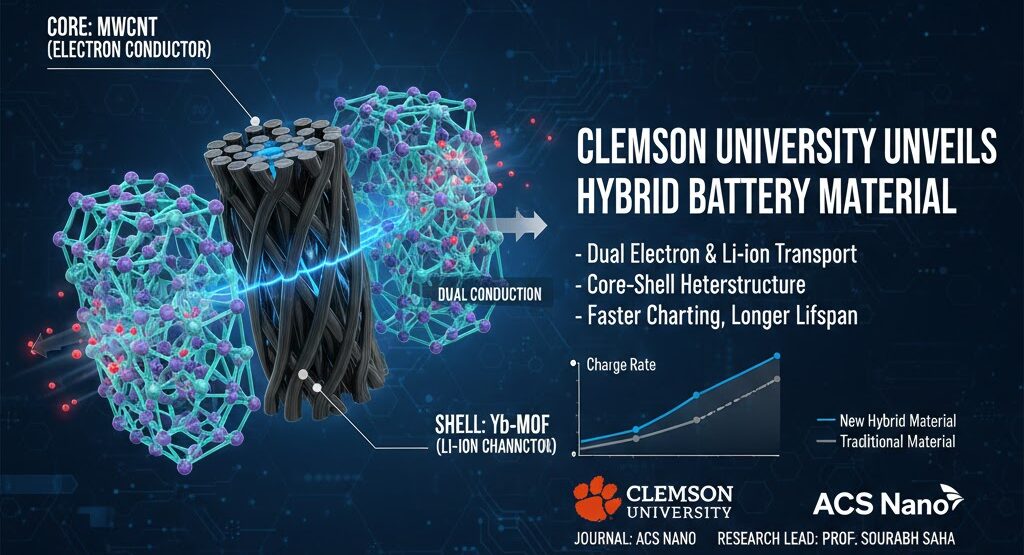
クレムソン大学のソウラブ・サハ教授らのチームは、「リチウムイオン」と「電子」の両方を高速で輸送できる画期的なハイブリッド材料を開発しました。
通常、電池材料はどちらか一方の伝導性に特化していますが、この新材料は双方の利点を組み合わせることで、充電速度の向上や電池の長寿命化を実現する可能性を秘めています。
新材料の構造と特徴:コアシェルヘテロ構造
この材料は、2つの高度な素材を組み合わせた「コアシェル構造(芯と殻の構造)」をしています。
- 核(コア):多層カーボンナノチューブ (MWCNT)
- 極めて高い電子伝導性を持ち、電気をスムーズに流す役割を担います。
- 殻(シェル):金属有機構造体 (MOF)
- イッテルビウム (Yb) と有機配位子(ヘキサヒドロキシヘキサアザトリナフタレン)で構成。
- 無数の微細な孔(チャネル)を持ち、リチウムイオンを効率よく貯蔵・輸送します。
関連解説:なぜこの発見が重要なのか?
1. 「二重伝導性」が解決する課題
従来の電池設計では、イオンを通す材料と電子を通す材料を物理的に混ぜ合わせる必要がありましたが、接触不良や不均一さが性能低下の原因となっていました。今回の材料は単体で両方の機能を高水準に備えているため、電極の効率が劇的に向上します。
2. MOF(金属有機構造体)の注目度
MOFは「化学のジャングルジム」とも呼ばれ、設計次第で特定の分子だけを通したり蓄えたりできるため、2025年のノーベル化学賞の対象となるほど世界的に注目されている分野です。
3. 次世代バッテリーへの応用
この材料を電極(陽極や陰極)に使用することで、以下のメリットが期待されます。
- 急速充電: イオンと電子が同時に素早く移動できるため、充電時間が短縮されます。
- 安全性と寿命: 構造が安定しているため、充放電の繰り返しによる劣化を抑えられます。
- 高容量: 多孔質なMOF構造により、より多くのリチウムを保持できる可能性があります。
研究の詳細データ
- 掲載誌: ACS Nano(アメリカ化学会発行のナノテクノロジー専門誌)
- 論文タイトル: Dual Electron- and Li-ion-Conducting Ytterbium-Hexaazatrinaphthylene Metal-Organic Framework and Its Carbon Nanotube Composite
- 主要メンバー:
- Sourabh Saha 教授
- Mohamed Ansari 氏(大学院生)
- Ashok Yadav 氏(博士研究員)
- Jorge Barroso 氏(応用計算学講師)
今後の展望
サハ教授は、同大学の物理学者アパラオ・ラオ教授と協力し、この材料を実際の電池電極として組み込む実証試験を進めています。初期段階のテストではすでに優れたパフォーマンスを確認しており、電気自動車(EV)やスマートフォンなどのモバイル機器の次世代化に大きく貢献すると期待されています。
Clemson University Chemists Develop New Material That Overturns Battery Norms by Transporting Both Lithium Ions and Electrons Simultaneously
Professor Sourabh Saha and his team at Clemson University have developed a breakthrough hybrid material capable of transporting both lithium ions and electrons at high speeds.
While most battery materials specialize in only one type of conductivity, this new material combines the strengths of both, holding the potential to improve charging speeds and extend battery life.
Structure and Features: The Core-Shell Heterostructure
The material utilizes a “core-shell” design, which integrates two advanced components:
- Core: Multi-walled Carbon Nanotubes (MWCNT)
- Possesses extremely high electronic conductivity, acting as the highway for electrical current.
- Shell: Metal-Organic Framework (MOF)
- Composed of Ytterbium (Yb) and an organic ligand (hexahydroxyhexaazatrinaphthylene).
- Features countless microscopic pores (channels) that efficiently store and transport lithium ions.
Analysis: Why Is This Discovery Important?
1. Solving the “Dual-Conductivity” Challenge In traditional battery design, materials that conduct ions and those that conduct electrons must be physically mixed. This often leads to poor contact or non-uniformity, which degrades performance. This new material possesses both functions at a high level within a single structure, dramatically increasing electrode efficiency.
2. The Global Rise of MOFs Often called “chemical jungle gyms,” MOFs can be engineered to store or filter specific molecules. The field has gained immense global attention, culminating in the 2025 Nobel Prize in Chemistry being awarded to three pioneers in the field.
3. Applications for Next-Generation Batteries Using this material for electrodes (anodes or cathodes) offers several key benefits:
- Rapid Charging: Simultaneous, high-speed movement of ions and electrons shortens charging times.
- Safety and Longevity: The stable structure minimizes degradation caused by repeated charging and discharging cycles.
- High Capacity: The porous MOF structure allows for a higher density of lithium storage.
Research Data
- Journal: ACS Nano (A premier nanotechnology journal by the American Chemical Society)
- Paper Title: “Dual Electron- and Li-ion-Conducting Ytterbium-Hexaazatrinaphthylene Metal-Organic Framework and Its Carbon Nanotube Composite”
- Key Members:
- Professor Sourabh Saha
- Mohamed Ansari (Graduate Student)
- Ashok Yadav (Postdoctoral Researcher)
- Jorge Barroso (Lecturer in Applied Computing)
Future Outlook
Professor Saha is currently collaborating with Clemson physicist Professor Apparao Rao to test the practical application of these materials as battery electrodes. Initial results are highly promising, showing excellent performance that could revolutionize the batteries used in electric vehicles (EVs) and portable electronics.


コメント