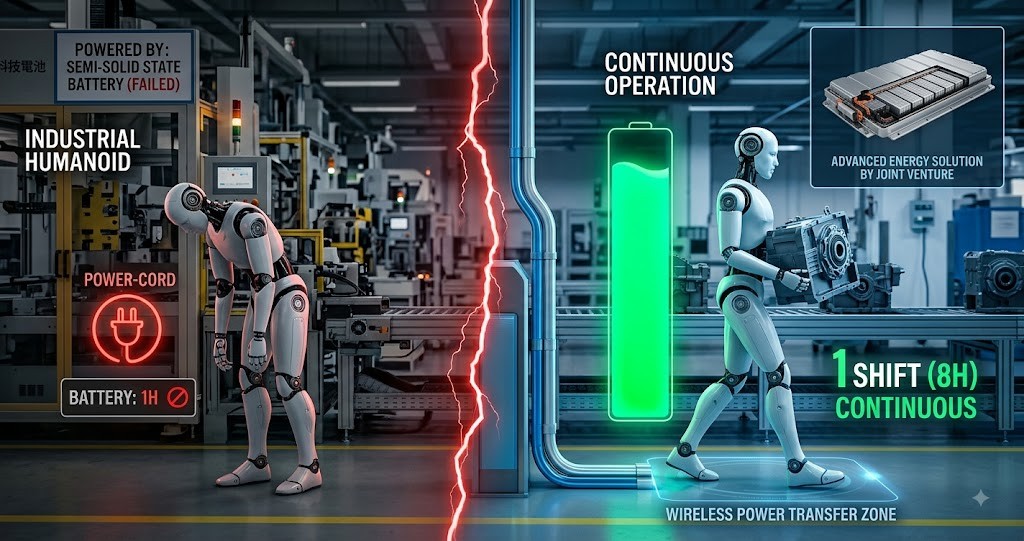
中国を中心に人型ロボット(ヒューマノイド)の産業利用や実用化が急速に進む中、従来の産業用ロボットとは異なる「エネルギー供給の壁」が顕著な課題となっています。特に一般的な工場勤務の1シフト(約8時間)を単一のバッテリー charge でカバーできない連続稼働時間の短さは、現場導入への大きなボトルネックです。
こうした市場のボトルネックに対し、車載部品大手と次世代電池開発企業による合弁会社「均恩新能源」が、高エネルギー密度の半固体電池パックおよびワイヤレス給電システムなどの包括的な電源ソリューションを提示しました。以下に、発表の骨子と技術的・市場的背景を整理します。
1. ヒューマノイドロボットが直面する電源課題と技術的背景
ヒューマノイドは多自由度アクチュエータ(多数のモーター)を常時駆動させ、自己姿勢制御や高負荷動作を行うため、従来のモバイル機器や電気自動車(EV)と比較しても特異な電源要件を求められます。
- 稼働時間の限界: 現在量産されているモデルの連続稼働時間は 2〜4時間程度 に留まり、工場等の稼働シフトに対応しきれていません。
- 物理的制約: 人間と同等のサイズ感を維持するため、バッテリーを搭載できる内部スペースや重量(可搬重量への影響)に厳しい制限が存在します。
- 出力特性と安全性の両立: 立ち上がりや物体持ち上げ時のピーク電力(大電力需要)に対応しつつ、転倒リスク等に耐えうる高い熱暴走耐性(安全性)が必要です。
2. 均恩新能源(Joyson Enpower)の概要と提示アプローチ
企業背景
- 出資企業: 自動車部品大手の均勝電子(Joyson Electronics)と、次世代電池開発で実績のある恩力動力(Enpower)による共同出資会社。
- 事業領域: 次世代電池技術を活用したロボット向けエネルギーソリューションの展開。
- 発表機会: 「世界人工知能大会(WAIC 2026)」(2026年7月開催)にて固液混合型半固体電池パックや双方向ワイヤレス給電システムを披露。
技術開発ロードマップと戦略方針
同社は、エネルギー供給課題を電池単体ではなく「モーター効率・運動制御アルゴリズム・エネルギー管理」を含めたシステム全体の最適化で解決するアプローチをとっています。
- 短期(即効策):バッテリー交換(スワップ)方式
- 稼働停止時間を最小限に抑える現実的解。
- 中期(主力ソリューション):固液混合型「半固体電池」
- 安全性とエネルギー密度のバランスに優れ、早期の実用化・量産が可能。
- 長期(将来技術):全固体電池
- 量産プロセスの確立や製造コスト低減に向け、技術成熟を待つ段階。
3. 投入された半固体電池パックのスペックとインパクト
2026年4月より量産出荷が開始されている半固体電池パックの性能概要と、想定される市場への影響は以下の通りです。
| 項目 | スペック・特徴 | 関連解説・補足 |
| エネルギー密度 | 300 Wh/kg 超 | 一般的なリン酸鉄リチウム(LFP)電池(150〜180Wh/kg程度)の約2倍。同等重量で飛躍的な容量増加を実現。 |
| 稼働時間 | 従来の2〜3倍 | パック寸法や重量を変更せずに高容量化できるため、従来の2〜4時間稼働から6〜10時間規模への延伸が期待される。 |
| 量産時期 | 2026年4月出荷開始 | 実用化フェーズに入っており、人型ロボットの商用導入を加速させる要素となる。 |
4. 関連情報・考察
- LFP(リン酸鉄リチウム)からの移行従来の産業機器や低価格EVではコストと安全性に優れるLFPが主流ですが、重量エネルギー密度の低さがヒューマノイドの軽量化・長時間稼働を阻んでいました。半固体電池の採用により、安全性を維持したままLFPの弱点を克服する動きが加速しています。
- 非接触(ワイヤレス)給電との組み合わせWAIC 2026で同時に提示された「双方向ワイヤレス給電」と組み合わせることで、ロボットが待機時や特定エリアの作業中に自動で給電を受ける「連続稼働システム」の構築が可能となります。
Emerging Chinese Firm Begins Mass Production of Semi-Solid-State Batteries for Humanoids — Extending Operating Time by 2–3x to Overcome On-Site Deployment Barriers
As the industrial application and commercialization of humanoid robots rapidly progress, particularly in China, an “energy supply barrier”—distinct from that of conventional industrial robots—has emerged as a major challenge. In particular, the short continuous operating time, which fails to cover a standard factory shift (approx. 8 hours) on a single battery charge, presents a significant bottleneck to real-world deployment.
To address this market bottleneck, Joyson Enpower—a joint venture between a major automotive component supplier and a next-generation battery developer—has presented a comprehensive power solution featuring high-energy-density semi-solid-state battery packs and wireless charging systems. Below is a summary of the key announcement points along with the technical and market context.
1. Power Challenges and Technical Background Facing Humanoid Robots
Humanoids require unique power specifications compared to conventional mobile devices or electric vehicles (EVs), as they constantly drive multi-degree-of-freedom actuators (numerous motors) to execute self-posture control and high-load operations.
- Operating Time Limits: Continuous operating times for currently mass-produced models remain at around 2 to 4 hours, which is insufficient for full factory operational shifts.
- Physical Constraints: Severe limitations exist regarding internal mounting space and weight (which directly impacts payload capacity) in order to maintain a human-like form factor.
- Balancing High Output with Safety: The system must supply high peak power for sudden movements and heavy lifting while delivering exceptional thermal runaway resistance (safety) to withstand risks such as tipping or falling.
2. Overview of Joyson Enpower and Proposed Approach
Corporate Background
- Investors: A joint venture established by major automotive components supplier Joyson Electronics and next-generation battery developer Enpower.
- Business Area: Development of energy solutions for robotics utilizing next-generation battery technologies.
- Announcement Platform: Unveiled solid-liquid hybrid semi-solid-state battery packs and bidirectional wireless charging systems at the World Artificial Intelligence Conference (WAIC 2026) in July 2026.
Technology Roadmap and Strategic Policy
The company tackles the energy supply challenge not through battery chemistry alone, but via a system-wide optimization approach that integrates motor efficiency, motion control algorithms, and energy management.
- Short-Term (Immediate Strategy): Battery Swapping A practical solution to minimize operational downtime.
- Medium-Term (Core Solution): Solid-Liquid Hybrid Semi-Solid-State Batteries Offers an optimal balance of safety and energy density, enabling rapid commercialization and mass production.
- Long-Term (Future Technology): All-Solid-State Batteries Awaiting technology maturation to establish scalable manufacturing processes and reduce production costs.
3. Specifications and Impact of the Introduced Semi-Solid-State Battery Pack
The performance overview of the semi-solid-state battery pack, which entered mass production and shipment in April 2026, and its anticipated market impact are detailed below:
| Parameter | Specifications & Features | Technical Context & Insights |
|---|---|---|
| Energy Density | Over 300 Wh/kg | Approximately double that of conventional lithium iron phosphate (LFP) batteries (~150–180 Wh/kg), achieving a dramatic capacity increase at equivalent weight. |
| Operating Time | 2x to 3x longer than conventional | Enables capacity expansion without altering pack dimensions or weight, extending runtime from the traditional 2–4 hours to 6–10 hours. |
| Mass Production | Shipments began April 2026 | Already in the commercial execution phase, acting as a catalyst for the adoption of commercial humanoid robots. |
4. Relevant Insights and Analysis
- Transition Away from LFP (Lithium Iron Phosphate) While LFP has been the mainstream choice for conventional industrial equipment and low-cost EVs due to its safety and cost efficiency, its lower gravimetric energy density has restricted humanoid lightweighting and extended operation. The adoption of semi-solid-state batteries accelerates the shift toward overcoming LFP’s limitations while maintaining safety standards.
- Integration with Contactless (Wireless) Power Transfer Combined with the bidirectional wireless charging system presented alongside at WAIC 2026, robots can automatically receive power while idling or performing tasks within designated areas, enabling the deployment of truly continuous operation systems.

コメント