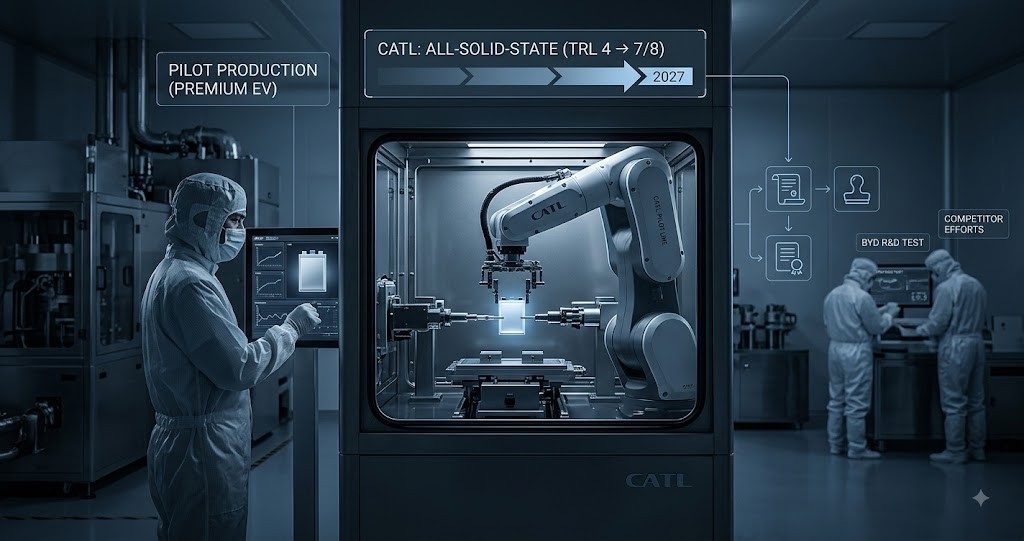
- CATLの目標と進捗計画
- パイロット生産の開始: 車載電池世界最大手のCATL(中国)は、2027年にパイロット生産ラインを構築し、小規模な全固体電池セルのテスト生産を開始する目標を発表しました。
- 技術成熟度(TRL)の引き上げ: 現在は研究室レベル評価である「TRL 4」段階ですが、2027年までに実際の道路走行検証が可能な「TRL 7 から 8」レベルへと急速に引き上げる方針です。
- 初期展開と本格量産の時期: 初期セルは製造コストが高いため、25万元(約480万円)以上のプレミアムEV車両向けに供給される見込みです。年間100万台規模の大規模な普及・大量量産は、2030年以前の達成は困難と予測されています。
- 競合BYDの追随と特許戦略
- 2027年実車テスト: 業界2位のBYDも2027年のモデル生産および実車テストを目標としており、開発車両(偽装幕車)での評価を進める計画です。
- 独自技術の開発: ハライド系と硫化物系を組み合わせた二重電解質正極構造や界面抵抗の軽減、熱暴走防止に関する新規特許を相次いで取得しています。
関連情報・技術背景の補足
- 2027年~2028年に集中する競合各社のタイムライン全固体電池の試作・実用化目標は中国勢だけでなく、世界的に2027年前後に集中しています。日本のトヨタ自動車も2027年から2028年頃の実用化を目指しており、韓国のサムスンSDIなども2027年の量産開始目標を掲げています。2027年は全固体電池が研究室を抜け出し、実車検証へ移る世界的な節目の年となります。
- エネルギー密度と高コストの課題CATLが開発中の全固体電池はエネルギー密度 500 Wh/kg 級を目指しており、従来の液体リチウムイオン電池の約2倍に達します。しかし、主要な候補である硫化物系固体電解質は、電極と電解質の界面接触を維持するための高度な加圧機構が必要なことや、現時点でのセル製造コストが従来電池の3倍から5倍と高価であることが大規模普及への障壁となっています。
- 段階的な市場投入シナリオこのように初期コストが高価であるため、CATLやBYDをはじめとするメーカーは、初期(2027年~2029年)は高級EVやドローン、ロボティクスといった高価格帯・高性能要求の分野に用途を限定し、技術確立とコストダウンを進めた上で2030年以降の本格的な大衆車普及を図る二段階戦略をとっています。
出典:https://www.starnewskorea.com/ja/business-life/2026/08/11/2026081110483595506
CATL to Begin Pilot Production of All-Solid-State Batteries in 2027: A Push for Commercialization Following BYD
CATL’s Targets and Progress Plan
- Launch of Pilot Production: CATL (China), the world’s largest automotive battery manufacturer, announced its target to establish a pilot production line in 2027 and begin small-scale test production of all-solid-state battery cells.
- Raising Technology Readiness Level (TRL): While currently at the “TRL 4” phase (laboratory-level evaluation), the company plans to rapidly raise this to “TRL 7 to 8” by 2027, enabling real-world road-testing verification.
- Initial Deployment and Timeline for Mass Production: Due to high manufacturing costs, initial cells are expected to be supplied for premium EV models priced above 250,000 RMB (approximately 4.8 million JPY). Large-scale adoption and mass production on the order of 1 million vehicles per year is projected to be difficult to achieve before 2030.
Competitor BYD’s Pursuit and Patent Strategy
- 2027 Real-Vehicle Testing: Second-ranked BYD is also targeting pilot production and real-vehicle testing in 2027, with plans to conduct evaluations using camouflaged test vehicles.
- Proprietary Technology Development: BYD has filed a series of new patents related to a dual-electrolyte cathode structure combining halide and sulfide-based solid electrolytes, interface resistance reduction, and thermal runaway prevention.
Supplementary Context and Technical Background
- Competitors’ Timelines Concentrated in 2027–2028: Prototype and commercialization targets for all-solid-state batteries are converging around 2027 worldwide, not just among Chinese makers. Toyota Motor in Japan aims for practical application around 2027 to 2028, and Samsung SDI in South Korea has set a target to begin mass production in 2027. The year 2027 will mark a global turning point as all-solid-state batteries transition from the laboratory to real-vehicle verification.
- Challenges of Energy Density and High Cost: CATL’s all-solid-state battery under development aims for an energy density class of 500 Wh/kg, roughly double that of conventional liquid lithium-ion batteries. However, major hurdles to widespread adoption include the need for advanced pressurization mechanisms to maintain interfacial contact between electrodes and solid electrolytes—particularly in sulfide-based candidates—and cell manufacturing costs that are currently three to five times higher than conventional batteries.
- Phased Market Entry Scenario: Given these high initial costs, manufacturers such as CATL and BYD are adopting a two-stage strategy: initially (2027–2029) restricting applications to high-price, high-performance segments like luxury EVs, drones, and robotics to mature the technology and drive down costs, before pursuing full-scale adoption in mass-market vehicles from 2030 onward.


コメント