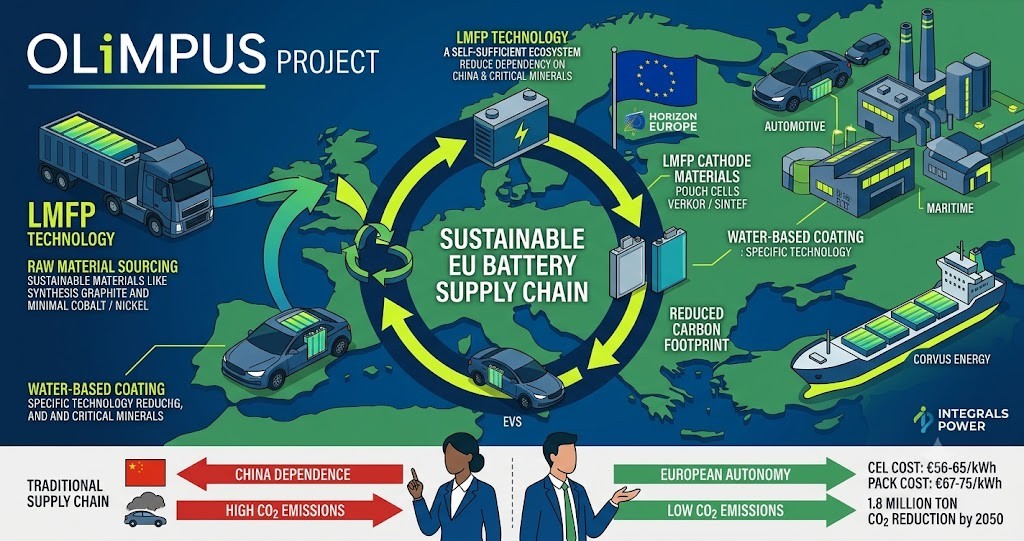
欧州の自動車・海事産業における次世代のバッテリーサプライチェーン構築に向けて、大きな動きがありました。英国の革新的な電池材料開発企業であるインテグラルズ・パワー(Integrals Power)社が、EUの「ホライズン・ヨーロッパ」から資金援助を受けた900万ユーロ規模の国家級プロジェクト「OLiMPUS」の正極材サプライヤーに選定されました。本プロジェクトは、中国の技術やニッケル・コバルトといった特定鉱物への依存を減らし、欧州自前の持続可能なバッテリー製造能力を確立することを目指しています。本稿では、提供されたニュースのまとめに加え、LMFP(リチウムマンガン鉄リン酸)材料の技術的特徴や市場の背景などの関連情報を付け加えて詳しく解説します。
1. ニュースの要約:OLiMPUSプロジェクトとインテグラルズ・パワー社の役割
プロジェクトの概要と参加企業
- 規模と期間:総額900万ユーロを投じるEUの「OLiMPUSプロジェクト」は2030年まで実施され、2032年までの欧州内での量産体制確立を目標としています。
- 強力なパートナーシップ:ノルウェーの研究機関SINTEFが調整役となり、ボルボ・トラック、マグナ・シュタイアー、ヴェルコール、ヴィアノード、コルバス・エナジーなど、バッテリーのバリューチェーン全体から16の主要パートナーが参画しています。
インテグラルズ・パワー社の供給内容と目標性能
- 供給と量産検証:同社は特許取得済みの、マンガンを80%含有するLMFP正極活物質を150kg以上製造・供給します。製造プロセスの規模拡大(工業化)やセルの試作・性能検証も主導します。
- 試作セルの仕様:SINTEFのパイロットラインとVerkorのギガファクトリーにて、10Ahから80Ahのパウチ型・角型車載グレードセルを130個以上生産し、セルエネルギー密度を最大220Wh/kgまで高めることを目指します。
環境負荷の低減とコスト目標
- エコフレンドリーな製造:有害なNMP(N-メチル-2-ピロリドン)系スラリーを排除して「水系電極コーティング」を採用し、さらに半乾燥式プロセスで乾燥エネルギーを削減します。負極には合成黒鉛を用います。
- 圧倒的なコスト競争力:セルコストを56から65ユーロ/kWh、パックコストを67から75ユーロ/kWhに抑える計画です。これにより、同等のNMC811バッテリーと比較して、2050年までに約180万トンの二酸化炭素換算排出量を削減できると試算されています。
2. 関連情報の補足:LMFP材料の技術的特徴と市場の背景
ニュースをより深く理解するために、LMFPという材料の重要性と、なぜ欧州がこれほど注力しているのかという背景を解説します。
- LMFP(リチウムマンガン鉄リン酸)とは: 現在広く普及している安価なLFP(リン酸鉄リチウム)電池の結晶構造に「マンガン」を加えた進化型の正極材料です。LFPの最大の弱点であった「電圧の低さ(エネルギー密度の低さ)」を克服するために開発されました。
- エネルギー密度の向上(LFPとの比較): LFP電池の平均動作電圧が約3.2Vであるのに対し、マンガンを添加したLMFPは約4.0V前後まで電圧を引き上げることができます。これにより、インテグラルズ・パワー社が公表している通り、LFPの持つ高い安全性、長寿命、低コストというメリットを維持したまま、エネルギー密度を最大20%向上させることが可能になります。
- NMC(三元系)の代替としての位置づけ: 現在、航続距離の長い高性能EVには、ニッケル・マンガン・コバルトを使用した「NMC系(あるいは三元系)」電池が主流です。しかし、NMCはコバルトなどの高価で地政学的リスクの高いレアメタルを必要とし、熱暴走(発火)のリスクもLFPより高いという課題があります。LMFPは、これら高価なニッケルやコバルトを一切使わずにNMCに近い性能(今回の目標は220Wh/kg)を目指せるため、「ポストNMC」の最有力候補として世界中で開発競争が激化しています。
- 脱・中国技術への依存と欧州の自立: 現在のLFPおよびLMFPのサプライチェーンや製造技術は、中国企業が世界シェアの大部分を握っています。CEOのベナム・ホルモジ氏が指摘する通り、欧州がクリーンエネルギーへの移行を進める上で、特定の国への過度な依存は経済安全保障上の大きなリスクです。英国に拠点を置くインテグラルズ・パワー社の特許技術を欧州のギガファクトリー(Verkorなど)で工業化するOLiMPUSプロジェクトは、欧州における「自国・自地域内でのバッテリーエコシステム」を確立するための極めて重要な戦略的一歩といえます。
結び
インテグラルズ・パワー社のLMFP技術は、自動車(ボルボ・トラック等)や海事(コルバス・エナジー等)といった大型モビリティだけでなく、将来的には防衛分野やグリッド規模(電力網)の大型エネルギー貯蔵システム(ESS)への応用も期待されています。
安価で安全なLMFP電池の欧州現地生産化は、コスト削減と環境負荷低減を同時に達成し、今後の世界のバッテリー産業における欧州の存在感を大きく高める鍵となるでしょう。
出典:https://www.bestmag.co.uk/integrals-power-lmfp-olimpus/
A Step Toward European Battery Autonomy: UK’s Integrals Power to Supply LMFP Materials for EU-Led Project
A major milestone has been reached toward establishing a next-generation battery supply chain within the European automotive and maritime industries. Integrals Power, an innovative UK-based battery materials developer, has been selected as the cathode material supplier for the 9-million-euro “OLiMPUS” project, a sovereign-level initiative funded by the EU’s Horizon Europe. This project aims to reduce dependence on Chinese technology and critical minerals like nickel and cobalt, establishing a sustainable, homegrown battery manufacturing capacity in Europe. This article summarizes the core news and provides a detailed analysis of the technical characteristics of LMFP (Lithium Manganese Iron Phosphate) materials alongside their broader market context.
1. News Summary: The OLiMPUS Project and the Role of Integrals Power
Project Overview and Participants
- Scale and Duration: The OLiMPUS project, with a total budget of 9 million euros, will run through 2030, targeting the establishment of mass-production capacity within Europe by 2032.
- A Powerful Partnership: Coordinated by the Norwegian research institute SINTEF, the initiative brings together 16 major partners across the entire battery value chain, including Volvo Trucks, Magna Steyr, Verkor, Vianode, and Corvus Energy.
Supplies and Target Performance by Integrals Power
- Supply and Scaling Validation: Integrals Power will manufacture and supply over 150 kg of its proprietary LMFP cathode active material, which features an 80% manganese content. The company will also lead the scale-up (industrialization) of the manufacturing process and assist with cell prototyping and performance validation.
- Prototype Cell Specifications: Over 130 automotive-grade pouch and prismatic cells ranging from 10 Ah to 80 Ah will be produced at SINTEF’s pilot line and Verkor’s gigafactory facilities. The partners aim to push cell energy density up to 220 Wh/kg.
Environmental Impact Reduction and Cost Targets
- Eco-Friendly Manufacturing: The process eliminates hazardous NMP (N-Methyl-2-pyrrolidone) slurries in favor of water-based electrode coating, utilizing a semi-dry coating process to cut down drying energy requirements. Synthetic graphite will be used for the anodes.
- Outstanding Cost Competitiveness: The project aims to reduce cell costs to between 56 and 65 euros/kWh, and pack costs to between 67 and 75 euros/kWh. As a result, lifecycle greenhouse gas emissions are projected to drop by approximately 1.8 million tonnes of CO2 equivalent by 2050 compared to introducing equivalent NMC811 batteries.
2. Supplemental Insights: Technical Characteristics and Market Context of LMFP Materials
To better understand the significance of this news, this section outlines why LMFP material is critical and the background of Europe’s intense focus on it.
- What is LMFP (Lithium Manganese Iron Phosphate)? LMFP is an evolved cathode material created by adding manganese to the crystal structure of LFP (Lithium Iron Phosphate), an affordable and widely used chemistry. It was developed specifically to overcome LFP’s greatest drawback: low voltage (and consequently lower energy density).
- Boosting Energy Density (Compared to LFP): While a standard LFP battery operates at an average voltage of around 3.2V, adding manganese allows LMFP to raise the operating voltage to around 4.0V. As stated by Integrals Power, this approach preserves the inherent advantages of conventional LFP chemistry—such as high safety, long cycle life, and low cost—while increasing energy density by up to 20%.
- Positioning as a Substitute for NMC (Ternary) Chemistries: Currently, high-performance EVs with longer ranges primarily rely on NMC (Nickel Manganese Cobalt) ternary batteries. However, NMC chemistry requires expensive, geopolitically volatile rare metals like cobalt, and presents a higher risk of thermal runaway (fire) than LFP. Because LMFP can approach NMC-like performance (with this project targeting 220 Wh/kg) without using costly nickel or cobalt, it has emerged as a top candidate for “post-NMC” technology, triggering intense development global competition.
- Moving Away from Dependence on Chinese Technology: The vast majority of the current LFP and LMFP supply chain and production technology is controlled by Chinese companies. As Behnam Hormozi, founder and CEO of Integrals Power, points out, relying too heavily on any single nation for a clean energy transition introduces severe economic and national security risks. The OLiMPUS project’s mission to industrialize the proprietary UK technology at European gigafactories (such as Verkor) represents a highly strategic move toward building an autonomous, regional battery ecosystem.
Conclusion
The LMFP technology developed by Integrals Power is expected to serve not only heavy mobility sectors like trucking (Volvo Trucks) and maritime transport (Corvus Energy), but also has potential future applications in defense and grid-scale Energy Storage Systems (ESS).
Localizing the production of safe, low-cost LMFP batteries in Europe will simultaneously deliver cost reductions and environmental benefits, serving as a key driver to significantly bolster Europe’s standing in the future global battery industry.
コメント