スマートフォン市場において、近年急速にシェアを拡大しているのが「折りたたみ式(フォルダブル)スマホ」です。しかし、従来の折りたたみ型端末は「厚くて重い」「バッテリーの持ちが悪い」「画面の折り目が目立つ」といった物理的な課題を抱えていました。
本稿では、サムスン電子が英国ロンドンで発表した最新の折りたたみ式スマホ「Galaxy Z8」シリーズにおいて、チタン素材を活用した新型ディスプレイ構造と、同社初となる「シリコンカーボン電池」の採用により、どのように薄型化と耐久性・大容量化を同時に達成したのかについて詳しく解説します。
- 1. 統合プラットフォームによるアプローチ
- 2. 新開発のチタン構造「Flex Titanium」による強度と薄型化
- 3. Galaxy初「シリコンカーボン複合バッテリー」の導入
- 4. 45W急速充電とデュアル制御システム
- 5. 【関連情報】折りたたみスマホ市場の動向と技術的背景
- まとめ
- 1. An Integrated Platform Approach
- 2. Strength and Slimness Driven by the Newly Developed “Flex Titanium” Structure
- 3. Introduction of Samsung’s First “Silicon-Carbon Composite Battery”
- 4. 45W Fast Charging and Dual-Path Control System
- 5. Market Trends and Technical Background
- Summary
1. 統合プラットフォームによるアプローチ
サムスン電子モバイルエクスペリエンス部門のムン・ソンフン副社長(モバイルハードウェア研究開発室長)は、特定のパーツ単体を改良するのではなく、ディスプレイ、ヒンジ、バッテリー、放熱システムを一つの「統合プラットフォーム」として再設計したと説明しました。
各部品を個別に進化させるのではなく、デバイス全体のアーキテクチャを見直すことで、性能や耐久性を犠牲にすることなく劇的な薄型化を実現しています。
2. 新開発のチタン構造「Flex Titanium」による強度と薄型化
折りたたみスマホの最大の課題である「画面の折り目」と「耐久性」に対処するため、サムスンは「Flex Titanium(フレックス・チタン)」と呼ばれる新構造を採用しました。
主な技術的特長
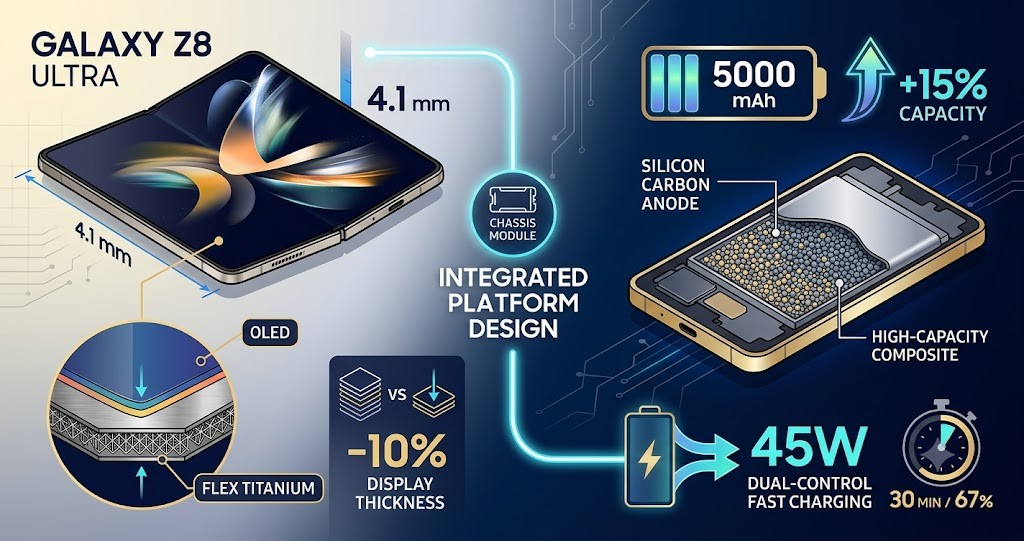
- チタン合金フィルムの採用: OLED(有機EL)パネルの直下に独自開発のチタン合金フィルムを配置し、折りたたみ部分を下から支えることで画面のたるみを防止。
- 格子構造の精密加工: 化学エッチングとレーザー加工を用いてチタンプレートの内部格子構造を再設計し、強度を維持しながら柔軟性を向上。
- モジュールの10%薄型化: ディスプレイモジュール全体で従来の構造より約10%の薄型化を達成。創出された内部スペースは、大容量バッテリーや改良型カメラ、放熱パーツへ充当。
- Galaxy Z8 Ultraの薄さ: 展開時の厚さはわずか4.1 mm(ミリメートル)となり、サムスン史上最も薄い折りたたみ端末を実現。
3. Galaxy初「シリコンカーボン複合バッテリー」の導入
サムスンは、Galaxyブランドとして初めて「シリコンカーボン(珪素・炭素複合)電池」を導入しました。
シリコンカーボン電池のメリットと課題解決
- 高エネルギー密度: 従来のグラファイト(黒鉛)負極に比べ、シリコンは体積あたりに蓄えられるリチウムイオンの量が多く、エネルギー密度が大幅に向上。
- 膨張問題の克服: シリコンは充放電時に大きく膨張・収縮するため長期安定性が課題でしたが、シリコン負極へのカーボンコーティング処理に加え、正極、電解質、セパレーターなど電池セル内の全材料を再設計・最適化することで解決。
- 容量15%アップ: 従来の薄型軽量デザインを維持したまま、Galaxy Zシリーズ全体のバッテリー容量を約15%増加させることに成功(Galaxy Z8 Ultraには5,000 mAh(ミリアンペア時)の電池を搭載)。
4. 45W急速充電とデュアル制御システム
Galaxy Z8シリーズでは、新たに45 W(ワット)の有線急速充電に対応しました。
- 2経路の独立制御: バッテリーへの充電経路を2つに分けて独立制御することで、急速充電に伴う発熱を抑制しながら効率的に電力を供給。
- 充電スピード: 最上位モデルのGalaxy Z8 Ultraでは、約30分で67%までの充電が可能。
5. 【関連情報】折りたたみスマホ市場の動向と技術的背景
1. シリコンカーボン電池を巡るグローバル競合
シリコンカーボン電池技術は、中国のスマートフォンメーカー(HonorやXiaomiなど)が先行して超薄型折りたたみスマホに導入し、市場の注目を集めていました。今回、世界最大手の一角であるサムスンが自社の主力フラッグシップラインに導入したことで、モバイル業界全体における「シリコンカーボン電池」の標準化が一気に加速すると見られます。
2. プレミアムスマホにおけるチタン素材のトレンド
チタンは軽量でありながら極めて高い強度と耐食性を持つ金属です。すでにスマートフォンの外装フレーム部分などで採用が進んでいましたが、サムスンのように「ディスプレイ内部の支持構造や補強フィルム」として精密加工を施して組み込む手法は、端末の薄型化とフラットな画面維持を両立する革新的なアプローチといえます。
3. 他のGalaxyシリーズへの横展開の可能性
サムスンは「薄型・軽量・耐久性のバランスが取れる場合」という条件付きで、シリコンカーボン電池を他のGalaxyスマートフォン(ストレート型のSシリーズなど)にも順次拡大搭載していく方針を示しています。これにより、将来的にスマートフォン全体のバッテリー持続時間が飛躍的に伸びることが期待されています。
まとめ
サムスン「Galaxy Z8」シリーズにおける革新は、単なるスペックの底上げではなく、チタン製ディスプレイ構造「Flex Titanium」と「シリコンカーボン電池」という2つの核心技術を統合システムとして結実させた点にあります。
「薄くすればバッテリーが犠牲になり、バッテリーを大きくすれば厚く重くなる」という折りたたみスマホのジレンマを克服した本技術は、今後のプレミアムスマートフォン設計における新たなベンチマークとなるでしょう。
出典:https://www.koreaherald.com/article/10821580
15% Capacity Boost Without Sacrificing Thickness! Samsung Debuts the Galaxy Z8 Featuring Its First “Silicon-Carbon Battery”
In the smartphone market, foldable smartphones have been rapidly expanding their market share in recent years. However, conventional foldable devices have faced physical hurdles, such as being “thick and heavy,” having “poor battery life,” and exhibiting “noticeable screen creases.”
This article explores how Samsung Electronics achieved a thinner profile, enhanced durability, and larger battery capacity simultaneously in its latest foldable lineup, the “Galaxy Z8” series—unveiled in London, UK—by utilizing a new titanium-based display structure and adopting the company’s first “silicon-carbon battery.”
1. An Integrated Platform Approach
Sung-Hoon Moon, Executive Vice President and Head of the Mobile Hardware R&D Office at Samsung Electronics’ Mobile eXperience Business, explained that rather than improving individual components in isolation, the company redesigned the display, hinge, battery, and thermal management systems into a single “integrated platform.”
By rethinking the architecture of the entire device rather than evolving components individually, Samsung achieved a dramatically thinner profile without sacrificing performance or durability.
2. Strength and Slimness Driven by the Newly Developed “Flex Titanium” Structure
To tackle the biggest challenges of foldable phones—screen creasing and structural durability—Samsung adopted a new structure called “Flex Titanium.”
Key Technological Highlights
- Adoption of Titanium Alloy Film: A proprietary titanium alloy film placed directly underneath the OLED panel supports the folding area from below, preventing display sagging.
- Precision-Engineered Lattice Structure: Using chemical etching and laser processing, engineers redesigned the internal lattice structure of the titanium plate, enhancing flexibility around the fold while maintaining rigidity.
- 10% Thinner Display Module: The overall display module is approximately 10% thinner than previous structures. The freed-up internal space was reallocated to a larger battery, improved camera hardware, and enhanced cooling components.
- Galaxy Z8 Ultra’s Slim Profile: Measures just 4.1 mm (millimeters) when unfolded, making it the thinnest foldable device in Samsung’s history.
3. Introduction of Samsung’s First “Silicon-Carbon Composite Battery”
Samsung introduced a “silicon-carbon (silicon-graphite composite) battery” for the first time in its Galaxy lineup.
Benefits and Solutions Offered by Silicon-Carbon Batteries
- High Energy Density: Compared to traditional graphite anodes, silicon can store significantly more lithium ions per unit volume, resulting in much higher energy density.
- Overcoming Expansion Issues: Because silicon undergoes severe expansion and contraction during charge-discharge cycles, long-term stability was a major challenge. Samsung solved this by applying a carbon coating to the silicon anode and redesigning all materials within the battery cell—including the cathode, electrolyte, and separator.
- 15% Capacity Increase: Successfully boosted battery capacity across the Galaxy Z series by approximately 15% while maintaining the slim and lightweight design (the Galaxy Z8 Ultra houses a 5,000 mAh (milliampere-hour) battery).
4. 45W Fast Charging and Dual-Path Control System
The Galaxy Z8 series introduces support for 45 W (watt) wired fast charging.
- Independent Dual-Path Control: By controlling two separate charging pathways independently, the system efficiently delivers power while suppressing heat generation associated with fast charging.
- Charging Speed: The top-tier Galaxy Z8 Ultra can charge up to 67% in approximately 30 minutes.
5. Market Trends and Technical Background
1. Global Competition Surrounding Silicon-Carbon Batteries
Silicon-carbon battery technology gained strong market attention when Chinese smartphone manufacturers (such as Honor and Xiaomi) pioneered its use in ultra-thin foldable phones. Now that Samsung, a global market leader, has adopted this technology for its flagship line, the standardization of silicon-carbon batteries across the broader mobile industry is expected to accelerate rapidly.
2. Titanium Trends in Premium Smartphones
Titanium is a lightweight metal known for its extremely high strength and corrosion resistance. While its use has been growing in smartphone outer frames, Samsung’s approach—precision-machining and integrating it internally as a display support plate and reinforcement film—is an innovative solution that achieves both a thinner body and a flat screen surface.
3. Potential Rollout Across Other Galaxy Series
Samsung indicated that it may gradually expand the use of silicon-carbon batteries to other Galaxy smartphones (such as the slab-style S series), provided it enhances the overall balance of thinness, weight, and durability. This raises expectations for dramatic improvements in battery life across future smartphone lineups.
Summary
The innovation in Samsung’s “Galaxy Z8” series goes beyond a simple spec bump; it stems from uniting two core technologies—the “Flex Titanium” display structure and the “silicon-carbon battery”—into a single integrated system.
By overcoming the classic foldable smartphone dilemma—where making a device thinner sacrifices battery life, and adding a bigger battery makes it thick and heavy—this technology sets a new benchmark for future premium smartphone design.

コメント