次世代の高エネルギー密度バッテリーとして期待される「リチウム硫黄(Li-S)電池」。その理論容量の高さから、航空宇宙や定置用蓄電池への応用が期待されています。しかし、実用化に向けた最大の課題の一つが「初期活性化時における活物質(硫黄)の失活や副反応」です。
本研究(早稲田大学の奈良宏樹責任著者らによる報告、2026年発表)では、フルオロエチレンカーボネート(FEC)系電解液を用いた硫黄/ケッチェンブラック(S/KB)複合正極において、初期のリチウム化(放電)プロセスを従来の「定電流(CC)」から「定電位(CV)」へと変更するだけで、可逆容量が大幅に向上することを解明しました。
- 1. 研究の背景と課題
- 2. 定電位(CV)活性化による性能向上の検証結果
- 3. 分析と機構の解明(なぜCV法で容量が伸びるのか)
- 4. 【関連情報】リチウム硫黄電池の技術動向と本研究の意義
- まとめ
- 1. Research Background and Challenges
- 2. Experimental Results: Performance Improvement via Potentiostatic (CV) Activation
- 3. Analysis and Mechanism (Why CV Activation Boosts Capacity)
- 4. Related Context: Technological Trends in Li-S Batteries and Significance of This Study
- Summary
1. 研究の背景と課題
リチウム硫黄電池は、正極材料として安価で豊富な硫黄を使用するため、低コストかつ高エネルギー密度の蓄電池として注目されています。しかし、以下の技術的課題が存在します。
- 硫黄および生成物(Li2S)の低伝導性: 充放電反応をスムーズに進めるのが難しく、ケッチェンブラック(KB)などの多孔質炭素担体との複合化が必要。
- 電解液との競合反応: 安全性や被膜形成のために使用されるFEC系電解液中では、FECの還元による被膜(CEI:正極電解質界面)の形成と、硫黄のリチウム化反応が同じ電位領域で同時に発生する。
- 従来の定電流(CC)法の限界: 定電流で初期活性化を行うと、印加した電流の一部が副反応やCEI形成に割り振られ、時間経過に伴って硫黄が電気化学的にアクセスできない状態(不活性化)に陥ってしまう。
2. 定電位(CV)活性化による性能向上の検証結果
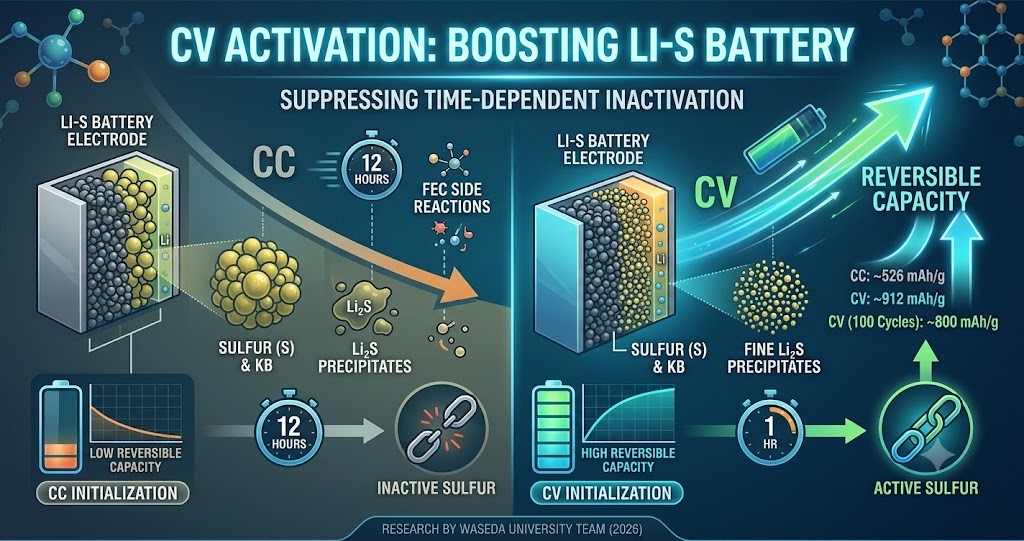
本研究では、1 M LiTFSI/FEC-HFE (1:1, v/v) 電解液中において、S/KB複合正極への定電位(1.0 Vで20時間)リチウム化処理(CV法)を適用し、従来の定電流法(CC法)と比較・評価しました。
主な実験結果とスペック比較
- 初回放電容量: CC法 2107 mAh g-1 に対し、CV法では 2481 mAh g-1 を記録。
- 初回充電(可逆)容量: CC法 526 mAh g-1 に対し、CV法では 912 mAh g-1 へと飛躍的に向上。
- 100サイクル後の放電容量: CC法 約600 mAh g-1 に対し、CV法は 約800 mAh g-1 の高容量を維持。
3. 分析と機構の解明(なぜCV法で容量が伸びるのか)
研究チームは、電気化学インピーダンス分光法(EIS)、X線光電子分光法(XPS)、走査型電子顕微鏡(SEM)を用いて容量増加の要因を精密に分析しました。
- CEI被膜の化学組成・膜厚の類似性: XPSおよびEIS分析の結果、CC法とCV法で形成された正極表面のCEI被膜の化学組成や厚さには大きな差がないことが確認されました。
- 初期析出物の粒子径の違い: SEM観察により、CV法適用後の析出物粒子(123 nm)はCC法(484 nm)よりも著しく微細であることが判明しました。ただし、1サイクル充放電後にはこの形態差は消失するため、形態差だけが持続的な容量向上の理由ではありません。
- 時間依存的な「硫黄の不活性化」の抑制: 最大の要因は「リチウム化にかかる時間」でした。CC法では1.0 Vに達するまでに約12時間かかり、長時間の反応過程でポリ硫化物とFECとの化学的副反応や局所的な不動態化(不活性化)が進行します。一方、CV法では1時間以内に90%以上の反応が進むため、この時間依存的な不活性化を抑制し、電気化学的にアクセス可能な硫黄を効率よく利用できることが突き止められました。
4. 【関連情報】リチウム硫黄電池の技術動向と本研究の意義
- 材料開発から「電気化学的制御(制御プロセス)」への視点転換 これまでリチウム硫黄電池の性能改善は「新しい電解液の合成」や「ナノカーボン担体の設計」といった材料工学が主流でした。本研究は、電極電位の制御という「電気化学的アプローチ(プロセス制御)」のみで副反応を抑え、活物質の利用率を大幅に向上させられることを証明した点で極めて高い価値があります。
- 再生可能エネルギー・大型蓄電池への波及効果 太陽光や風力発電の導入拡大に伴い、系統用電力貯蔵システム(ESS)の需要が高まっています。希少金属(コバルトやニッケル)を使わず、石油精製の副産物である硫黄を活用するLi-S電池は、コスト面・環境面で最も有望な選択肢の一つです。
- 高高度プラットフォーム(HAPS)やドローンへの応用 Li-S電池は重量エネルギー密度が極めて高いため、長時間の飛行が求められる無人航空機(HAPS)や電動航空機向け電源として実用化研究が世界中で加速しています。初期化プロセスの効率化は、製造コスト削減やセル品質の均一化に直接寄与します。
まとめ
早稲田大学の研究グループによる本成果は、FEC系電解液を用いたリチウム硫黄電池において、「定電位(CV)リチウム化」を適用することで、CEIの構造を変えることなく時間依存的な硫黄の不活性化を防ぎ、可逆容量を526 mAh g-1から912 mAh g-1へと大幅に向上させられることを示しました。
複雑な材料合成を伴わず、初期化手順の制御のみでバッテリー性能を最大限に引き出す本手法は、次世代高エネルギー密度電池の実用化に向けたシンプルかつ極めて強力なアプローチです。
Simply Changing How Potential Is Applied! How Potentiostatic Activation Dramatically Boosts Lithium-Sulfur Battery Capacity
Lithium-sulfur (Li-S) batteries are widely anticipated as next-generation, high-energy-density energy storage systems. Thanks to their high theoretical capacity, they are expected to find applications in aerospace and stationary energy storage. However, one of the primary obstacles to commercialization is the deactivation of active material (sulfur) and side reactions occurring during initial activation.
In this study (reported in 2026 by Hiroki Nara et al. at Waseda University), researchers discovered that in sulfur/Ketjenblack (S/KB) composite cathodes using fluoroethylene carbonate (FEC)-based electrolytes, simply switching the initial lithiation (discharge) process from conventional galvanostatic (galvanostatic / CC) to potentiostatic (potentiostatic / CV) mode dramatically increases reversible capacity.
1. Research Background and Challenges
Lithium-sulfur batteries attract significant attention as low-cost, high-energy-density storage devices because they use inexpensive and abundant sulfur as a cathode material. However, several technical hurdles remain:
- Low conductivity of sulfur and its discharge products (Li2S): Smooth charge-discharge reactions are difficult to achieve, requiring complexation with porous carbon supports such as Ketjenblack (KB).
- Competing reactions with the electrolyte: In FEC-based electrolytes used for safety and film formation, cathode electrolyte interphase (CEI) formation via FEC reduction and the sulfur lithiation reaction occur within the same potential range.
- Limitations of the conventional galvanostatic (CC) method: When performing initial activation under galvanostatic conditions, a portion of the applied current is consumed by side reactions and CEI formation. Over time, sulfur degrades into an electrochemically inaccessible state (deactivation).
2. Experimental Results: Performance Improvement via Potentiostatic (CV) Activation
In this study, a potentiostatic lithiation process (CV method at 1.0 V for 20 hours) was applied to S/KB composite cathodes in a 1 M LiTFSI/FEC-HFE (1:1, v/v) electrolyte, and its performance was compared and evaluated against the conventional galvanostatic method (CC method).
Key Experimental Results and Performance Comparison
- Initial discharge capacity: 2107 mAh g-1 with the CC method vs. 2481 mAh g-1 with the CV method.
- Initial charge (reversible) capacity: Increased dramatically from 526 mAh g-1 (CC) to 912 mAh g-1 (CV).
- Discharge capacity after 100 cycles: Maintained a high capacity of approximately 800 mAh g-1 with the CV method, compared to around 600 mAh g-1 with the CC method.
3. Analysis and Mechanism (Why CV Activation Boosts Capacity)
The research team performed detailed analyses using Electrochemical Impedance Spectroscopy (EIS), X-ray Photoelectron Spectroscopy (XPS), and Scanning Electron Microscopy (SEM) to identify the factors driving capacity enhancement.
- Similarity in CEI chemical composition and thickness: XPS and EIS analyses confirmed that there were no significant differences in the chemical composition or thickness of the CEI layer formed on the cathode surface between the CC and CV methods.
- Differences in initial deposit particle size: SEM observations revealed that the deposit particles formed after CV lithiation (123 nm) were significantly smaller than those formed after CC lithiation (484 nm). However, because this morphological difference disappeared after one charge-discharge cycle, morphology alone cannot explain the sustained capacity improvement.
- Suppression of time-dependent sulfur deactivation: The most decisive factor was the time required for lithiation. Under the CC method, reaching 1.0 V took about 12 hours, during which chemical side reactions between polysulfides and FEC, as well as localized passivation (deactivation), progressed over time. In contrast, the CV method achieved over 90% of the reaction within 1 hour, suppressing this time-dependent deactivation and enabling efficient utilization of electrochemically accessible sulfur.
4. Related Context: Technological Trends in Li-S Batteries and Significance of This Study
- Shift from material development to electrochemical process control: Historically, performance improvements in lithium-sulfur batteries focused mainly on materials engineering, such as synthesizing new electrolytes or designing nanocarbon structures. This study is highly valuable because it proves that simply adjusting the electrochemical approach (process control)—specifically, controlling the electrode potential—can suppress side reactions and greatly increase active material utilization.
- Impact on renewable energy and grid-scale storage: With the rapid expansion of solar and wind power, demand for energy storage systems (ESS) for power grids is growing. Li-S batteries, which rely on sulfur (a byproduct of petroleum refining) rather than scarce metals like cobalt or nickel, represent one of the most promising candidates from both cost and environmental perspectives.
- Applications in High-Altitude Platform Stations (HAPS) and drones: Because Li-S batteries offer extremely high gravimetric energy density, research into their commercialization for uncrewed aerial vehicles (HAPS) and electric aircraft requiring long flight endurance is accelerating globally. Streamlining the initial activation process directly contributes to lower manufacturing costs and better cell quality consistency.
Summary
This work by the research team at Waseda University demonstrates that applying potentiostatic (CV) lithiation in lithium-sulfur batteries using FEC-based electrolytes prevents time-dependent sulfur deactivation without altering the underlying CEI structure, substantially boosting reversible capacity from 526 mAh g-1 to 912 mAh g-1.
Without relying on complex material synthesis, this simple and highly effective strategy maximizes battery performance purely through control of the initial activation protocol, marking a major step forward toward the practical realization of next-generation, high-energy-density batteries.

コメント