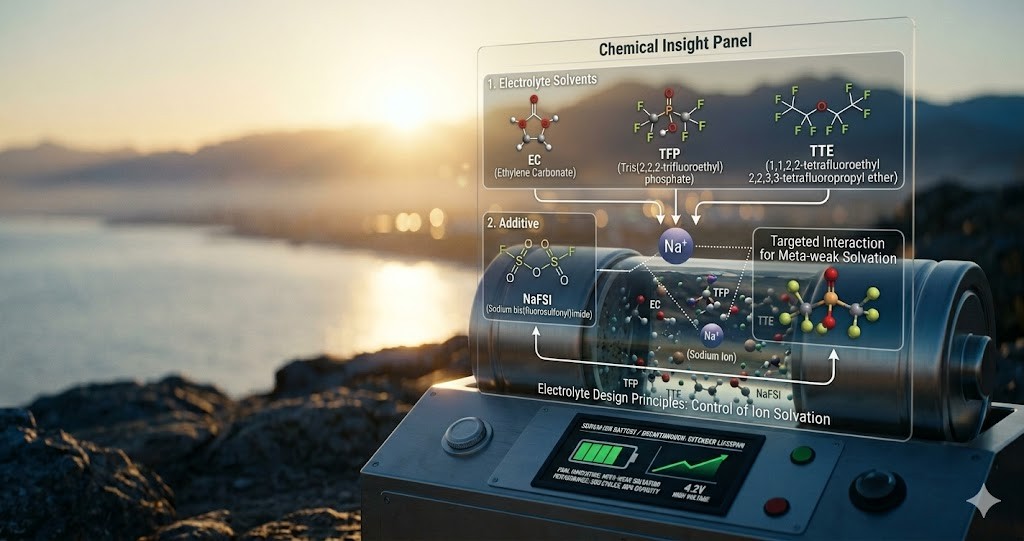
ナトリウムイオン電池の商業化における最大の障壁は、高電圧動作時の電解液の分解と、それに伴う寿命の短さでした。PNNL(米国太平洋北西国立研究所)の研究チームは、分子レベルでイオンの「囲い(溶媒和)」の強さを制御する「メタ弱溶媒和(Meta-weak Solvating)」という新概念を提唱しました。これは、特定のフッ素系化合物を組み合わせることで、イオンの輸送効率と電極界面の保護を両立させる画期的なアプローチです。
- 1. 電解液の具体的な化学組成
- 2. メタ弱溶媒和(MWS)のメカニズム
- 3. 実証された性能とデバイス構成
- 4. 分析によって判明した劣化抑制の証拠
- まとめ
- From PNNL: New Electrolyte Technology for High-Voltage Sodium-Ion Batteries
- 1. Specific Chemical Composition of the Electrolyte
- 2. Mechanism of Meta-weak Solvating (MWS)
- 3. Proven Performance and Device Configuration
- 4. Evidence of Degradation Suppression via Analysis
- Summary
1. 電解液の具体的な化学組成
この技術の核となるのは、従来の溶媒に特殊なリン酸エステル系およびエーテル系溶媒を組み合わせた多成分系の設計です。
- 電解質塩(Main Salts)
- NaPF6 (Sodium hexafluorophosphate): 標準的な塩。
- NaFSI (Sodium bis(fluorosulfonyl)imide): 界面保護膜(SEI/CEI)の質を向上させる補助的な塩。
- ベース溶媒(Co-Solvents)
- EC (Ethylene carbonate): 高い誘電率を持ち、塩を溶かす役割。
- DEC (Diethyl carbonate): 粘度を下げ、イオンの移動を助ける役割。
- メタ弱溶媒和を制御するキー化合物
- TEP (Triethyl phosphate): 難燃性を付与しつつ、イオンと結合。
- TFP (Tris(2,2,2-trifluoroethyl) phosphate): 本研究の主役。フッ素基を持つことで、ナトリウムイオンとの結合を「適度に弱める」役割を果たします。
- TTE (1,1,2,2-tetrafluoroethyl 2,2,3,3-tetrafluoropropyl ether): 希釈剤(Diluent)として機能。溶媒と結合しない「自由なナトリウムイオン」を適切に配置し、均一な液体構造を作ります。
2. メタ弱溶媒和(MWS)のメカニズム
なぜこれらの化合物の組み合わせが、寿命を2倍以上に延ばすのでしょうか。
- 「強すぎる結合」からの脱却 従来のECやTEPのみの系では、ナトリウムイオンが溶媒分子にガッチリと捕まった状態(強溶媒和)でした。これでは電極に入る際に溶媒を脱ぎ捨てにくく、無理やり電極に衝突して分解反応を起こしていました。
- TFPによる「動的な入れ替わり」 フッ素化されたTFPを導入すると、イオン周囲の分子が猛烈なスピードで入れ替わるようになります。この「緩いガード」のおかげで、イオンは移動中は守られ、電極界面ではスムーズに溶媒を脱ぎ捨てて内部へ潜り込むことができます。
3. 実証された性能とデバイス構成
研究チームは、より実用に近い環境でその効果を証明しました。
- フルセル構成
- 正極: NFM424 (Sodium nickel manganese iron oxide) – 高電圧での動作が可能。
- 負極: ハードカーボン (Hard Carbon) – ナトリウム電池の標準的な負極材。
- 試験結果
- 電圧: 4.2Vの高電圧駆動。
- 寿命: 500サイクル経過後も容量の80%を維持。
- 従来比較: 従来の電解液では100から300サイクルで劣化していたのに対し、圧倒的な安定性を示しました。
4. 分析によって判明した劣化抑制の証拠
SEM(走査電子顕微鏡)やXPS(X線光電子分光)などの多角的な分析により、ナノレベルでの変化が確認されています。
- 均一なCEI(カソード電解質中間相)の形成 高電圧正極の表面に、極めて薄く、かつ緻密な保護層が形成されていました。これにより、電解液が直接正極に触れて分解される「浪費」が止まりました。
- 物理的ダメージの軽減 50サイクル後の電極を観察したところ、従来の電解液では表面がボロボロに侵食されていたのに対し、新電解液では電極の構造が新品に近い状態で維持されていました。
まとめ
PNNLの開発した電解液は、NaPF6/NaFSIをベースに、TFPやTTEといったフッ素系溶媒を戦略的に配合することで、ナトリウムイオンの「捕まり具合」を最適化したものです。この「メタ弱溶媒和」という設計指針は、リチウムに依存しない安価なグリッド蓄電池の実用化を数年単位で早める可能性を秘めています。
From PNNL: New Electrolyte Technology for High-Voltage Sodium-Ion Batteries
The primary barriers to the commercialization of sodium-ion batteries have been the decomposition of the electrolyte during high-voltage operation and the resulting short cycle life. A research team at the Pacific Northwest National Laboratory (PNNL) has proposed a new concept called “Meta-weak Solvating,” which controls the strength of the ionic “cage” (solvation) at the molecular level. This is a breakthrough approach that balances ion transport efficiency with electrode interface protection by combining specific fluorinated compounds.
1. Specific Chemical Composition of the Electrolyte
The core of this technology is a multi-component design that combines conventional solvents with specialized phosphate and ether-based solvents.
- Main Salts
- NaPF6 (Sodium hexafluorophosphate): The standard electrolyte salt.
- NaFSI (Sodium bis(fluorosulfonyl)imide): An auxiliary salt that improves the quality of the interface protection films (SEI/CEI).
- Co-Solvents
- EC (Ethylene carbonate): Has a high dielectric constant and serves to dissolve the salts.
- DEC (Diethyl carbonate): Reduces viscosity and facilitates ion movement.
- Key Compounds Controlling Meta-weak Solvation
- TEP (Triethyl phosphate): Binds with ions while providing flame retardancy.
- TFP (Tris(2,2,2-trifluoroethyl) phosphate): The protagonist of this research. Its fluorine groups serve to “moderately weaken” the bond with sodium ions.
- TTE (1,1,2,2-tetrafluoroethyl 2,2,3,3-tetrafluoropropyl ether): Functions as a diluent. It appropriately positions “free sodium ions” that do not bind to solvents, creating a uniform liquid structure.
2. Mechanism of Meta-weak Solvating (MWS)
Why does this combination of compounds extend the battery life by more than twofold?
- Moving Away from “Strong Binding”: In conventional systems using only EC or TEP, sodium ions were tightly trapped by solvent molecules (strong solvation). This made it difficult for ions to shed their solvent shells when entering the electrode, causing them to collide forcefully with the electrode and trigger decomposition reactions.
- “Dynamic Exchange” via TFP: By introducing fluorinated TFP, the molecules surrounding the ions begin to swap at an extremely high speed. Thanks to this “loose guard,” ions are protected during transport but can smoothly shed their solvents and enter the electrode interior at the interface.
3. Proven Performance and Device Configuration
The research team demonstrated the effectiveness of this technology in an environment close to practical application.
- Full-Cell Configuration
- Cathode: NFM424 (Sodium nickel manganese iron oxide) – Capable of high-voltage operation.
- Anode: Hard Carbon – The standard anode material for sodium batteries.
- Test Results
- Voltage: High-voltage drive at 4.2V.
- Cycle Life: Maintained 80% of initial capacity even after 500 cycles.
- Comparison: Showed overwhelming stability compared to conventional electrolytes, which typically degrade within 100 to 300 cycles.
4. Evidence of Degradation Suppression via Analysis
Nano-level changes were confirmed through multi-faceted analyses such as SEM (Scanning Electron Microscopy) and XPS (X-ray Photoelectron Spectroscopy).
- Formation of a Uniform CEI (Cathode Electrolyte Interphase): An extremely thin and dense protective layer was formed on the surface of the high-voltage cathode. This stopped the “wasteful” decomposition of the electrolyte caused by direct contact with the cathode.
- Reduction of Physical Damage: Observation of the electrodes after 50 cycles revealed that while electrodes in conventional electrolytes were severely eroded, those in the new electrolyte maintained a structure nearly identical to a new electrode.
Summary
The electrolyte developed by PNNL optimizes the “trapping strength” of sodium ions by strategically blending fluorinated solvents like TFP and TTE into a NaPF6/NaFSI base. The “Meta-weak Solvating” design principle holds the potential to accelerate the practical application of low-cost, lithium-independent grid storage batteries by several years.


コメント