電池技術の進化において、資源リスクの少ない「ナトリウムイオン電池」および高エネルギー密度を実現する「アノードフリー(負極レス)構造」は、次世代蓄電デバイスの本命として世界中で大きな注目を集めています。特に、中国を中心とするリチウムおよびコバルトやニッケルなどの主要レアメタルの供給網(サプライチェーン)偏重は、経済安全保障の観点から防衛や航空宇宙、重要インフラ業界にとって極めて深刻なリスクとなっています。
本まとめでは、フランスの世界的電池メーカーであるSaftと、米国の先進ベンチャーMana Batteryが2026年8月に発表した共同開発契約の最新ニュースを中心に、アノードフリー・ナトリウムイオン電池の技術的背景や市場的・戦略的意義などの関連情報を加えて整理・解説します。
1. ニュースの概要(SaftとMana Batteryの共同開発契約)
- 発表日: 2026年8月3日
- 提携企業:
- Saft(サフト): フランスに拠点を置く大手石油・エネルギー企業TotalEnergies(トタルエナジーズ)の完全子会社。防衛、航空宇宙、鉄道、産業用、定置型アプリケーション向け蓄電池の設計・製造・認証において数十年の知見を持つ。
- Mana Battery(マナ・バッテリー): 米国コロラド州ブルームフィールドを拠点とし、コロラド大学ボルダー校からスピンアウトしたスタートアップ。低コストかつ安全性に優れた電解質およびアノードフリー技術を開発。
- 契約の内容: 防衛および重要インフラ用途に向けた「アノードフリー・ナトリウムイオン電池」の共同開発。研究・検証を通じて、極めて高い性能・安全性が要求される環境下での認定を目指す。
- ターゲット領域: 防衛、航空宇宙、鉄道、データセンター用バックアップ電源、産業用無停電電源装置(UPS)。
2. 技術解説:アノードフリー・ナトリウムイオン電池とは
(1) 基本的な仕組み
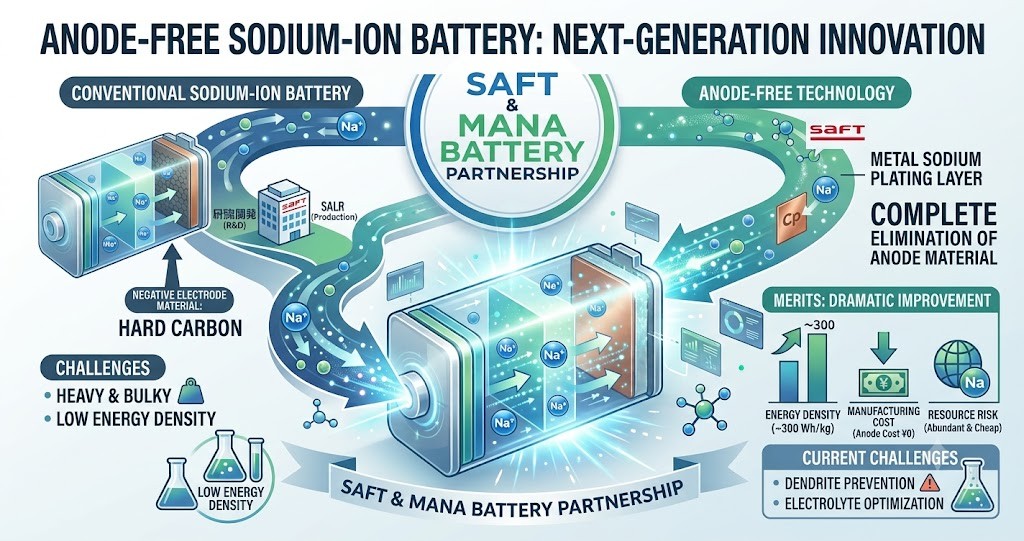
従来のナトリウムイオン電池やリチウムイオン電池は、負極(アノード)にハードカーボン(硬質炭素)やグラファイトなどの活性物質を使用します。 一方、アノードフリー(負極レス)設計では、出荷時・組み立て時には負極活性物質が存在しません。初回充電に伴い、正極(カソード)から移動してきたナトリウムイオンが負極の集電体(銅箔など)の上に直接析出し、その場で「金属ナトリウムアノード」を形成します。放電時にはこれが溶出して正極へ戻ります。
(2) 主なメリット
- 高エネルギー密度化: 負極材料(ハードカーボン等)の重量や体積を完全に排除できるため、電池全体の体積エネルギー密度(Wh/L)および重量エネルギー密度(Wh/kg)が大幅に向上します。
- コスト削減・軽量化: 材料費の削減と製造プロセスの簡略化が可能となります。
(3) 技術的課題とMana社の強み
- 主な課題: 金属ナトリウムの充放電(析出・溶解)を繰り返すと、表面での不均一な析出(デンドライト形成)や電解液との副反応が生じ、サイクル寿命が著しく低下したり短絡・発火の危険性が高まります。
- Mana Batteryの独自技術: 低コストかつフッ素を含まない(Non-fluorinated)独自の液体電解質を開発。米国エネルギー省(DOE)の支援・概要等でも紹介されており、効率的かつ均一なナトリウムの電着・溶解をサポートし、安全性を維持します。
3. 業界・市場的背景(関連情報)
(1) サプライチェーンの脱リチウム・脱コバルト・脱ニッケル
現在主流のリチウムイオン電池は、リチウム、コバルト、ニッケルといった特定地域に偏在するクリティカルミネラルに大きく依存しています。ナトリウムは食塩(塩化ナトリウム)などから無制限かつ安価に入手可能であるため、供給制約や地政学的リスクを劇的に軽減できます。
(2) 防衛・重要インフラ用途における要求基準
防衛や航空宇宙、重要データセンターでは、単なる高容量化だけでなく、過酷な温度環境での動作、物理的衝撃に対する耐性、熱暴走を起こさない高い安全性が絶対条件となります。Mana社の革新的な材料技術と、Saft社が長年培ってきた厳格な試験・認証プロセスの融合は、「研究室の技術(ラボスケール)を最速で実用現場(フィールド)へ届ける」ための理想的なアプローチと位置づけられています。
4. 両社首脳のコメントと今後の見通し
- タイラー・エバンス(Mana Battery CEO): 「Saftはまさにこのミッションのために設計された理想的なパートナーです。数十年にわたる認証・製造経験を持つSaftとの連携は、当社のプラットフォームの成熟度を証明するものであり、高エネルギー密度とサプライチェーンの優位性が求められる現場への展開を加速させます。」
- カメン・ネチェフ(Saft CTI/最高技術・イノベーション責任者): 「ナトリウムイオンは当社にとって戦略的に重要であり、アノードフリー設計はその最も有望な領域です。Mana社の世界クラスの電解質技術と当社のセル設計・製造・認証能力を組み合わせ、最高水準の安全・高パフォーマンス電池を提供していきます。」
開発の課題と今後の注視点
なお、今回の共同開発契約は2025年に開始された初期技術評価に基づくものであり、現時点で具体化されたセル形状(プリズマティックやポーチ型など)、想定される具体的なエネルギー密度、目標サイクル数、開発ロードマップ、商業生産および供給に関する拘束力のある契約は公表されていません。今後はプロトタイプセルの試作と評価の進捗が注目されます。
出典:https://www.bestmag.co.uk/saft-mana-anode-free-sodium-ion/
Saft and Mana Battery Partner: Frontlines of Anode-Free Sodium-Ion Battery Development
In the evolution of battery technology, “sodium-ion batteries”—which carry low resource supply risks—and “anode-free architectures”—which deliver high energy density—are drawing significant global attention as leading contenders for next-generation energy storage devices. In particular, heavy reliance on supply chains centered in China for primary critical minerals such as lithium, cobalt, and nickel poses an extremely severe risk from an economic security perspective for defense, aerospace, and critical infrastructure industries.
This summary outlines the technical background, market, and strategic significance of anode-free sodium-ion batteries, centered on the joint development agreement announced in August 2026 by Saft, a global French battery manufacturer, and Mana Battery, an advanced US startup.
1. News Overview (Joint Development Agreement Between Saft and Mana Battery)
- Announcement Date: August 3, 2026
- Partner Companies:
- Saft: A wholly owned subsidiary of TotalEnergies, the major French oil and energy company. It possesses decades of expertise in cell design, manufacturing, testing, and qualification of energy storage batteries for defense, aerospace, rail, industrial, and stationary applications.
- Mana Battery: A US-based startup headquartered in Broomfield, Colorado, spun out of the University of Colorado Boulder. It develops low-cost, highly safe electrolytes and anode-free cell technologies.
- Agreement Details: Joint development of anode-free sodium-ion batteries targeting defense and critical infrastructure applications. The collaboration aims to achieve qualification under performance and safety conditions required by demanding environments through research and validation.
- Target Domains: Defense, aerospace, rail, data center backup power, and industrial uninterruptible power supply (UPS) systems.
2. Technical Explanation: What is an Anode-Free Sodium-Ion Battery?
(1) Basic Mechanism
Conventional sodium-ion and lithium-ion batteries use active materials such as hard carbon or graphite for the negative electrode (anode).
In contrast, an anode-free design is assembled without any anode active material present at the time of shipping and assembly. During the initial charge, sodium ions migrating from the positive electrode (cathode) deposit directly onto the negative current collector (such as copper foil) to form a metallic sodium anode in situ. During discharge, this sodium dissolves and returns to the cathode.
(2) Key Advantages
- Higher Energy Density: Fully eliminating the weight and volume of anode materials (such as hard carbon) significantly boosts the battery’s overall volumetric energy density (Wh/L) and gravimetric energy density (Wh/kg).
- Cost Reduction & Weight Savings: Enables reduced raw material costs and simplified manufacturing processes.
(3) Technical Challenges and Mana’s Strengths
- Primary Challenges: Repeated charging and discharging (deposition and dissolution) of metallic sodium can cause non-uniform deposition (dendrite formation) on the surface and side reactions with the electrolyte, severely shortening cycle life and increasing the risk of short circuits or thermal runaway.
- Mana Battery’s Proprietary Technology: Mana has developed a low-cost, fluorine-free liquid electrolyte. Highlighted in US Department of Energy (DOE) project descriptions, this electrolyte supports efficient and uniform sodium electrodeposition and dissolution while maintaining safety.
3. Industry and Market Background
(1) Supply Chain Independence from Lithium, Cobalt, and Nickel
Currently mainstream lithium-ion batteries depend heavily on critical minerals that are geographically concentrated. Sodium can be sourced abundantly and inexpensively from materials like common salt (sodium chloride), dramatically reducing supply constraints and geopolitical risks.
(2) Requirements for Defense and Critical Infrastructure
For defense, aerospace, and critical data centers, key requirements extend beyond high capacity to include operation under extreme temperatures, tolerance to physical shock, and high safety against thermal runaway. The combination of Mana’s material technology and Saft’s rigorous testing and qualification processes represents an ideal path to transition technology from the laboratory to the field as quickly as possible.
4. Executive Comments and Future Outlook
- Tyler Evans (CEO, Mana Battery):”Saft is exactly the partner we would design for this mission—a battery manufacturer with decades of experience qualifying cells for the world’s most demanding defense, aerospace, rail and industrial customers. This agreement validates the maturity of our electrolyte and anode-free platform and puts it on the fastest possible path from the lab to the field, where its energy density, safety and supply-chain advantages matter most.”
- Kamen Nechev (Chief Technology & Innovation Officer, Saft):”Sodium-ion is a strategically important chemistry for the industries we serve, and anode-free designs are its most promising frontier. Mana Battery brings world-class electrolyte innovation that complements our cell design, manufacturing and qualification capabilities. Together we intend to bring safe, high-performance sodium-ion batteries to defense, aerospace, rail, datacenter and industrial UPS customers.”
Development Challenges and Future Points to Watch
This joint development agreement builds on an initial technical evaluation initiated in 2025. At present, specific cell form factors (such as prismatic or pouch), concrete target energy densities, targeted cycle life, development roadmaps, and binding agreements regarding commercial production or supply have not been disclosed. Progress in prototype cell fabrication and evaluation will be key areas to monitor going forward.

コメント