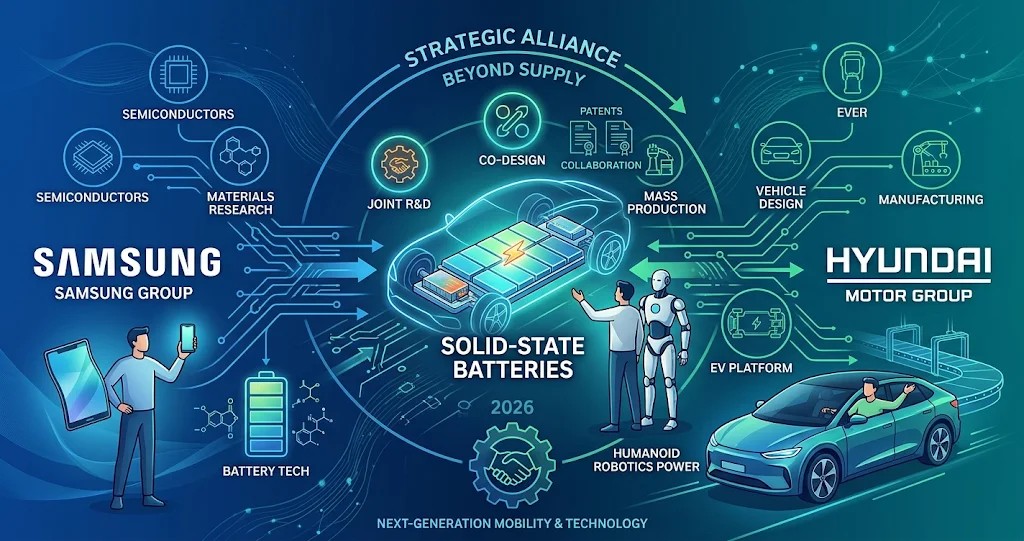
韓国の産業界を牽引する2大財閥、Samsung(サムスン)グループとHyundai Motor(ヒョンデ自動車)グループの協力関係が、従来の製品供給契約を超え、次世代技術の共同設計や量産プロセスの構築へと大きく進化しています。両社は2026年11月11日までに、全固体電池分野において材料研究から製造工程に至るまで計9件の特許を共同出願し、電気自動車(EV)用バッテリーパックの安全性を高める技術でも共同特許を公開しました。
かつて競合関係や歴史的経緯から一定の距離を保っていた両グループですが、3代目経営陣によるトップ会談(2020年)を機に急速に接近し、現在では車載電池、全固体、さらにはヒューマノイドロボット向け電源まで巻き込んだ包括的なアライアンスへと移行しています。
パック設計から量産工程へ:特許共同出願に見る協力を示す技術的根拠
両グループの技術提携は、単にセルを調達する関係を超え、車両の構造設計と電池の製造技術を一体化させる領域に達しています。
- 角形電池を軸とした「安全&高密度」パック構造の共同出願 2026年10月22日に韓国特許情報検索サービス(KIPRIS)で公開された共同特許「バッテリーパック及びそのバッテリーパックを含む車両」では、バッテリーセルの底部に排出口を設け、熱暴走時に発生する高温ガスを安全に外部へ放出する新構造が採り入れられました。従来は別々に設計されていた「ガス排出スペース」と「衝撃保護スペース」を統合することで、排気安全性を確保しながらパック全体のエネルギー密度を引き上げることに成功しています。
- 全固体電池の「WIP(高温等方加圧)量産工程」特許 2022年から2025年にかけて共同出願された全固体電池関連の特許(計9件、うち2件は登録済み)では、初期の「硫化物系固体電解質の耐水性コーティング技術」から、より実用的な「電池寿命改善」および「量産製造プロセス」へと研究領域が拡大しています。特に、全固体電池の製造に不可欠とされるWIP(Warm Isostatic Pressing:高温等方加圧)工程における精密な温度測定技術や、セルの予熱・自動搬送装置など、実際の工場ライン運用を見据えた特許が共同で確保されています。
事実上の車載採用拡大:ハンガリー工場から欧州向け3車種へ供給
Samsung SDIとHyundai Motorグループは、2023年に締結した初の大規模供給契約(2026年〜2032年の7年間)に基づき、実車の採用範囲を拡大させています。
Samsung SDIのハンガリー工場で生産される角形リチウムイオン電池は、欧州市場向けの以下の3車種へ搭載が進んでいます。
- Kia EV2(エントリー向け小型EV)
- Hyundai IONIQ 3(コンパクトEV)
- Genesis GV90(最上位プレミアム電動SUV)
従来、パウチ型電池を主軸に採用してきたHyundai MotorグループがSamsung SDIの角形電池を採用した背景には、空間効率を高めるパック設計の進展に加え、角形ならではの堅牢な外装による安全性と高エネルギー密度に対する高い評価が存在します。
グローバル全固体電池開発のトレンドと次なるフロンティア「ロボティクス」
全固体電池は、既存の液体電解質を固体に置き換えることで発火リスクを極限まで低減し、エネルギー密度を飛躍的に高める「夢の電池」として開発競争が激化しています。日本のトヨタ自動車やパナソニック、中国のCATL、米国のQuantumScapeやFactorial Energyなどが2020年代後半から2030年の実用化を目指す中、韓国連合は「車載」と「ロボティクス」の2軸で優位性を構築しようとしています。
両社はロボット専用高性能電池の共同開発に向けたMOUを締結しており、Samsung SDIが材料・セル設計を担当し、Hyundai傘下のロボティクスラボが実証を担当しています。
- ヒューマノイドロボット向け電源の課題 ヒューマノイド(例えばBoston Dynamicsの「Atlas」など)は、限られた胴体スペースにバッテリーを収めつつ、関節の高速駆動時に瞬間的な大出力を要求されます。さらに人と共存する環境での高水準な安全性、高密度、軽量化、超急速充電が同時に求められます。
- 全固体電池適用による稼働時間の飛躍 Samsung SDIの推計によると、円筒形電池に加えて全固体電池をヒューマノイドへ適用した場合、連続稼働時間を最大8時間まで延長できると試算されています。Hyundai Motorグループが2028年に米国ジョージア州のスマートファクトリー(Meta Plant)へAtlasを導入し、2030年に年3万台規模のロボット生産を目指す上で、全固体電池の存在が大きな鍵を握ります。
経営陣のパートナーシップと業績・課題の現実
両グループの強固な提携の裏には、トップ同士の深い信頼関係があります。Samsung Electronicsは2026年11月9日、西川研修院にHyundai Motorグループ経営陣を招き、異例の「HMG感謝デー」を開催しました。全永鉉(チョン・ヨンヒョン)副会長と張在勲(チャン・ジェフン)副会長が主宰したこのイベントには両社幹部・配偶者ら177人が出席し、電装、電池、オーディオからロボット、エネルギー分野に至る未来産業での結束を確認しました。
しかし、足元のビジネス環境には課題も残されています。
Samsung SDIの2026年第3四半期連結営業利益は4,078億ウォン(約480億円)を記録し、前年同期の赤字から黒字転換を果たしたものの、この回復は主にエネルギー貯蔵装置(ESS)事業が支えています。欧州向けEV用電池の出荷増はあるものの、一部地域の補助金縮小や北米市場の需要減速により、証券アナリストからは「第4四半期の車載電池部門は一時的な赤字へ転落するリスクがある」との指摘も出ています。
まとめ
部品供給の「売り手と買い手」から始まったSamsungとHyundai Motorの関係は、バッテリーパックの構造設計、全固体の量産WIP技術、そして将来のロボット電源に至るまで、共通の技術基盤を構築する戦略的同盟へと進化しました。
車載用全固体電池の2020年代後半における本格量産化と実車・ロボットへの搭載成功に向けて、研究室の技術をいかに高品質かつ低コストで量産ラインに落とし込めるかが、両グループのグローバル市場での勝敗を大きく左右することになります。
出典:https://finance.biggo.jp/news/933ea78b-6deb-4eac-a62d-419f650d3bb2
Samsung and Hyundai Motor Expand Joint All-Solid-State Battery Development — Filing 9 Patents Covering Pack Design to Mass Production
The partnership between South Korea’s two leading conglomerates—Samsung Group and Hyundai Motor Group—is evolving rapidly beyond traditional supply contracts into joint design of next-generation technologies and the construction of mass production processes. By November 11, 2026, the two companies had jointly filed a total of 9 patents in the all-solid-state battery sector covering material research through manufacturing steps, alongside publishing joint patents for technologies that enhance electric vehicle (EV) battery pack safety.
Once maintaining a certain distance due to competitive interests and historical background, the two groups have drawn close following top-level leadership meetings between third-generation management in 2020. Today, they are transitioning into a comprehensive alliance encompassing automotive batteries, all-solid-state chemistry, and power sources for humanoid robotics.
From Pack Design to Mass Production: Technical Evidence in Joint Patent Filings
The technical partnership between the two groups has expanded beyond simple cell procurement into integrating vehicle structural design with battery manufacturing technology:
- Joint Patent for “Safe and High-Density” Pack Structure Centered on Prismatic CellsThe joint patent titled “Battery Pack and Vehicle Including the Same,” published on the Korea Intellectual Property Rights Information Service (KIPRIS) on October 22, 2026, incorporates a structure with gas exhaust ports at the bottom of battery cells to safely vent high-temperature gases generated during thermal runaway. By integrating the previously separate “exhaust space” and “impact protection space,” the design succeeds in boosting overall pack energy density while securing exhaust safety.
- Patents for All-Solid-State “WIP (Warm Isostatic Pressing) Mass Production Process”The all-solid-state battery patents jointly filed between 2022 and 2025 (totaling 9 filings, 2 of which are registered) show an expanding research scope—moving from initial moisture-resistant coating technologies for sulfide-based solid electrolytes toward practical cell lifespan improvements and mass manufacturing processes. Notably, patents covering precise temperature measurement techniques during Warm Isostatic Pressing (WIP)—an essential process for all-solid-state manufacturing—as well as cell pre-heating and automated transport systems have been jointly secured for actual factory line operations.
Expanding Automotive Supply: Hungary Plant to Power 3 European Models
Under their first major supply agreement signed in 2023 (covering a 7-year term from 2026 to 2032), Samsung SDI and Hyundai Motor Group are expanding the deployment of cells in production vehicles.
Prismatic lithium-ion batteries produced at Samsung SDI’s Hungary facility are being integrated into three key models targeting the European market:
- Kia EV2 (Entry-level compact EV)
- Hyundai IONIQ 3 (Compact EV)
- Genesis GV90 (Top-tier flagship premium electric SUV)
For Hyundai Motor Group, which historically relied heavily on pouch-type cells, the decision to adopt Samsung SDI’s prismatic batteries reflects advances in space-efficient pack design alongside high evaluations of the safety, structural rigidity, and high energy density offered by prismatic casings.
Global Solid-State Battery Trends and the Next Frontier: Robotics
All-solid-state batteries—which replace liquid electrolytes with solid materials to minimize fire risks and dramatically boost energy density—are subject to intense global R&D competition. While global players including Japan’s Toyota Motor and Panasonic, China’s CATL, and US firms QuantumScape and Factorial Energy target commercial rollout between the late 2020s and 2030, the South Korean alliance aims to build a competitive edge across two pillars: automotive and robotics.
The two companies have signed a Memorandum of Understanding (MOU) to jointly develop high-performance batteries specifically for robotics, with Samsung SDI leading material and cell design while Hyundai’s Robotics Lab oversees real-world verification.
- Power Supply Challenges for Humanoid RobotsHumanoids (such as Boston Dynamics’ “Atlas”) require high instantaneous power output during rapid joint actuation while housing batteries within constrained torso volumes. They simultaneously demand strict safety for human-coexisting environments, high energy density, low weight, and ultra-fast charging.
- Dramatic Increase in Operating Time via Solid-State BatteriesSamsung SDI estimates that applying all-solid-state batteries alongside cylindrical cells to humanoids can extend continuous operation time up to 8 hours. As Hyundai Motor Group targets introducing Atlas to its Georgia Meta Plant in 2028 and scaling robot production capacity to 30,000 units annually by 2030, solid-state batteries represent a critical enabling technology.
Executive Leadership Partnership and Financial Realities
Underpinning this alliance is strong trust between executive management. On November 9, 2026, Samsung Electronics hosted an unprecedented “HMG Appreciation Day” at its Seocheon Training Institute for Hyundai Motor Group leadership. Co-hosted by Samsung Electronics Vice Chairman Jun Young-hyun and Hyundai Motor Group Vice Chairman Chang Jae-hoon, 177 executives and spouses attended to reaffirm unity across automotive electronics, batteries, audio, robotics, and energy.
However, challenges remain in the immediate operating environment:
While Samsung SDI recorded a consolidated operating profit of 407.8 billion KRW (approx. 480 million USD) in Q3 2026—turning profitable compared to a loss in the previous year—this recovery was primarily supported by its Energy Storage System (ESS) division. Despite rising EV battery shipments to Europe, subsidy rollbacks in select regions and slowing North American EV demand have led market analysts to note the potential risk of a temporary return to operating losses for the automotive battery division in Q4.
Summary
What began as a buyer-seller relationship for component supply has matured into a strategic alliance building a shared technological foundation spanning battery pack architecture, all-solid-state WIP mass production techniques, and future robotics power systems.
As both groups target commercial mass production of automotive solid-state batteries in the late 2020s, their success in translating lab breakthroughs into high-quality, cost-effective volume manufacturing will be a decisive factor in their global market position.
コメント