米国市場において電気自動車(EV)需要の伸び悩みや政策の不透明感から、多くの自動車メーカーがEV投資の縮小や延期を余儀なくされています。しかし、ドイツのBMWはEVモデルの新規投入とバッテリー現地生産の強化を強気に推し進めています。
本稿では、サウスカロライナ州ウッドラフ工場で開始される新型EV「iX5」向け巨大高電圧バッテリーパックの生産計画と、BMWが推進する「地産地消(ローカル・フォー・ローカル)」戦略の背景や製造プロセスの詳細について詳しく解説します。
1. BMWウッドラフ工場の生産計画と主要スペック
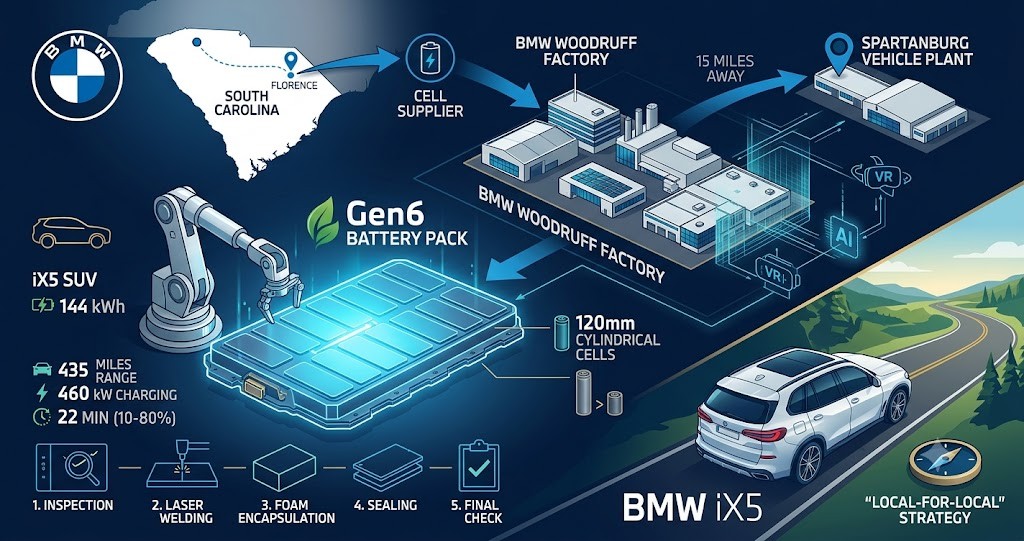
BMWはサウスカロライナ州に新設したウッドラフ工場において、新型電気SUV「iX5」向けの第6世代(Gen6)高電圧バッテリーパックの量産を12月より開始します。
ウッドラフ工場の概要と体制 YouTube
- 投資方針: サプライヤーからの輸入や完成品調達に頼らず、車両工場(スパルタンバーグ工場)からわずか15マイルの近接地に自社バッテリー組立拠点を設けて物流コストを大幅削減。
- 人員・設備: 約300人の技術作業員と250台の産業用ロボットを導入。 InsideEVs
- 先進技術の活用: AI(人工知能)による検査、デジタルツイン、VR(仮想現実)を活用した事前トレーニングやエラー検知システムを導入。
iX5搭載バッテリーのスペック Assembly Magazine
- 電池容量: 米国仕様 144 kWh(キロワット時)、欧州仕様 141 kWh(BMW史上最大級)。 Driven Car Guide他 1 件
- 推定航続距離: 435 マイル。
- 急速充電能力: 最大 460 kW(キロワット)に対応し、わずか22分で10%から80%まで充電可能。
- セル形状: 高さ120 mm(ミリメートル)の円筒形セルを採用(前世代iX3の95 mmセル比で利用可能エネルギーが30%増加)。
2. セル調達の背景と組み立てプロセス
バッテリーセルの供給網
採用される円筒形セルは、日本のバッテリーメーカーをルーツに持ち、現在は中国エンビジョングループが過半数を保有するAESC(Automotive Energy Supply Corp.)が供給します。トランプ政権下の優遇措置撤回などを受け、AESCの米サウスカロライナ現地工場計画は一時停止されましたが、BMWへの第6世代セルの供給自体は継続されます。
厳格なバッテリーパック製造プロセス
- 初期受入検査: パック化の前にサプライヤーから届いた各セルの電圧を精密チェック。
- セル結合・レーザー溶接: セルを冷却部品と連結し、レーザー溶接で堅牢に一体化。
- 発泡材封入: パック内に特殊発泡材を注入して硬化させ、セル群を単一の強固なブロックとして包み込んで保護。
- 密封と制御機器取り付け: 筐体を密閉し、制御ユニット「エナジーマスター」を専用接着剤とシール材で強力かつ絶縁状態で固定。
- 最終検査と輸送: 全品検査をクリアしたパックは、車体組立を行うスパルタンバーグ工場へ陸送。
3. 【関連情報】BMWのグローバル戦略と技術的背景
1. 「ローカル・フォー・ローカル」による地政学リスクの低減
BMWは「EVを作る場所のすぐ近くでバッテリーを組立てる」自社完結型の調達構造を世界規模で構築しています。
- 米国内拠点: サウスカロライナ州ウッドラフ(スパルタンバーグ車体工場に近接)
- 欧州拠点: ドイツ・ニーダーバイエルン、ハンガリー・デブレツェン
- その他の世界拠点: 中国・瀋陽、メキシコ・サン・ルイス・ポトシ
関税や貿易摩擦、地政学的ショックが起きた場合でも、現地生産網を確立しておくことで supply chain(サプライチェーン)の途絶リスクや国際輸送コストを最小限に抑えることができます。
2. 「ノイエ・クラッセ(Neue Klasse)」世代の技術革新
iX5に導入される第6世代(Gen6)バッテリーは、モジュール構造を省いてセルを直接パックに組み込む「セル・トゥ・パック(Cell-to-Pack)」構造を採用しています。これによりパック内のスペース効率が劇的に向上し、エネルギー密度の向上と軽量化、さらには従来比でCO2排出量を約28%削減することに成功しています。
3. 米国政策の揺らぎと自動車各社の動向
米国のEV優遇策(IRA法など)の改定や政策変更により、多くのメーカーがバッテリー工場の建設延期やEV計画の縮小を選択しています。その中でBMWがウッドラフ工場の建設・稼働を予定通り進めたことは、長期的な電動化シフトに対する強固な意志を示しています。
まとめ
BMWによるウッドラフ工場でのバッテリー自社組み立ては、短期的には莫大な設備投資が必要となるものの、将来的なコスト競争力、物流の効率化、そして供給網の安定化を確実に手に入れる戦略的布石です。
市場の逆風に左右されず「地産地消」の製造体制を整えるBMWのアプローチは、次世代EV競争における同社の大きなアドバンテージとなると期待されます。
出典:https://insideevs.com/news/802839/bmw-ix5-ev-battery-production-plant-woodruff/
Taking an Aggressive Stance Despite EV Headwinds! BMW Challenges In-House Production of Massive “iX5” Battery in South Carolina, USA
In the US market, slowing growth in electric vehicle (EV) demand and policy uncertainties have forced many automakers to scale back or postpone their EV investments. However, Germany’s BMW is aggressively pushing forward with new EV models and the expansion of local battery production.
This article provides an in-depth look at the production plans for the massive high-voltage battery pack for the new “iX5” EV, scheduled to begin at the Woodruff plant in South Carolina, as well as the details of the manufacturing process and the background of BMW’s “Local for Local” strategy.
1. BMW Woodruff Plant Production Plan and Key Specifications
At its newly built Woodruff plant in South Carolina, BMW will begin mass production in December of the 6th-generation (Gen6) high-voltage battery pack for its new electric SUV, the “iX5.”
Overview and Setup of the Woodruff Plant
- Investment Strategy: Rather than relying on imported cells or pre-assembled battery packs from suppliers, BMW built an in-house battery assembly facility just 15 miles from its vehicle assembly plant (Spartanburg plant), significantly reducing logistics costs.
- Workforce and Equipment: Employs approximately 300 technical workers and 250 industrial robots.
- Use of Advanced Technologies: Integrates AI (artificial intelligence) for inspection, digital twins, and VR (virtual reality) for pre-training and error detection systems.
Battery Specifications for the iX5
- Battery Capacity: 144 kWh (kilowatt-hours) for the US spec, 141 kWh for the European spec (the largest ever for BMW).
- Estimated Driving Range: 435 miles.
- Fast Charging Capability: Supports up to 460 kW (kilowatts), recovering 10% to 80% charge in just 22 minutes.
- Cell Form Factor: Uses cylindrical cells with a height of 120 mm (millimeters), yielding 30% more usable energy compared to the 95 mm cells used in the previous-generation iX3.
2. Cell Procurement Background and Assembly Process
Battery Cell Supply Chain
The cylindrical cells are supplied by Automotive Energy Supply Corp. (AESC), a battery manufacturer with Japanese roots now majority-owned by China’s Envision Group. Although AESC’s local factory project in South Carolina was paused due to the repeal of EV incentives under the Trump administration, the supply of Gen6 cells to BMW remains unaffected.
Rigorous Battery Pack Manufacturing Process
- Initial Receiving Inspection: Voltage across each cell received from the supplier is precisely checked prior to pack assembly.
- Cell Joining and Laser Welding: Cells are connected to cooling components and solidly integrated using laser welding.
- Foam Encapsulation: A specialized foam is injected inside the pack and cured, enclosing the cell array inside a single, solid protective block.
- Sealing and Control Unit Installation: The casing is sealed, and the control unit—known as the “Energy Master”—is bolted on and secured in an insulated state using specialized adhesive and sealant.
- Final Inspection and Transport: Packs that pass all final inspections are transported by land over the short 15-mile distance to the Spartanburg plant for vehicle assembly.
3. BMW’s Global Strategy and Technical Background
1. Mitigating Geopolitical Risks Through “Local for Local”
BMW is building an in-house, self-contained procurement structure globally under the philosophy of assembling batteries in close proximity to where EVs are produced.
- US Base: Woodruff, South Carolina (close to the Spartanburg vehicle assembly plant)
- European Bases: Niederbayern (Germany), Debrecen (Hungary)
- Other Global Bases: Shenyang (China), San Luis Potosi (Mexico)
By establishing localized production networks, BMW can minimize international shipping costs and supply chain disruption risks caused by tariffs, trade tensions, or geopolitical shocks.
2. Technological Innovation of the “Neue Klasse” Generation
The 6th-generation (Gen6) battery featured in the iX5 adopts a “Cell-to-Pack” structure, bypassing module structures to integrate cells directly into the pack. This dramatically improves volumetric efficiency inside the pack, enhances energy density, reduces weight, and cuts carbon dioxide emissions by approximately 28% compared to previous generations.
3. Fluctuating US Policies and Automaker Trends
Amid revisions to US EV incentives (such as the IRA) and shifting policy environments, many automakers have chosen to delay battery plant construction or downscale EV plans. Against this backdrop, BMW’s decision to proceed as scheduled with the construction and operation of the Woodruff plant demonstrates a firm commitment to the long-term transition toward electrification.
Summary
In-house battery assembly at BMW’s Woodruff plant requires a massive short-term capital investment, but it is a strategic move designed to secure long-term cost competitiveness, logistical efficiency, and supply chain stability.
Unswayed by market headwinds, BMW’s approach of establishing a localized manufacturing ecosystem is expected to serve as a major competitive advantage in the next-generation EV race.
コメント