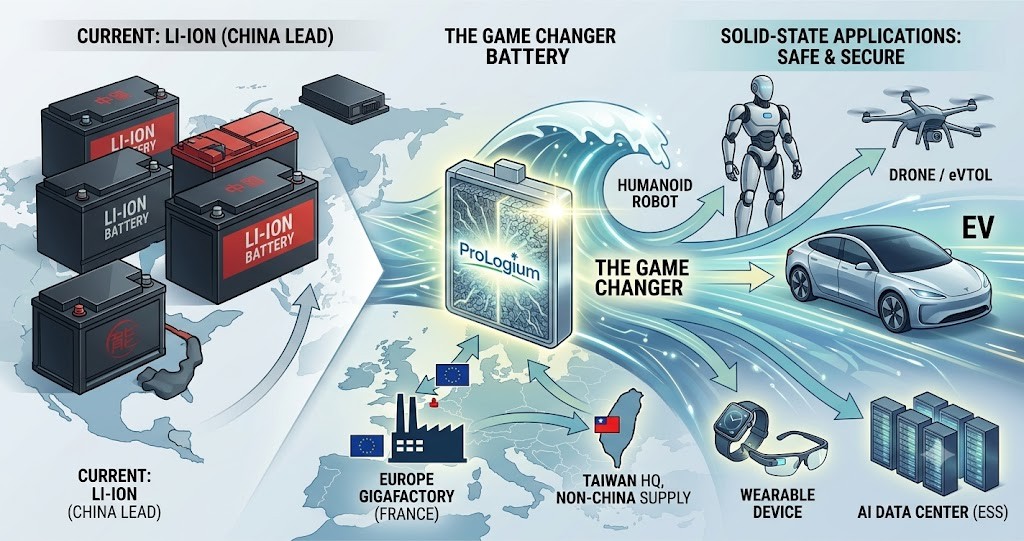
現在、電気自動車(EV)やエネルギー貯蔵システム(ESS)向けリチウムイオン電池の市場は、CATLやBYDをはじめとする中国企業が圧倒的なシェアを握っています。しかし、従来の液体電解質から固体電解質へと刷新される「全固体電池」への技術シフトは、市場の勢力図を塗り替える「ゲームチェンジャー」として大きな注目を集めています。
製造プロセスや材料構成が根本から異なる全固体電池分野では、既存の巨大企業だけでなく新興スタートアップにも勝ち筋が存在します。本稿では、巨額の投資を集める台湾のスタートアップProLogium(輝能科技)の動きを中心に、地政学的な背景、ならびにEVにとどまらない全固体電池の新たな用途展開について整理・解説します。
- 1. 電池市場の現状と「全固体電池」がもたらす機運
- 2. 台湾発スタートアップ「ProLogium」の台頭と戦略
- 3. アプリケーションの変容:EVからロボット・AIデータセンターへ
- 4. 関連・補足情報(技術背景とグローバル競合環境)
- 1. Current State of the Battery Market and Opportunities Created by Solid-State Batteries
- 2. Rise and Strategy of Taiwanese Startup “ProLogium”
- 3. Shift in Applications: From EVs to Robotics and AI Data Centers
- 4. Supplementary Information: Technical Background & Global Competitive Landscape
1. 電池市場の現状と「全固体電池」がもたらす機運
- 中国企業の圧倒的支配BYDやCATLなどの中国勢が、世界中のEV・エネルギー貯蔵設備向け電池の大部分を供給しています。規模の経済とコスト競争力で優位に立っており、中国国外の企業が従来型電池で対抗するのは非常に困難な状況です。
- 次世代主導権を握る「全固体電池」従来の液体電解質は漏洩や引火・発火の懸念があるのに対し、固体電解質を用いる全固体電池は高安全性・高出力・優れた耐低温性を備えます。
- 新興企業への参入機会材料や製造方法がゼロベースで変わるため、巨大なインフラを持つ既存大手にとっても難度の高い技術課題であり、新興スタートアップが対等に戦える新しい競争舞台が生まれています。
2. 台湾発スタートアップ「ProLogium」の台頭と戦略
- 量産に向けた技術と大規模投資
- ProLogium(CEO: ヴィンセント・ヤン)は、低コストで量産性に優れた全固体電池の開発を進めています。
- フランス・ダンケルクでのギガファクトリー建設: 地元政府から約15億ユーロ(約2,780億円)の助成金を受け、欧州生産拠点の起工・建設を進行中(2028年後半の量産開始を目指す)。
- 米SPAC合併と上場計画: 企業価値38億ドル(約6,200億円)規模での米国ナスダック上場に向けた動きを推進。
- 地政学的アノマリーの追い風(中国非依存の強み)
- 米欧諸国を中心に「中国依存からの脱却」を進める保護主義政策(例:EUのネットゼロ産業法など)が強まっています。
- ProLogiumは「中国本土に工場を持たない」ことが強みとなり、中国以外のサプライチェーンを求める政府系インフラ企業や欧州自動車メーカーとの契約・出資(メルセデス・ベンツ等)を獲得しています。
3. アプリケーションの変容:EVからロボット・AIデータセンターへ
全固体電池は量産初期において製造コストが高く、車載電池(車両コストの大部分を占める)として普及させるには価格面でのハードルが存在します。そのため、初期の主要用途は「高コストでも導入メリットが大きい領域」へとシフトしています。
- 初期市場のターゲット分野
- ヒューマノイドロボット / 産業用ロボット / ドローン
- ウェアラブル機器 / 航空宇宙(eVTOL・空飛ぶクルマ等)
- AIデータセンター用バックアップ電源(ESS)
- 安全性が最重視される理由
- 電動航空機・ドローン: 飛行中の不具合・発火が致命的事故につながるため、絶対的な安全性が不可欠。
- AIデータセンター: ピークシフトや非常用電源として高密度の蓄電設備が必要だが、火災リスクを極限まで排除できる全固体電池のニーズが高い(※出資元のベトナムVinFastなどもデータセンター向け活用へシフト)。
- 長期的な見通し
- 2032年時点の予測(ヤンCEOの試算): 出荷容量の60%は自動車向け、40%は新用途向け。一方、売上高ベースでは価格許容度の高い「新用途向け」が60%を占めると予測されています。
4. 関連・補足情報(技術背景とグローバル競合環境)
より深い背景を把握するための補足情報を追加します。
① 全固体電池の技術方式と課題
全固体電池は電解質の材質によって大きく3つに分類されます。
| 方式 | 特徴・メリット | 主な課題 | 代表的なアプローチ企業 |
| 硫化物系 | イオン伝導率が最も高く、超急速充電や大出力に向く | 耐湿度性が低く、水と反応すると有毒ガス(硫化水素)を発生。製造コストが高い | トヨタ自動車、出光興産、QuantumScape、CASIP参加企業 |
| 酸化物系 | 熱安定性・安全性が極めて高く、大気中で扱いやすい | 硬く柔軟性がないため界面抵抗が大きい(イオン移動が阻害されやすい) | ProLogium(独自のセラミック/超流動系)、村田製作所 |
| 高分子(ポリマー)系 | 既存の製造設備を転用しやすく製造コストが低い | 室温でのイオン伝導率が低く、加温が必要。エネルギー密度に限界 | 欧州の一部のスタートアップ |
ProLogiumは酸化物・セラミック系をベースにしつつ、界面の不連続性を補う独自の「超流動化無機固体電解質」などのプラットフォームを発表しており、製造難易度と伝導率の極限での両立を狙っています。
② 世界各国の陣営と対立構造
- 中国(国家集結体制)
- 2024年に「中国全固体電池協同創新平台(CASIP)」を立ち上げ、CATLやBYD、学術機関、政府系ファンドを一堂に集約。国家主導で材料開発や規格化を加速させています。
- 日本・韓国(技術先行型の大手企業)
- 日本: トヨタ自動車(出光興産等と提携)やパナソニックが硫化物系を中心に多くの特許を保有し、2020年代後半の実用化を目指す。
- 韓国: サムスンSDIやLGエナジーソリューションがパイロットラインを構築し、高級EVやモバイル用途への展開を狙う。
- 欧米・台湾(スタートアップ&政府主導のサプライチェーン再構築)
- 米国: QuantumScape(VWが出資)、Solid Power(BMW・フォードが出資)などがSPAC上場を経て試作ラインを稼働。
- 欧州・台湾: ProLogiumのようにEU補助金(ネットゼロ産業法)を活用し、資源・電池製造の対中依存度を下げる「地域密着型サプライチェーン」の構築を進める。
出典:https://wired.jp/article/prologium-battery-startup-betting-against-china/
Latest Trends in the Solid-State Battery Market: ProLogium’s European Expansion and Shift Toward New Domains (AI & Robotics)
Currently, Chinese companies such as CATL and BYD hold a dominant market share in lithium-ion batteries for electric vehicles (EVs) and energy storage systems (ESS). However, the technological shift toward “solid-state batteries,” which replace conventional liquid electrolytes with solid ones, is drawing significant attention as a game-changer that could redraw the competitive landscape.
Because the manufacturing processes and material compositions of solid-state batteries are fundamentally different, emerging startups—not just established industry giants—have a viable path to victory. Focusing on the moves of ProLogium, a Taiwanese startup raising massive capital investments, this article outlines and analyzes the geopolitical background and the expansion of solid-state battery applications beyond EVs.
1. Current State of the Battery Market and Opportunities Created by Solid-State Batteries
- Overwhelming Dominance of Chinese EnterprisesChinese players like BYD and CATL supply the vast majority of batteries for EVs and energy storage facilities worldwide. Leveraging economies of scale and cost competitiveness, they make it extremely difficult for non-Chinese companies to compete in conventional battery technologies.
- Solid-State Batteries: Taking the Lead in the Next GenerationWhile conventional liquid electrolytes carry risks of leakage, vaporizing, and flammability, solid-state batteries using solid electrolytes offer high safety, high power output, and superior low-temperature performance.
- Entry Opportunities for StartupsBecause materials and manufacturing methods are being reinvented from scratch, solid-state technology presents high technical hurdles even for incumbents with massive infrastructure, creating a fresh playing field where emerging startups can compete on equal footing.
2. Rise and Strategy of Taiwanese Startup “ProLogium”
- Technology and Large-Scale Investment Aimed at Mass Production
- ProLogium (CEO: Vincent Yang) is advancing the development of low-cost, mass-producible solid-state batteries.
- Gigafactory Construction in Dunkirk, France: Supported by approximately €1.5 billion (~¥278 billion) in local government subsidies, ground-breaking and construction of its European manufacturing base are underway, targeting mass production by late 2028.
- U.S. SPAC Merger and Listing Plans: The company is pursuing a U.S. Nasdaq listing via a SPAC merger with a valuation of $3.8 billion (~¥620 billion).
- Tailwinds from Geopolitical Shifts (Advantage of Non-China Footprint)
- Protectionist policies driven by Western nations to reduce reliance on China (e.g., the EU’s Net-Zero Industry Act) are intensifying.
- ProLogium’s advantage of having “no manufacturing plants in mainland China” has enabled it to secure contracts and investments from government-backed infrastructure entities and European automakers (such as Mercedes-Benz) seeking non-Chinese supply chains.
3. Shift in Applications: From EVs to Robotics and AI Data Centers
In the early stages of mass production, solid-state batteries will carry high manufacturing costs, posing price hurdles for adoption in mass-market EVs (where batteries account for a major portion of total vehicle cost). Consequently, initial target applications are shifting toward domains where high costs are tolerated due to high added value.
- Target Domains in the Early Market
- Humanoid robots / Industrial robots / Drones
- Wearable devices / Aerospace (eVTOL, flying cars, etc.)
- Backup power supplies for AI data centers (ESS)
- Why Safety is the Top Priority
- Electric Aircraft & Drones: Absolute safety is essential, as inflight failures or fires can lead to catastrophic accidents.
- AI Data Centers: High-density storage facilities are required for peak shaving and emergency backup. Solid-state batteries are highly demanded here to eliminate fire risks (e.g., Vietnam’s VinFast, a key investor, is shifting focus toward data center applications).
- Long-Term Outlook
- Projections for 2032 (CEO Yang’s Estimate): 60% of shipment capacity will go to automotive and 40% to new applications. On a revenue basis, however, new applications (with higher price tolerance) are projected to account for 60% of sales.
4. Supplementary Information: Technical Background & Global Competitive Landscape
① Solid-State Battery Technologies and Key Challenges
Solid-state batteries are categorized into three main types based on their electrolyte materials:
| Technology Type | Features & Advantages | Key Challenges | Representative Companies |
| Sulfide-based | Highest ionic conductivity; suitable for ultra-fast charging and high power output. | Low moisture resistance; generates toxic gas (hydrogen sulfide) when reacting with water. High manufacturing costs. | Toyota Motor, Idemitsu Kosan, QuantumScape, CASIP member companies |
| Oxide-based | Extremely high thermal stability and safety; easy to handle in ambient air. | Hard and non-flexible, resulting in high interfacial resistance (inhibiting ion transport). | ProLogium (proprietary ceramic/ultra-fluid system), Murata Manufacturing |
| Polymer-based | Easy to adapt to existing manufacturing lines; lower production costs. | Low ionic conductivity at room temperature (requires heating). Limited energy density. | Select European startups |
Note: While leveraging an oxide/ceramic base, ProLogium has announced platform technologies such as its proprietary “ultra-fluidic inorganic solid electrolyte” to bridge interfacial discontinuities, aiming to achieve both high conductivity and manufacturability.
② Global Camps and Competitive Structures
- China (State-Led Integration Platform)In 2024, China established the China All-Solid-State Battery Collaborative Innovation Platform (CASIP), uniting CATL, BYD, academic institutions, and government funds to accelerate material development and standardization under state leadership.
- Japan & South Korea (Tech-Leading Incumbents)
- Japan: Toyota Motor (partnering with Idemitsu Kosan, etc.) and Panasonic hold extensive patents, primarily in sulfide-based technology, targeting commercialization in the late 2020s.
- South Korea: Samsung SDI and LG Energy Solution are building pilot lines, aiming for deployment in premium EVs and mobile applications.
- US, Europe & Taiwan (Startups & Policy-Driven Supply Chain Reconfiguration)
- United States: Startups like QuantumScape (backed by VW) and Solid Power (backed by BMW and Ford) are operating pilot lines following SPAC listings.
- Europe & Taiwan: Companies like ProLogium are leveraging EU subsidies (Net-Zero Industry Act) to build localized supply chains, reducing reliance on China for raw materials and battery manufacturing.

コメント