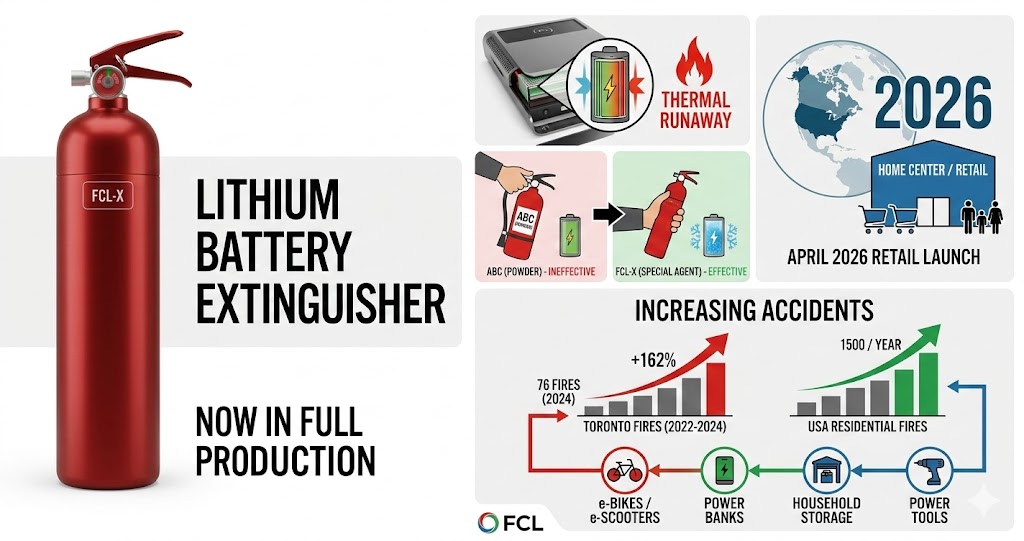
米国を拠点とするフルサークル・リチウム社(FCL)は2026年3月3日、独自開発のリチウム電池消火器「FCL-X」の製造工場がフル稼働に達したと発表しました。2026年4月より、北米の大手ホームセンターや専門店を通じて小売販売が開始される予定です。
主なトピックス
- フル生産体制: 急増する需要に対応するため、製造ラインを最大能力で運用。
- 販路拡大: 一般消費者向けの小売チャネルに加え、産業・商業分野への大型消火器の展開も強化。
- 統合施設: 製造だけでなく、実機燃焼テストや消防関係者向けの訓練を行う専用施設の開発も進行中。
背景情報:なぜ「専用」消火器が必要なのか?
リチウムイオン電池の火災は、一般的な火災とは異なる「熱暴走(Thermal Runaway)」という現象を伴うため、従来の対策では不十分とされています。
- 熱暴走の危険性: 電池内部で化学反応が連鎖的に発生し、数秒で1000度Cを超える高温に達します。
- 再燃リスク: 表面を消火しても内部の熱が残っている場合、再び発火する恐れがあります。
- 有毒ガスの発生: 燃焼時にフッ化水素などの有害物質を放出するため、迅速な抑制が不可欠です。
- 従来型(ABC消火器)の限界: 一般的な粉末消火器は酸素を遮断しますが、熱暴走中の電池は内部で酸素を生成し続けるため、効果が限定的です。
市場動向と安全上の課題
消費者製品の普及に伴い、リチウムイオン電池関連の火災事故は世界的に急増しています。
- 事故統計:
- カナダ・トロント市消防局:2024年の関連火災は76件(2022年比162%増)。
- 米国:住宅火災のうち年間約1500件がリチウムイオン電池に関連。
- 主な発火源:
- 電動自転車(e-bike)や電動キックボード。
- モバイルバッテリーやポータブル電源。
- 家庭用蓄電システムや電動工具。
Addressing the Surge in Battery Fires: Full Circle Lithium Ramps Up Production of Specialized Extinguishers
On March 3, 2026, U.S.-based Full Circle Lithium Corp. (FCL) announced that its manufacturing plant for the “FCL-X,” a proprietary lithium-ion battery fire extinguisher, has reached full production capacity. Retail sales are scheduled to begin in April 2026 through major home improvement centers and specialty stores across North America.
Key Highlights
- Full Production Status: Manufacturing lines are operating at maximum capacity to meet rapidly growing demand.
- Expanded Distribution: In addition to retail channels for general consumers, FCL is strengthening the rollout of large-scale extinguishers for industrial and commercial sectors.
- Integrated Facility: Development is underway for a specialized hub that combines manufacturing with live-fire testing and training programs for first responders.
Background: Why is a “Specialized” Extinguisher Necessary?
Lithium-ion battery fires involve a phenomenon known as “Thermal Runaway,” which differs from standard fires, making conventional countermeasures insufficient.
- Danger of Thermal Runaway: Chain-reaction chemical reactions occur inside the battery, reaching temperatures exceeding 1000 degrees C within seconds.
- Re-ignition Risk: Even if surface flames are extinguished, the battery can re-ignite if internal heat remains.
- Toxic Gas Emission: Combustion releases hazardous substances such as hydrogen fluoride, making rapid suppression essential.
- Limitations of Conventional (ABC) Extinguishers: Standard dry chemical extinguishers work by cutting off oxygen. However, their effectiveness is limited because batteries in thermal runaway continue to produce oxygen internally.
Market Trends and Safety Challenges
Fire incidents related to lithium-ion batteries are surging globally alongside the proliferation of consumer electronics.
- Accident Statistics:
- Toronto Fire Services (Canada): Reported 76 related fires in 2024 (a 162% increase compared to 2022).
- United States: Approximately 1,500 residential fires per year are linked to lithium-ion batteries.
- Primary Ignition Sources:
- E-bikes and electric scooters.
- Power banks and portable power stations.
- Home energy storage systems and electric power tools.
コメント