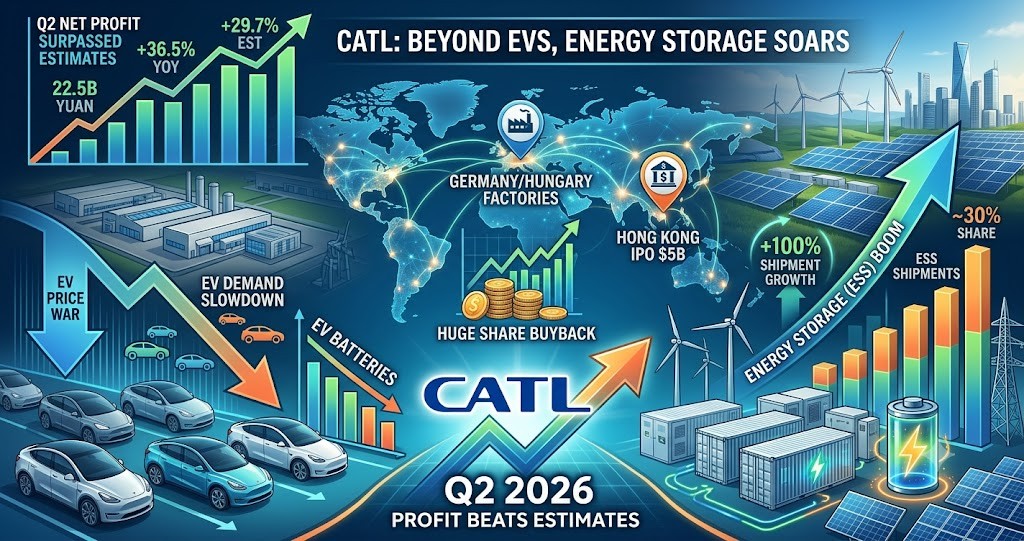
世界最大の電池メーカーである中国のCATL(寧徳時代新能源科技)は、2026年第2四半期の純利益が市場予想を上回る好決算を発表しました。本国中国での長期化するEV価格競争や世界的なEV需要の鈍化(いわゆる「EVキャズム」傾向)が車載用バッテリーの利益率を押し下げる中、同社の業績を力強く支えたのは電力網向けエネルギー貯蔵システム(ESS:Energy Storage System)事業の急成長です。
本稿では、同社の最新決算数値のポイントと、EV頼みからの脱却を図る成長戦略、さらに背景にあるグローバル市場の最新動向について解説します。
- 1. 第2四半期(2026年4〜6月期)決算のハイライト
- 2. 業績の明暗:減速するEV用と急伸する「エネルギー貯蔵(ESS)」
- 3. グローバル展開と資金調達の強化
- 4. 関連・補足情報(業界構造と今後の展望)
- 1. Highlights of Q2 2026 Financial Results
- 2. Divergent Performance: Slowing EV Battery vs. Rapidly Growing ESS
- 3. Acceleration of Global Expansion and Financing
- 4. Supplementary Information: Industry Structure & Outlook
1. 第2四半期(2026年4〜6月期)決算のハイライト
- 純利益:市場予想を上回る大幅増益
- 純利益: 225億元(約33億2,000万ドル) / 前年同期比 +36.5%増(アナリスト予想の+29.7%増を超過)。
- ただし、前年同期比の純利益成長率としてはここ1年余りで最低水準となり、成長の鈍化傾向も覗かせています。
- 売上高:増収も成長スピードは緩やかに
- 売上高: 1,478億元 / 前年同期比 +56.9%増(第1四半期の+52.5%増からは拡大するも、高成長基調の中で収益性の維持が課題に)。
- 大規模な株主還元策
- 決算発表と同時に、200億元〜400億元(約4,000億〜8,000億円規模)にのぼる大規模な自社株買い(A株)計画を公表。
2. 業績の明暗:減速するEV用と急伸する「エネルギー貯蔵(ESS)」
中国国内におけるEVメーカー同士の激烈な値下げ合戦がサプライヤーの単価と利益率を圧迫する中、CATLはポートフォリオのシフトを加速させています。
① EV用バッテリー事業(成熟化と価格競争の直撃)
- 市場シェア: 2026年1〜5月期の世界EVバッテリー市場シェアで40.2%を占め、圧倒的首位(SNE Research調べ)。テスラ、BMW、VWなど大手自動車メーカーへ供給を継続。
- 利益率の低下: 上半期の粗利益率は前年同期比で1.8ポイント低下し20.6%に縮小。価格競争と原材料価格の変動が圧迫因子。
② エネルギー貯蔵(ESS)事業(新たな成長ピラー)
- 出荷量とシェアの拡大: 第1四半期の出荷量は前年同期比でほぼ倍増。世界市場シェアも26.9%から29.9%へ拡大。
- 粗利益率: 上半期の粗利益率は前年同期(25.5%)から24.0%へやや低下したものの、依然としてEV用(20.6%)を上回る収益性を維持。再生可能エネルギー発電所や電力網(グリッド)向け需要を確実に取り込んでいます。
3. グローバル展開と資金調達の強化
地政学リスクや各国の保護主義政策(米国のIRA法や欧州の各種規制など)に対応するため、海外現地生産と資金調達の足固めを進めています。
- 欧州での現地生産拠点
- ドイツ工場(稼働中)およびハンガリーでの大型ギガファクトリー建設を推進。欧州自動車メーカーへの供給体制と域内生産要件をクリアする狙い。
- 香港市場への重複上場
- 2026年5月に香港証券取引所へ上場し、約50億ドル(約7,500億円)を調達。調達資金の大部分を欧州や東南アジア等の海外展開および海外サプライチェーンの構築に投入。
4. 関連・補足情報(業界構造と今後の展望)
決算の背景を理解するための業界トレンドを解説します。
① なぜ今「エネルギー貯蔵(ESS)」が急成長しているのか?
- 再生可能エネルギーの出力変動対策太陽光や風力発電の導入が進むにつれ、天候による発電量のブレを吸収・平準化する大型蓄電池(Grid-scale ESS)が世界中で不可欠になっています。
- AIデータセンターの電力需要急増生成AIの普及に伴い、データセンターの消費電力が爆発的に増加。停電対策(UPS)や電力ピークカット用の大容量蓄電池としてリチウムイオン電池の需要が急増しています。
② LFP(リン酸鉄リチウム)電池におけるCATLの強み
- コストと安全性の両立ESS用途では「エネルギー密度(重さあたりの容量)」よりも「低コスト・長寿命・高い安全性」が最優先されます。CATLが得意とするLFP電池は、コバルトやニッケルを使わないため安価で熱安定性が高く、ESSの標準技術となっています。
- 新技術の投入(神行バッテリー・天行バッテリーなど)超急速充電が可能なLFP「神行(Shenxing)バッテリー」や商用車・ESS向けの「天行」ブランドを投入し、他社に対する製品差別化とプレミアム価格の維持を図っています。
③ 競合環境とリスク要因
- 中国勢同士のESS価格競争BYD(比亜迪)やEVE Energy(億緯絶能)など他の中国勢も一斉にESS分野へ注力しており、EV用と同様にESS向けセルの価格下落(過剰設備問題)が今後の利益率リスクとして懸念されています。
- 米国市場への参入障壁米中対立背景による関税引き上げや関与規制(FEOC規制など)により、米国市場での直接販売には制約があります。フォード等との「技術ライセンス方式(CATLが技術提供し米国企業が工場所有)」など変則的なモデルでのアプローチを模索しています。
CATL Q2 2026 Earnings Analysis: A Growth Structure Driven by Surging ESS Business and Global Expansion
China’s CATL (Contemporary Amperex Technology Co., Limited), the world’s largest battery manufacturer, reported strong financial results for the second quarter of 2026, with net profit exceeding market expectations. While a prolonged EV price war in its home market of China and a global slowdown in EV demand growth (the so-called “EV chasm”) exerted downward pressure on EV battery margins, the company’s performance was powerfully buoyed by rapid growth in its grid-scale Energy Storage System (ESS) business.
This report outlines key takeaways from CATL’s latest financial figures, its growth strategy to reduce reliance on the EV market, and the broader global market trends behind these developments.
1. Highlights of Q2 2026 Financial Results
- Net Profit: Strong Growth Beating Market Expectations
- Net Profit: 22.5 billion yuan (~$3.32 billion) / +36.5% YoY (surpassing the analyst estimate of +29.7%).
- However, this represents the slowest rate of quarterly net profit growth in over a year, signaling a gradual deceleration in expansion.
- Revenue: Solid Growth, but Moderating Pace
- Revenue: 147.8 billion yuan / +56.9% YoY (expanding from +52.5% in Q1, though maintaining profitability amid high revenue growth remains a key task).
- Massive Capital Return to Shareholders
- Concurrent with the earnings release, CATL announced a plan to repurchase between 20 billion and 40 billion yuan (~$2.8 billion to $5.5 billion equivalent) worth of its own A-shares.
2. Divergent Performance: Slowing EV Battery vs. Rapidly Growing ESS
With fierce price wars among domestic EV makers pressuring supplier unit prices and profit margins, CATL is accelerating a portfolio pivot.
① EV Battery Business (Hit by Maturity and Price Competition)
- Market Share: Retained an overwhelming lead with a 40.2% global EV battery market share from January to May 2026 (per SNE Research), maintaining supplies to major automakers including Tesla, BMW, and Volkswagen.
- Margin Compression: Gross margin for the first half contracted by 1.8 percentage points YoY to 20.6%, squeezed by price competition and raw material price fluctuations.
② Energy Storage System (ESS) Business (A New Growth Pillar)
- Shipments and Share Expansion: First-quarter shipment volume nearly doubled YoY, expanding its global market share from 26.9% to 29.9%.
- Gross Margin: Although H1 gross margin slightly declined from the previous year’s 25.5% to 24.0%, it remains higher than the EV segment (20.6%), effectively capturing rising demand from renewable power plants and power grids.
3. Acceleration of Global Expansion and Financing
To navigate geopolitical risks and localized protectionist policies (such as the U.S. IRA and European regulations), CATL is solidifying its overseas production footprint and financing capabilities.
- European Production Hubs
- Operating its plant in Germany while advancing construction on a large-scale gigafactory in Hungary to secure supply channels for European OEMs and satisfy local production requirements.
- Dual-Listing in Hong Kong
- Completed a secondary listing on the Hong Kong Stock Exchange in May 2026, raising approximately $5 billion. The bulk of these proceeds is designated for overseas expansion and establishing supply chains in Europe and Southeast Asia.
4. Supplementary Information: Industry Structure & Outlook
① Drivers Behind the Rapid Growth of Energy Storage (ESS)
- Mitigating Renewable Energy VolatilityAs solar and wind generation expand globally, grid-scale ESS has become essential to absorb and balance weather-dependent output fluctuations.
- Surging Power Demand from AI Data CentersThe proliferation of generative AI is driving exponential growth in data center electricity consumption. This has spurred demand for high-capacity lithium-ion batteries used in peak shaving and emergency uninterruptible power supply (UPS) systems.
② CATL’s Competitive Edge in LFP (Lithium Iron Phosphate) Batteries
- Balancing Cost and SafetyESS applications prioritize low cost, long cycle life, and high safety over gravimetric energy density. LFP chemistry—which eliminates nickel and cobalt—is inherently safer and cheaper, making it the industry standard for ESS. CATL holds a commanding position in this segment.
- Deployment of Next-Gen Products (Shenxing & Tianxing)By rolling out ultra-fast charging LFP “Shenxing” batteries and the “Tianxing” brand for commercial vehicles and ESS, CATL aims to differentiate its offerings and defend premium pricing.
③ Competitive Landscape and Key Risks
- Intensifying ESS Price Wars Among Chinese PeersRivals like BYD and EVE Energy are aggressively increasing their focus on ESS. As a result, cell price declines caused by overcapacity—similar to trends seen in the EV market—present an ongoing margin risk.
- Barriers to the U.S. MarketHigher tariffs and regulatory constraints (such as FEOC rules) under ongoing U.S.-China tensions limit direct cell sales to the United States. In response, CATL is pursuing non-traditional entry models, such as technology licensing arrangements with partners like Ford (where CATL licenses its IP while the host company owns the facility).
コメント