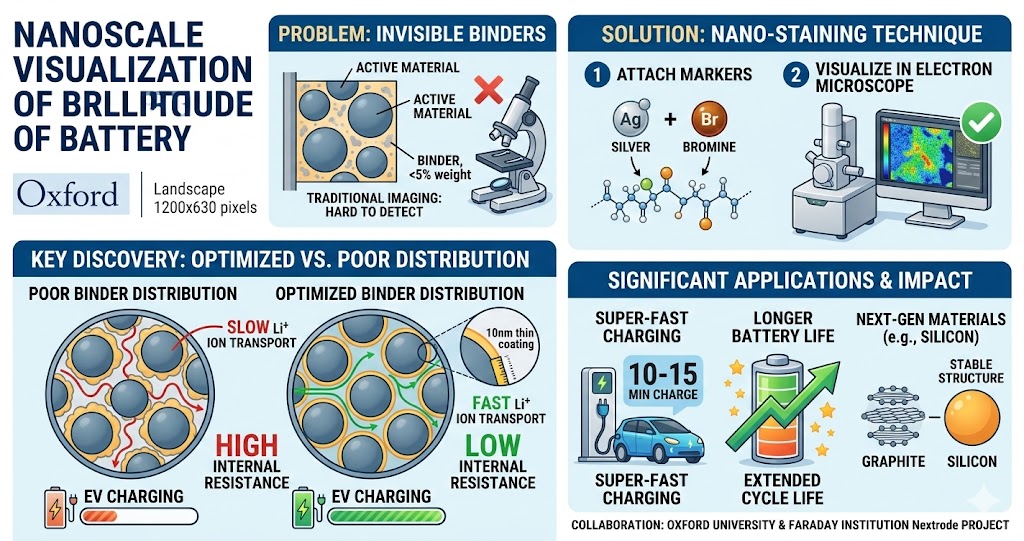
2026年2月、オックスフォード大学の研究チームは、リチウムイオン電池の電極内で材料を固定する「ポリマーバインダー」の分布をナノスケールで特定する新技術を発表しました。この発見により、電池の内部抵抗を大幅に低減し、急速充電と長寿命化を同時に実現できる可能性があります。
技術の核心:特許出願中の「ナノ染色法」
- 課題: バインダーは電極重量の5%未満と極微量で、従来の手法ではどこにどう分布しているか観察困難でした。
- 解決策: バインダーに「銀」や「臭素」のマーカーを付着させる染色技術を開発。これにより、電子顕微鏡下でバインダーの位置を詳細なマップとして可視化することに成功しました。
- 発見: わずか10nm(ナノメートル)という極薄のコーティング層が、製造過程で不均一に分解される様子を捉えました。
補足:なぜ「バインダー」の可視化が重要なのか?
電池の性能向上といえば活物質(リチウムなど)に注目が集まりがちですが、バインダー(接着剤)は電池の「血管」と「骨格」を支える重要な役割を担っています。
1. 内部抵抗の低減(最大40%カット)
バインダーが理想的に分布すると、リチウムイオンの移動路がスムーズになります。研究では、製造時の混合・乾燥工程を微調整するだけで、内部抵抗を最大40%低減できることが証明されました。これは、スマホやEVの充電時間を劇的に短縮する鍵となります。
2. 次世代材料(シリコン負極)への応用
現在主流のグラファイト(黒鉛)だけでなく、次世代材料として期待されるシリコン(Si)負極にもこの技術は有効です。シリコンは充放電時の膨張・収縮が激しいため、バインダーの配置を最適化して構造を維持することが実用化の必須条件となっています。
業界へのインパクトと今後の展望
この研究は、英国の電池研究機関であるファラデー研究所(Faraday Institution)の「Nextrode」プロジェクトの一環として行われ、すでに自動車メーカーや電池メーカーから高い関心を集めています。
期待される効果
- EV(電気自動車): 10分から15分程度の超急速充電でも劣化しにくい電池の開発。
- 製造コストの削減: 試行錯誤に頼っていた電極製造工程を、可視化データに基づいて理論的に最適化できるようになります。
- 製品寿命の延長: 電極の微細な崩壊を防ぐことで、数年後の電池容量低下を抑制します。
まとめ表
| 項目 | 詳細 |
| 研究機関 | オックスフォード大学 材料学科 |
| 主要技術 | マーカー(銀・臭素)を用いたEsBイメージング可視化 |
| 主な成果 | 内部抵抗を最大40%低減、ナノスケール(10nm)での分布把握 |
| 対象材料 | グラファイト、シリコン、SiOx(次世代負極材) |
| メリット | 急速充電の実現、電池寿命の延長、製造工程の最適化 |
| 支援組織 | ファラデー研究所 Nextrodeプロジェクト |
この技術は、既存の生産ラインに「染色」というステップを加える、あるいは製造パラメータを調整するための分析ツールとして、早期の産業応用が期待されています。
出典:https://www.sciencedaily.com/releases/2026/02/260220010830.htm
University of Oxford Identifies Binder Distribution in Lithium-ion Batteries Using Patent-Pending Marker Technology
In February 2026, a research team from the University of Oxford announced a breakthrough technology to identify the nanoscale distribution of “polymer binders” that hold materials together within lithium-ion battery electrodes. This discovery has the potential to significantly reduce internal resistance, enabling both ultra-fast charging and longer battery life.
Core Technology: Patent-Pending “Nano-Staining” Method
- The Challenge: Binders account for less than 5% of the electrode weight. Because of this minute quantity, it was previously difficult to observe exactly how and where they were distributed using conventional methods.
- The Solution: The team developed a staining technique that attaches “silver” and “bromine” markers to the binders. This allows for the successful visualization of binder locations as detailed maps under an electron microscope.
- The Discovery: Researchers captured how ultra-thin coating layers—as thin as 10nm (nanometers)—can break down into non-uniform fragments during the manufacturing process.
Note: Why is Binder Visualization Important?
While improvements in battery performance often focus on active materials (like lithium), the binder (the “glue”) plays a crucial role in supporting the battery’s “veins” and “skeleton.”
1. Reducing Internal Resistance (Up to 40% Cut)
When binders are distributed ideally, the pathways for lithium ions become smoother. The study proved that by fine-tuning the mixing and drying processes during manufacturing, internal ionic resistance can be reduced by up to 40%. This is key to drastically shortening charging times for smartphones and EVs.
2. Application to Next-Generation Materials (Silicon Anodes)
This technology is effective not only for current graphite anodes but also for silicon (Si) anodes, which are expected to be the next-generation material. Since silicon expands and contracts significantly during charge-discharge cycles, optimizing binder placement to maintain structural integrity is a prerequisite for its practical use.
Industry Impact and Future Outlook
Conducted as part of the “Nextrode” project by the Faraday Institution (the UK’s independent institute for electrochemical energy storage science), this research has already garnered significant interest from automotive and battery manufacturers.
Expected Benefits
- EVs (Electric Vehicles): Development of batteries that resist degradation even with ultra-fast charging of 10 to 15 minutes.
- Manufacturing Cost Reduction: Electrode manufacturing processes, which previously relied on trial and error, can now be theoretically optimized based on visualization data.
- Extended Product Lifespan: By preventing microscopic collapse of the electrodes, the drop in battery capacity over several years can be suppressed.
Summary Table
| Item | Details |
| Research Institution | University of Oxford, Department of Materials |
| Core Technology | EsB imaging visualization using markers (Silver, Bromine) |
| Key Achievements | Up to 40% reduction in internal resistance; Nanoscale (10nm) distribution mapping |
| Target Materials | Graphite, Silicon, SiOx (Next-generation anode materials) |
| Benefits | Faster charging, extended battery life, optimized manufacturing |
| Supporting Organization | The Faraday Institution, Nextrode Project |
This technology is expected to see early industrial application, either by adding a “staining” step to existing production lines or by serving as an analytical tool to calibrate manufacturing parameters.

コメント