クリーンエネルギーへの移行において、バッテリー(電池セル)は21世紀の国家安全保障と経済成長を左右する戦略物資となっています。米国の著名なシンクタンク「カーネギー国際平和財団」が発表した新たな報告書は、2030年までに中国の電池生産能力が世界全体の需要を大きく上回るという極めて衝撃的な予測を示しました。
安価な中国製電池の「供給過剰」は、欧米諸国が推進する自国サプライチェーンの構築(脱中国化)に冷や水を浴びせる可能性を秘めています。この予測データの詳細と、欧米諸国が直面する課題、そして同財団が提唱する現実的な処方箋について解説します。
1. 2030年の予測データ:中国の圧倒的な「供給過剰」
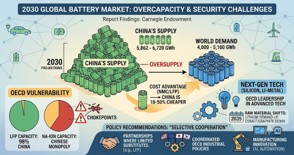
報告書によると、2030年時点における世界の電池セル市場は、中国の生産能力が世界の総需要を凌駕する見込みです。
需給予測の比較(2030年時点)
- 世界の総需要予測: 4,000 GWh ~ 5,100 GWh
- 中国の生産能力予測:5,862 GWh ~ 6,720 GWh
- 関連情報:中国単体の生産能力だけで、世界中の電気自動車(EV)や蓄電池の需要を完全に満たし、さらに余りが出る計算になります。
- OECD加盟国の生産能力予測: 約 1,881 GWh(最大で2,422 GWh)
- 新興市場(インド・インドネシア等)の生産能力予測: 約 217 GWh
中国の圧倒的なコスト優位性(欧州市場での比較)
中国の競争力を支えているのは、他国が追随できない圧倒的な製造コストの低さです。2025年には中国の電池輸出額は月間60億ドルを超え、その約半分が欧州市場へ向かうとされています。
- NMC(ニッケル・マンガン・コバルト)電池: 欧州の現地生産品より 10〜27%安い
- LFP(リン酸鉄リチウム)電池: 欧州の現地生産品より 24〜50%安い
2. 欧米経済が抱えるサプライチェーンの「脆弱性」
報告書は、特定の電池技術と原材料において、中国への依存が致命的なリスク(チョークポイント)になっていると警告しています。
- LFP(リン酸鉄リチウム)電池への極端な集中 EVや定置型蓄電池(BESS)の普及に伴い、現在世界のリチウムイオン電池市場の約半分をLFP電池が占めています。しかし、世界のLFP生産能力の約98%が中国に集中しており、欧米にとって最大の脆弱性となっています。
- ナトリウムイオン電池という新たな影 ポスト・リチウムとして期待され、安価な塩などを原料とする「ナトリウムイオン電池」についても、商業規模での製造は現在ほぼ完全に中国に集中しており、LFPと同様の依存ルートをたどるリスクがあります。
- 次世代技術における欧米の優位性 一方で、さらに先を見据えた「シリコン負極電池」や「リチウム金属電池」などの次世代技術においては、OECD諸国が比較的強い立場(優位性)を維持しています。
【技術革新による原材料需要の変化(2035年予測)】 ナトリウムイオン電池やリチウム金属電池の普及が進むと、2035年までに欧州では資源リスクの高い黒鉛(グラファイト)需要が約25.6%減少、コバルト需要が約8.7%減少する一方、リチウム需要は約5.4%増加すると試算されています。
3. カーネギー財団による政策提言:「選択的協力」への転換
従来の「完全なデカップリング(分断)」や「中国の排除」は現実的ではなく、かえって欧米のエネルギー移行を遅らせると報告書は指摘します。そのため、以下のような戦略的なアプローチを推奨しています。
- 完全な分離ではなく「選択的な協力」 代替サプライヤーが極めて限られている分野(LFPなど)においては、中国企業との合弁事業(JV)や産業パートナーシップを容認し、実利をとるべきである。
- 日米欧韓の産業政策の協調 米国、欧州、日本、韓国がバラバラに動くのではなく、中国の独占に対抗するために協調した産業政策を実施する。
- 次世代分野への集中支援 中国以外のナトリウムイオン電池製造業者への支援を強化し、中国が独占する前にサプライチェーンを多様化させる。
- 最先端テクノロジーによる製造イノベーション 製造効率やコストで中国に対抗するため、工場への自動化、デジタルツイン(仮想試作)、人工知能(AI)の導入を拡大し、生産性を飛躍的に高める。
Is “Complete Exclusion” Impossible? US Think Tank Recommends “Selective Cooperation” with Chinese Battery Companies
In the transition to clean energy, battery cells have become a strategic commodity that shapes 21st-century national security and economic growth. A new report published by the Carnegie Endowment for International Peace, a prominent US think tank, presented a shocking forecast: China’s battery production capacity could significantly outstrip total global demand by 2030.
This potential “oversupply” of cheap, Chinese-made batteries threatens to throw cold water on the efforts of Western nations to build localized supply chains (de-Chinafication). This article breaks down the details of these forecast data, the challenges facing Western economies, and the realistic remedies proposed by the foundation.
1. 2030 Forecast Data: China’s Overwhelming “Oversupply”
According to the report, China’s production capacity is projected to outpace total global demand in the global battery cell market by 2030.
Global Supply and Demand Forecast Comparison (As of 2030)
- Global Total Demand Forecast: 4,000 GWh to 5,100 GWh
- China’s Production Capacity Forecast:5,862 GWh to 6,720 GWh
- Related Information: China’s production capacity alone will be more than enough to fully satisfy the worldwide demand for electric vehicles (EVs) and energy storage systems, leaving a substantial surplus.
- OECD Member Countries’ Production Capacity Forecast: Approx. 1,881 GWh (potentially up to 2,422 GWh)
- Emerging Markets’ Forecast (India, Indonesia, etc.): Approx. 217 GWh
China’s Overwhelming Cost Advantage (Comparison in the European Market) China’s competitiveness continues to be underpinned by an overwhelming advantage in manufacturing costs that other nations cannot match. In 2025, China’s monthly battery exports are expected to exceed $6 billion, with nearly half destined for the European market.
- NMC (Nickel Manganese Cobalt) Batteries: 10% to 27% cheaper than European locally produced counterparts.
- LFP (Lithium Iron Phosphate) Batteries: 24% to 50% cheaper than European locally produced counterparts.
2. Supply Chain “Vulnerabilities” Facing Western Economies
The report warns that reliance on China for specific battery technologies and raw materials has become a critical vulnerability (choke point).
- Extreme Concentration in LFP (Lithium Iron Phosphate) Batteries With the widespread adoption of EVs and Battery Energy Storage Systems (BESS), LFP batteries now account for about half of the global lithium-ion battery market. However, an estimated 98% of the world’s LFP production capacity is concentrated in China, marking it as the greatest vulnerability for the West.
- The Emerging Shadow of Sodium-Ion Batteries Sodium-ion batteries, which rely on cheap raw materials like salt and are highly anticipated as a post-lithium alternative, also face commercial-scale manufacturing that is currently concentrated almost entirely in China. This poses a risk of following the same dependency path as LFP batteries.
- Western Edge in Next-Generation Technologies On the other hand, looking further ahead, OECD countries maintain a stronger position (advantage) in next-generation technologies, such as silicon-anode and lithium-metal batteries.
【Shift in Raw Material Demand Driven by Technological Innovation (2035 Forecast)】 If the adoption of sodium-ion and lithium-metal batteries accelerates, it is estimated that by 2035, Europe’s demand for high-resource-risk graphite will decrease by approximately 25.6% and cobalt by about 8.7%, while lithium demand could increase by roughly 5.4%.
3. Policy Recommendations by the Carnegie Endowment: Shifting to “Selective Cooperation”
The report points out that conventional ideas of “complete decoupling” or “total exclusion of China” are unrealistic and would instead delay the West’s energy transition. Therefore, it recommends the following strategic approaches:
- “Selective Cooperation” Over Complete Decoupling In sectors where alternative suppliers are extremely limited (such as LFP), Western nations should pursue practical benefits by permitting joint ventures (JVs) and industrial partnerships with Chinese firms.
- Coordinated Industrial Policies Among the US, Europe, Japan, and South Korea Rather than acting independently, the United States, Europe, Japan, and South Korea must implement coordinated industrial policies to counter China’s monopoly.
- Targeted Support for Next-Generation Sectors Governments should strengthen support for non-Chinese sodium-ion battery manufacturers to diversify the supply chain before China establishes a monopoly.
- Manufacturing Innovation Through Cutting-Edge Technology To compete with China on manufacturing efficiency and cost, Western nations must expand the use of automation, digital twins, and artificial intelligence (AI) in factories to drastically boost productivity.
コメント