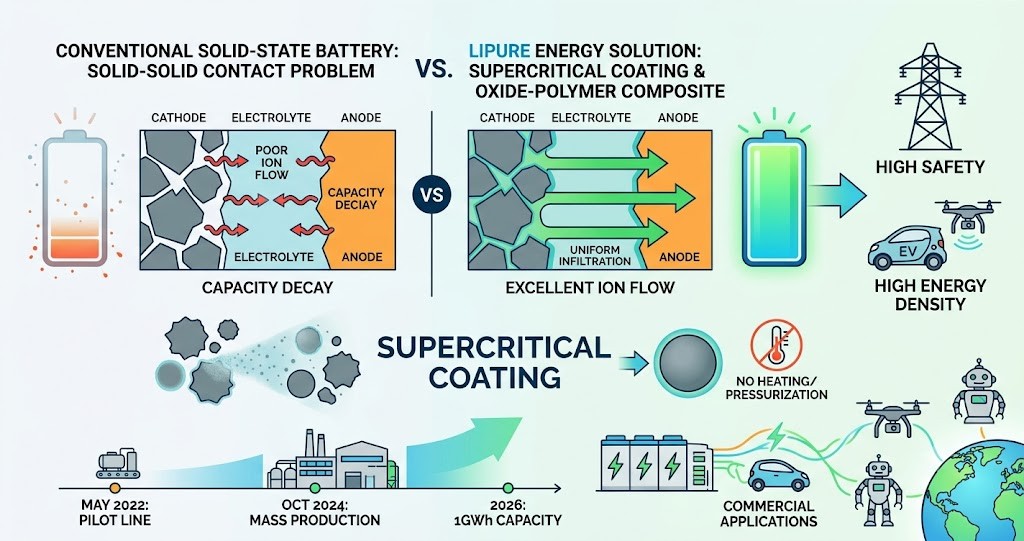
次世代の革新的な蓄電技術として世界中で開発競争が激化している「全固体電池」。従来の液式リチウムイオン電池に比べ、高い安全性とエネルギー密度を誇る一方で、材料同士が固体のまま接するため電気の流れ(イオン伝導)が悪くなる「固固接触」の課題が量産化の大きな壁となっていました。 本稿では、この課題を独自の「超臨界コーティング」技術で克服し、蓄電・モビリティ市場での商用化を加速させる中国の新興企業「純鋰新能源(Lipure Energy)」の最新動向と、関連する技術背景についてまとめています。
1. 純鋰新能源(Lipure Energy)の概要と資金調達
中国の全固体電池開発スタートアップである「純鋰新能源」は、2022年5月に設立されました。同社はプレシリーズAの追加ラウンドにおいて、北京亦荘国際投資発展(E-Town Capital)から数千万元(数億円規模)の資金調達を実施しました。 この資金は、製品開発や市場開拓、そして生産ラインの建設(蘭考県での1GWhクラスの増設など)に投入される予定です。
2. 「固固接触」を解決するキーテクノロジー
全固体電池は、電解質が固体であるため液漏れによる発火リスクがなく安全性が高い反面、電極と電解質の間に隙間ができやすく、容量が低下しやすいという弱点がありました。純鋰新能源はこの問題を以下の2つのアプローチで解決しています。
- 有機・無機複合固体電解質: イオン伝導率の高い「酸化物材料」と、柔軟性・加工性に優れコストの低い「三元共重合ポリマー材料」を独自開発して結合させました。
- 超臨界コーティング: 材料を気体と液体の両方の性質を持つ「超臨界状態」にすることで、微細な粒子材料の隙間まで均等に浸透させます。これにより、液体電解質のような高い浸潤効果を固体でありながら実現しました。
- 実用上の優位性(加熱・加圧不要): 他社の全固体電池の多くは作動時に高温への加熱や高い圧力をかける仕組みを必要としますが、同社の技術で開発された電池は日常の環境でそのまま使用できるため、商業化へのハードルを大幅に下げています。
3. 製品スペックと生産体制のロードマップ
同社はすでに小規模パイロットラインから量産フェーズへと移行しています。
- 第1世代製品の仕様(リン酸鉄リチウム正極×グラファイト負極):
- 容量:50Ah
- エネルギー密度:200Wh/kg以上
- サイクル寿命:6000回から8000回
- 充放電レート:1C(1時間で満充放電可能)
- 安全認証:中国の国家認可委員会(CNAS)による安全認証(CNAS GB/T36276-2018)を取得済み。
- 生産拠点の現状:
- 河南省蘭考県にて、現在500MWhの量産ラインが稼働中。
- さらに1GWhクラスの生産ラインを建設中で、2026年内の操業開始を予定。2026年は売上高1億元(約23億円)の突破を目指しています。
4. ターゲット市場と商用化への戦略
業界の予測(中国固体電池産業発展白書2025年)では、全固体電池の本格的な大規模出荷は2030年頃とされていますが、純鋰新能源は用途を絞ることで早期の市場参入を果たしています。
- 蓄電システム(最優先市場):
- 火災リスクが極めて低い全固体電池は、大型の蓄電所で大きな強みとなります。また長寿命(6000回以上のサイクル)であるため、長期間運用した際のトータルコスト(ライフサイクルコスト)を低減できます。すでに国家電力投資集団(SPIC)や国家電網(State Grid)などの大手国有エネルギー企業と共同プロジェクトを展開しています。
- 低速・中速モビリティ:
- 電動二輪車の電池交換実証プロジェクト(車両1000台規模)を2025年に実施。従来の液式電池で30kmから50kmだった航続距離を最大100kmまで伸ばすことに成功しました。現在、電動バイク向け製品の市場投入を進めています。
- 今後の展望(高速モビリティ・その他):
- 自動車(乗用車・商用車)のトップメーカーと駆動用全固体電池の共同開発を進めているほか、今後はさらにエネルギー密度を高めた製品を開発し、ドローン、ロボット、ポータブル電源などへの展開を目指しています。
【関連情報の補足】 一般的に全固体電池といえば、トヨタ自動車などが電気自動車(EV)向けに本命視している「硫化物系」が有名ですが、硫化物系は水と反応すると有害な硫化水素を発生するリスクや、製造コストが非常に高いという課題があります。 これに対し、今回純鋰新能源が採用している「酸化物+ポリマー(高分子)」の複合系は、エネルギー密度の限界値こそ硫化物系に劣るものの、製造が比較的容易で安全性が高く、コストを抑えやすい特徴があります。そのため、莫大な電池容量を必要とする「EV市場」をあえて後回しにし、コストと安全性のバランスが重視される「定置型蓄電システム」や「二輪車市場」から着実に普及させるという同社の戦略は、極めて現実的でスピーディーな商用化ルートであると言えます。
Fusion of Oxides and Polymers: A New Type of All-Solid-State Battery Achieving Liquid-Like Infiltration Through Supercritical Technology
Introduction: “All-solid-state batteries” are center stage in an intensifying global development race as the next-generation revolutionary energy storage technology. While they boast higher safety and energy density compared to conventional liquid lithium-ion batteries, the challenge of “solid-solid contact”—where electricity flow (ionic conduction) degrades because materials meet as solids—has stood as a major barrier to mass production. This article summarizes the latest trends and technical background of Lipure Energy, a Chinese startup that has overcome this challenge with its proprietary “supercritical coating” technology to accelerate commercialization in the energy storage and mobility markets.
1. Lipure Energy Overview and Funding
Lipure Energy, a Chinese all-solid-state battery development startup, was established in May 2022. In an extension of its Pre-Series A funding round, the company raised tens of millions of yuan (amounting to several hundred million yen) from Beijing Yizhuang International Investment & Development (E-Town Capital). These funds will be allocated toward product development, market expansion, and the construction of production lines, including a 1GWh-class expansion in Lankao County.
2. Key Technologies Solving “Solid-Solid Contact”
Because all-solid-state batteries use a solid electrolyte, they eliminate the risk of fire from liquid leakage and offer high safety. On the other hand, they have a vulnerability where gaps easily form between the electrodes and the electrolyte, leading to capacity degradation. Lipure Energy addresses this issue through the following two approaches:
- Organic-Inorganic Composite Solid Electrolyte: The company independently developed and combined an “oxide material” featuring high ionic conductivity with a “terpolymer material” that offers excellent flexibility, processability, and low cost.
- Supercritical Coating: By bringing materials into a “supercritical state”—possessing properties of both gas and liquid—the electrolyte penetrates evenly into the microscopic gaps between particle materials. This achieves a high infiltration effect equivalent to a liquid electrolyte, despite being entirely solid.
- Practical Advantage (No Heating or Pressurization Required): While many all-solid-state batteries developed by other companies require mechanisms to apply high temperatures or high pressure during operation, the batteries developed with Lipure Energy’s technology can be used as-is in everyday environments. This significantly lowers the hurdle for commercialization.
3. Product Specifications and Production Roadmap
The company has already transitioned from a small-scale pilot line to the mass-production phase.
- First-Generation Product Specifications (Lithium Iron Phosphate Cathode x Graphite Anode):
- Capacity: 50Ah
- Energy Density: 200Wh/kg or more
- Cycle Life: 6000 to 8000 cycles
- Charge/Discharge Rate: 1C (Capable of full charge/discharge in 1 hour)
- Safety Certification: Already obtained safety certification (CNAS GB/T36276-2018) from an agency accredited by the China National Accreditation Service for Conformity Assessment (CNAS).
- Current Status of Production Bases:
- A 500MWh mass-production line is currently operational in Lankao County, Henan Province.
- A 1GWh-class production line is under construction, with operations scheduled to begin within 2026. For 2026, the company aims to surpass sales of 100 million yuan (approximately 2.3 billion yen).
4. Target Markets and Commercialization Strategy
Industry forecasts (China Solid-State Battery Industry Development White Paper 2025) predict that full-scale, large-scale shipments of all-solid-state batteries will shift into place around 2030. However, Lipure Energy is achieving early market entry by narrowing its initial applications.
- Energy Storage Systems (Highest Priority Market): All-solid-state batteries, with their extremely low fire risk, offer a powerful advantage for large-scale energy storage stations. Furthermore, due to their long cycle life (over 6000 cycles), they reduce total long-term operational costs (lifecycle costs). The company has already launched joint projects with major state-owned energy enterprises, such as State Power Investment Corporation (SPIC), State Grid, and Beijing Energy Holding.
- Low- and Medium-Speed Mobility: In 2025, the company conducted a battery-swapping demonstration project for electric two-wheelers involving 1000 vehicles. It successfully extended the cruising range up to 100km, compared to the 30km to 50km offered by conventional liquid batteries. The company is currently rolling out products designed for electric motorcycles into the market.
- Future Outlook (High-Speed Mobility & Others): Along with developing driving-use all-solid-state batteries in partnership with top automotive manufacturers (for both passenger and commercial vehicles), the company plans to develop products with higher energy densities to expand into consumer drones, robotics, and portable power supplies.
Supplementary Context: Generally speaking, when it comes to all-solid-state batteries, the “sulfide-type” backed heavily by companies like Toyota Motor for electric vehicles (EVs) is well known. However, sulfide-type batteries carry the risk of generating toxic hydrogen sulfide gas if they react with water, and their manufacturing costs are exceptionally high. In contrast, the “oxide + polymer (macromolecule)” composite system adopted by Lipure Energy falls short of the sulfide-type in terms of maximum energy density limits, but it features relatively easy manufacturing, high safety, and low cost. Therefore, Lipure Energy’s strategy—intentionally putting the massive EV market on the back burner to steadily penetrate the stationary energy storage and two-wheeler markets where the balance of cost and safety is paramount—can be viewed as a highly pragmatic and speedy route to commercialization.
コメント