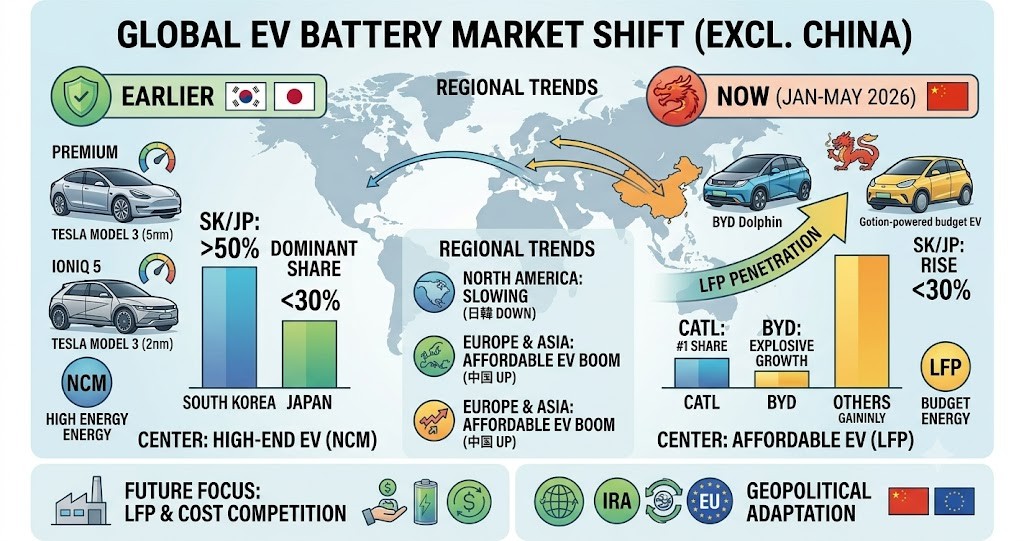
世界の電気自動車(EV)市場が中低価格帯モデルへ移行するなか、車載電池の勢力図が激変しています。これまで韓国・日本メーカーが優位性を保ってきた「中国を除くグローバル市場(非中国市場)」において、中国メーカーが価格競争力に優れたリン酸鉄リチウム(LFP)電池を武器に急速にシェアを拡大。2026年1~5月の最新データでは、市場全体が前年比2割超の成長を維持したものの、韓国主要3社の合算シェアが初めて30%を割り込むなど、既存サプライチェーンを揺るがす構造転換が本格化しています。
- 1. 市場の全体動向と背景にある地域格差
- 2. メーカー別の業績と要因分析
- 3. 今後の展望と競争の焦点
- Headwinds for NCM Chemistry: Portfolio Challenges Exposed for Japanese and South Korean Battery Makers in the Non-China Market
1. 市場の全体動向と背景にある地域格差
2026年1~5月に中国を除くグローバル市場で販売されたEV、PHEV、HEVの総電池使用量は、前年同期比21.8%増の209.1GWhに達しました。
市場は堅調な二桁成長を維持していますが、その中身には顕著な地域分断(地域デカップリング)が起きています。
- 北米市場の失速: 主要顧客である完成車メーカーの需要調整や、EV販売の減速(米国市場での一時的な販売落ち込みなど)が響き、北米依存度の高かった日韓の主要電池メーカーに直撃しました。
- 欧州およびアジア(非中国)の牽引: 一方で欧州や新興アジア地域は、新たな普及型EVモデルの投入や規制対応により成長軸がシフトしており、この成長の波を中国メーカーが捉える形となっています。
2. メーカー別の業績と要因分析
中国勢:圧倒的な成長とLFPによる市場侵食
- CATL(1位 / シェア 33.7%): 使用量は前年同期比37%増の70.6GWh。トヨタ、キア、テスラなどのグローバルOEMへの供給拡大に加え、欧州・アジア市場での採用が進み、首位の座を不動のものにしています。
- BYD(3位 / シェア 10.6%): 使用量が68.3%急増の22.2GWh。中国内需から脱却し、自社EVの海外輸出を本格化させるとともに、KGモビリティなど外部顧客へのLFP供給を増やしたことが大躍進の原動力です。
- 後発中国勢の猛追: Gotion(前年比128.8%増)、Svolt(同97%増)、CALB(同77.5%増)などが爆発的な成長を記録。欧州やアジアの普及型EVシフトの恩恵をダイレクトに受けています。
韓国勢:三元系(NCM)中心のポートフォリオに逆風
韓国3社の合算シェアは前年同期の37.1%から28.4%へ急落(8.7ポイント低下)しました。中低価格モデルが市場の主役に躍り出るなか、高性能だが高価な三元系(NCM)を主力とする戦略が足かせとなっています。
- LG Energy Solution(2位 / シェア 16.7%): テスラやGM、フォルクスワーゲン、キアの新型車(EV4など)への供給で微増(1%増の35GWh)を維持したものの、市場平均を大きく下回りシェアを落としました。
- SK On(4位 / シェア 7.6%): 現代自動車グループのアイオニック5の堅調な販売や新型アイオニック9の効果はあったものの、主要顧客であるフォード(F-150ライトニングの生産調整など)やフォルクスワーゲンの減速が響き、5.7%減(15.8GWh)のマイナス成長となりました。
- Samsung SDI(シェア 4.1%): BMWやアウディの新モデル向け供給はあったものの、北米市場への依存度が高いリビアンの販売不振が直撃し、29.7%急減(8.7GWh)と最も大きな打撃を受けました。
日本勢:テスラ動向に左右される構造
- パナソニック(5位 / シェア 7.2%): 使用量は8.5%減の15.1GWh。主軸であるテスラ(Model Yの成長に対し、Model 3/S/Xの需要変化)の北米市場における需要調整の影響を強く受け、足踏みが続いています。
3. 今後の展望と競争の焦点
非中国市場はもはや日韓メーカーの安全地帯ではなく、海外進出を本格化させた中国勢との「直接対決の主戦場」へと変貌しました。
今後の市場順位を左右するポイントは以下の3点に集約されます。
- 製品ポートフォリオの多様化: 韓国・日本勢が、高価格帯向けの三元系だけでなく、低価格帯向けのLFP電池や、コバルトフリーなどの次世代低コスト電池をいかに早く市場投入できるか。
- 顧客ポートフォリオの分散: 特定のOEM(テスラやリビアン、フォードなど)の販売動向に左右されないよう、供給先をグローバルに多様化できるか。
- 地政学的リスクへの対応: 米国のIRA(インフレ抑制法)や欧州の各種規制を回避するため、中国メーカーが展開する海外現地生産(欧州やモロッコ、東南アジア等への進出)に対し、日韓メーカーが現地サプライチェーンの強みをどう維持・発揮できるかが問われています。
出典:https://finance.biggo.jp/news/f104f551-46f0-4b0c-a4e0-4a13e126f646
Headwinds for NCM Chemistry: Portfolio Challenges Exposed for Japanese and South Korean Battery Makers in the Non-China Market
As the global electric vehicle (EV) market shifts toward low-to-mid-priced models, the competitive landscape for automotive batteries is undergoing a massive shake-up. In the global market excluding China (the non-China market)—where South Korean and Japanese manufacturers have historically held a dominant edge—Chinese manufacturers are rapidly expanding their market share, leveraging highly cost-competitive lithium iron phosphate (LFP) batteries. According to the latest data from January to May 2026, while the overall market maintained a strong growth rate of over 20% year-on-year, the combined market share of the top three South Korean makers fell below 30% for the first time. This marks the onset of a full-scale structural transformation that is rattling established supply chains.
1. Overall Market Trends and Underlying Regional Disparities
From January to May 2026, the total battery usage in EVs, PHEVs, and HEVs sold in the non-China global market reached 209.1 GWh, up 21.8% year-on-year. While the market continues to post solid double-digit growth, a sharp regional decoupling is taking place beneath the surface.
- Slowing North American Market: Demand adjustments by major automakers and a broader slowdown in EV sales (including temporary drops in the US market) have dealt a direct blow to major Japanese and South Korean battery manufacturers that are heavily reliant on North America.
- Europe and Non-China Asia Driving Growth: Conversely, the growth axis in Europe and emerging Asian markets is shifting due to the introduction of new mass-market EV models and regulatory compliance. Chinese manufacturers are successfully riding this growth wave.
2. Performance and Factor Analysis by Manufacturer
Chinese Players: Overwhelming Growth and Market Infiltration via LFP
- CATL (1st / 33.7% share): Battery usage rose 37% year-on-year to 70.6 GWh. Backed by expanding supplies to global OEMs such as Toyota, Kia, and Tesla, alongside rising adoption in European and Asian markets, the company has firmly secured its top position.
- BYD (3rd / 10.6% share): Battery usage surged 68.3% to 22.2 GWh. Breaking out of its domestic market, BYD has ramped up vehicle exports while increasing LFP shipments to external customers like KG Mobility, driving its massive growth.
- Rapid Chase by Up-and-Coming Chinese Makers: Gotion (up 128.8% year-on-year), Svolt (up 97%), and CALB (up 77.5%) recorded explosive growth rates, directly benefiting from the shift toward mass-market EVs in Europe and Asia.
South Korean Players: Headwinds for NCM-Centric Portfolios
The combined market share of the three major South Korean makers plummeted from 37.1% in the same period last year to 28.4% (an 8.7 percentage point drop). As affordable models take center stage, their heavy strategic reliance on high-performance but expensive nickel-cobalt-manganese (NCM) ternary batteries has become a clear disadvantage.
- LG Energy Solution (2nd / 16.7% share): Maintained slight growth (up 1% to 35 GWh) by supplying Tesla, GM, Volkswagen, and new Kia models like the EV4, but lagged far behind the market average, resulting in a lower market share.
- SK On (4th / 7.6% share): Despite steady sales of the Hyundai Ioniq 5 and positive momentum from the new Ioniq 9, the company posted negative growth, falling 5.7% to 15.8 GWh. This was driven by a slowdown from key customers like Ford (including production adjustments for the F-150 Lightning) and Volkswagen.
- Samsung SDI (4.1% share): While it supplied batteries for new BMW and Audi models, it suffered the hardest hit with a 29.7% plunge to 8.7 GWh, severely impacted by poor sales at Rivian, on which it relies heavily in the North American market.
Japanese Players: Structurally Dependent on Tesla
- Panasonic (5th / 7.2% share): Battery usage declined 8.5% to 15.1 GWh. Its performance remains sluggish, feeling the direct impact of North American demand adjustments from its main anchor customer, Tesla (amid shifting dynamics among Model 3/S/X relative to Model Y growth).
3. Future Outlook and Competitive Focus
The non-China market is no longer a safe haven for Japanese and South Korean manufacturers; it has turned into the primary battleground for direct competition with expanding Chinese players. Going forward, market rankings will hinge on three critical points:
- Product Portfolio Diversification: How quickly Japanese and South Korean players can bring low-cost alternatives—such as LFP and next-generation cobalt-free batteries—to market alongside their high-end NCM offerings.
- Customer Portfolio Diversification: Whether these manufacturers can diversify their global client base to avoid being overexposed to the sales performance of specific OEMs like Tesla, Rivian, or Ford.
- Navigating Geopolitical Risks: As Chinese companies bypass US IRA restrictions and European regulations by setting up local manufacturing hubs in Europe, Morocco, and Southeast Asia, the question is how effectively Japanese and South Korean makers can maintain and leverage their own local supply chain advantages.
コメント