次世代の蓄電技術として世界中で開発競争が激化している「全固体電池」。従来の液系リチウムイオン電池は成熟した技術である一方、可燃性の有機溶媒(電解液)を使用するため、発火や熱暴走のリスクが常に付きまといます。また、EVの航続距離を伸ばすために電極を厚くすると、液枯れや内部抵抗の増大という物理的な限界に直面していました。
これらの課題を解決するため固体電解質への移行が進められていますが、固体の材料同士を隙間なく接触させてイオンをスムーズに動かす(界面の形成)ことは極めて困難です。そのため、市場にある多くの技術は少量の液体を混ぜた「半固体」や「ハイブリッド」に留まっているのが現状です。
こうした中、SOLiTHOR社は完全な液体ゼロ(全固体)でありながら、圧倒的なエネルギー密度と実用的な製造プロセスを両立する技術を発表し、大きな注目を集めています。
発表の主要ポイントと達成された性能
SOLiTHOR社が達成した主な成果とスペックは以下の通りです。
1. 驚異的なエネルギー密度
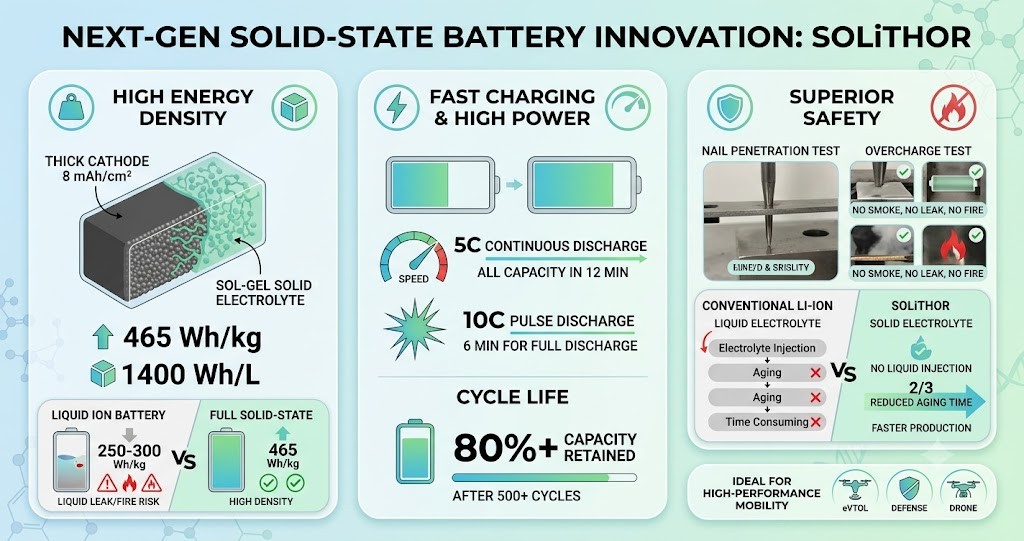
独自の「ゾル-ゲル化学」アプローチを採用し、液状の原料(ゾル)を電極内部に浸透させた後に化学反応で固体化(ゲル化)させるプロセスを開発しました。これにより、厚みのあるカソード(正極:8 mAh/cm2)の微細な隙間まで固体電解質を均一に行き渡らせることに成功しています。
- 重量エネルギー密度: 465 Wh/kg (一般的な液系電池は250〜300 Wh/kgで頭打ち)
- 体積エネルギー密度: 1400 Wh/L
2. 高出力特性(Cレート)と寿命の両立
一般的にエネルギー密度を高めると出力は低下傾向になりますが、今回のセルは優れた出力特性を示しています(25℃環境下)。
- 連続放電: 最大5C(全容量を12分で放電する速度)
- パルス放電: 充電深度50%において最大10Cを30秒間維持(全容量を6分で放電する激しい速度)
- サイクル寿命: 1Ahの多層パウチセルにて、500回以上の完全充放電サイクル後も初期容量の80%以上を維持
3. 極めて高い安全性
満充電状態(SOC 100%)での過充電試験および釘刺し試験において、発煙、液漏れ、熱暴走、発火は一切確認されませんでした。液体電解質を持たない固体複合電解質の本質的な不燃性が証明されています。
製造プロセスの革新と経済的メリット
量産化に向けた最大の強みは、既存のリチウムイオン電池の生産ライン(ロール・トゥ・ロール法)を大幅な追加投資なしで転用できる点です。
従来の液系電池製造でコスト全体の最大25%を占めていた「電解液注入」「化成(初期充放電による保護膜形成)」「エージング(長期間の保管工程)」のうち、液体を注入するステップ自体が不要になります。これにより、化成・エージングにかかる時間を従来の3分の2も短縮でき、工場の生産効率(スループット)を劇的に向上させることが可能です。
関連情報:ハイエンド分野への展開と欧州の地政学戦略
今回SOLiTHOR社が実験室レベル(数mAh〜1Ah)を脱し、実用規模に近い10Ahの大容量デモンストレーションセルの製造に成功したことは、スケールアップの壁を越えたことを意味します。この技術がもたらす社会的インパクトと関連する背景は以下の通りです。
1. 初期市場としてのハイエンド・モビリティ
10Cという瞬間的な高出力と軽量・高エネルギー密度の両立は、ドローンの離着陸、eVTOL(空飛ぶクルマ)のホバリング、防衛用機器など、短時間に爆発的なパワーを必要とする次世代モビリティに最適です。現在、中国のGAC(広汽集団)なども2027年に向けたeVTOL用全固体電池の実装ロードマップを掲げており、航空・宇宙・防衛分野が全固体電池の初期の主戦場になる見込みです。
2. 欧州のサプライチェーン強靭化
SOLiTHOR社の固体電解質は、欧州域内で豊富に調達可能な材料で構成されています。特定地域(アジア圏など)に偏在するレアメタルへの依存度を下げる戦略をとっており、欧州防衛基金(European Defence Fund)の「DEEP-TECH」プロジェクトから深海用自律機器向けに資金を獲得しています。地政学的なリスクを排除した次世代エネルギー戦略としても期待されています。
3. 業界の信頼性担保の重要性
全固体電池の分野では、過去に他国のスタートアップ(Donut Labなど)が「革新的な全固体電池」と称して実際には既存のリチウムイオン電池を転用していた虚偽疑惑が発覚するなど、技術プロセスの厳格な検証が求められています。SOLiTHOR社が10Ahセルで具体的な安全データやCレート、欧州の公的枠組みの支援を示したことは、技術の実現性を裏付ける強力なステップと言えます。
Solid-State Battery Breakthrough: SOLiTHOR Explores Mass Production and High-End Markets
Solid-state batteries are at the center of an intensifying global development race as the next generation of energy storage technology. While conventional liquid-based lithium-ion batteries are a mature technology, they rely on flammable organic solvents (liquid electrolytes), which carry inherent risks of fire and thermal runaway. Furthermore, when electrodes are thickened to extend the driving range of electric vehicles (EVs), they face physical limitations such as electrolyte depletion and increased internal resistance.
To overcome these challenges, the industry has been moving toward solid electrolytes. However, it is extremely difficult to establish seamless contact between solid materials to ensure smooth ion movement (interfacial formation). Consequently, many technologies currently on the market remain limited to semi-solid or hybrid types that still mix in a small amount of liquid.
In this landscape, SOLiTHOR has attracted significant attention by announcing a technology that achieves zero liquid (completely solid-state) while simultaneously delivering both overwhelming energy density and a practical manufacturing process.
Key Highlights and Achieved Performance
The primary achievements and specifications demonstrated by SOLiTHOR are as follows:
1. Remarkable Energy Density
Utilizing a proprietary sol-gel chemistry approach, the company developed a process where liquid raw materials (sol) penetrate into the electrode and then solidify (gel) through a chemical reaction. This has successfully enabled the solid electrolyte to distribute uniformly even into the microscopic gaps of a thick cathode (positive electrode: 8 mAh/cm2).
- Gravimetric Energy Density: 465 Wh/kg (Conventional liquid-based batteries cap out at around 250 to 300 Wh/kg)
- Volumetric Energy Density: 1400 Wh/L
2. Dual Achievement of High Power Output (C-rate) and Lifespan
Generally, increasing energy density tends to lower power output, but these cells demonstrate excellent output characteristics under a 25 deg C environment.
- Continuous Discharge: Up to 5C (A speed that fully discharges the total capacity in 12 minutes)
- Pulse Discharge: Maintains up to 10C for 30 seconds at 50% state of charge (SOC) (An intense speed that fully discharges the total capacity in 6 minutes)
- Cycle Life: Tests with a 1Ah multilayer pouch cell confirmed that it retains over 80% of its initial capacity even after more than 500 full charge-discharge cycles.
3. Exceptionally High Safety
During overcharge and nail penetration tests conducted at 100% state of charge (SOC 100%), no smoke, leakage, thermal runaway, or ignition was observed. This proves the inherent non-flammability of their solid composite electrolyte, which contains no liquid components.
Manufacturing Process Innovation and Economic Benefits
The greatest strength for mass production is that the technology can adapt existing lithium-ion battery production lines (Roll-to-Roll method) without requiring massive additional capital investment.
In conventional liquid-based battery manufacturing, the steps of electrolyte filling, formation (creating a protective layer through initial charging and discharging), and aging (a long-term storage process) account for up to 25% of the total processing cost. SOLiTHOR completely eliminates the liquid filling step itself. This reduces the time required for formation and aging by two-thirds compared to conventional methods, dramatically boosting factory production efficiency (throughput).
Related Information: Expansion into High-End Sectors and European Geopolitical Strategy
SOLiTHOR has successfully progressed from laboratory-scale cells (a few mAh to 1Ah) to manufacturing a 10Ah large-capacity demonstration cell closer to a practical scale, meaning they have crossed the barrier of scaling up. The societal impact and background of this technology are outlined below:
1. High-End Mobility as an Initial Market
The combination of an instantaneous high output of 10C, lightweight design, and high energy density is ideal for next-generation mobility that requires explosive power in short bursts, such as drone takeoffs and landings, eVTOL (electric vertical takeoff and landing aircraft) hovering, and defense equipment. Currently, companies like China’s GAC are setting implementation roadmaps for eVTOL solid-state batteries aiming for 2027, indicating that the aerospace, space, and defense sectors will be the initial battlegrounds for solid-state batteries.
2. Strengthening the European Supply Chain
SOLiTHOR’s solid electrolyte is composed of materials that can be sourced abundantly within Europe. This strategy reduces dependence on rare metals that are concentrated in specific regions (such as parts of Asia). In fact, as part of the DEEP-TECH project supported by the European Defence Fund, the company has secured its first defense funding for deep-sea autonomous equipment. This technology is highly anticipated as a next-generation energy strategy that mitigates geopolitical risks.
3. The Importance of Ensuring Industry Credibility
The solid-state battery field has previously seen controversy, such as when another foreign startup (Donut Lab) claimed to have a revolutionary solid-state battery that was later suspected of being a repurposed existing lithium-ion battery. This underscores the need for rigorous verification of technical processes. SOLiTHOR’s ability to show concrete safety data, C-rates, and backing from European public frameworks with their 10Ah cell represents a powerful step forward in proving the actual viability of their technology.

コメント