世界最大の電気自動車(EV)市場である中国において、2026年7月1日より、これまでで最も厳格とされる2つの国家安全基準が同時に施行されました。本レポートは、EV用バッテリーおよび車両レベルの安全性を抜本的に高める新規制の核心を整理するとともに、メーカーに課されるコスト圧力、産業構造の二極化、および今後の市場成長予測といった関連情報を補足・統合し、今後の業界動向を網羅的に解説するものです。
1. 新安全基準の核心と画期的な転換
今回の法改正では、従来の「リスク発生後の乗員保護(事後対応)」から、「リスクそのものを発生源で排除する(事前予防)」という安全理念への転換が図られました。
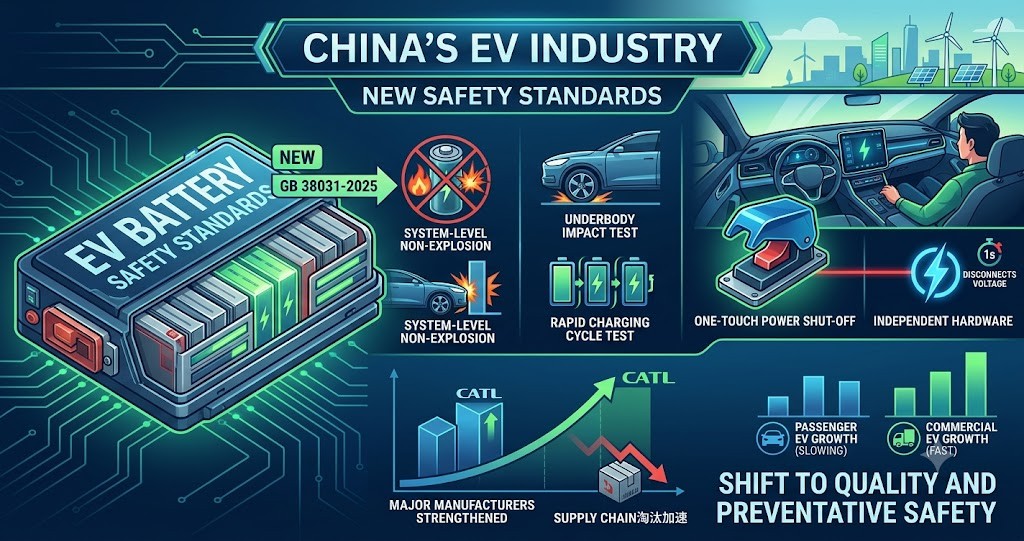
- GB 38031-2025(バッテリーの安全要件): 単一セルが熱暴走を起こした場合でも、システムレベルで「発火も爆発も起こさない」本質安全性が義務付けられました。
- GB 18384-2025(車両の安全要件): 激しい衝突でソフト側が破損しても、運転者が1秒以内に物理的に高電圧回路を切断できる、車載ソフトから独立した「ワンタッチ電源遮断装置(ハードウェア)」の搭載が義務付けられました。
- 実事故に即した試験の追加: 車両下部への衝撃を想定した「底面衝突試験」と、高頻度な超急速充電を想定した「長期急速充電サイクル試験」の2つが必須化されました。
2. サプライチェーンへの影響とコスト圧力
- コストの上昇: 新規制への適応により、バッテリーシステムのコストが15%から20%上昇すると試算されています。これは車両1台あたり約3,000元から5,000元の追加費用に相当します。
- 企業の二極化(淘汰の加速): CATL(2020年に対応技術を量産化済)やEVE Energy(2022年に達成済)などの最大手企業にとっては影響が最小限である一方、技術力のない中小企業や低価格帯モデルは深刻なコスト圧力に直面し、淘汰が加速すると見られます。
- LFP(リン酸鉄リチウム)の優位性: LFPは元々の熱安定性が高いため、新規制への対応コストが少なくて済み、三元系バッテリーに対する市場シェアをさらに拡大する可能性が高いです。
3. 【関連情報】中国EV・バッテリー市場のマクロ動向
新規制は、中国の車載用バッテリー業界が「急速な量的成長」から「構造的な質の高度化」へとシフトする過渡期に導入されました。
- 市場の成熟化: 2026年通年の国内牽引バッテリー設置需要は888.7 GWh(前年比15.8%増)と予測されています。これは2025年に記録された40.35%増という急成長から大きく減速し、市場が安定期に入ったことを示しています。
- 商用車が成長の主軸に: 乗用車向けの需要成長率が前年比10.8%増にとどまる一方、商用新エネルギー車(NEV)向けの需要は前年比34.7%増と予測されており、今後の市場を牽引する存在となっています。
結論
2026年7月に施行された新しい国家基準は、中国のEV市場における安全性のハードルを一挙に世界最高水準へと引き上げました。技術力・資本力を持つ大手メーカーの支配体制をさらに強める一方で、低品質な生産能力の退場を促す「業界の健全化プロセス」として機能することになります。
出典:https://cnevpost.com/2026/06/30/china-toughest-battery-safety-rules-take-effect-july/
China Implements World-First “No Fire, No Explosion” EV Battery Rule! Strictest Safety Regulations in History Begin
In China, the world’s largest electric vehicle (EV) market, two of the strictest national safety standards to date came into effect simultaneously on July 1, 2026. This report outlines the core of the new regulations, which fundamentally enhance safety at both the EV battery and vehicle levels. It also supplements and integrates relevant information, such as cost pressures on manufacturers, the polarization of the industry structure, and future market growth forecasts, to provide a comprehensive explanation of future industry trends.
1. The Core of the New Safety Standards and a Groundbreaking Shift This regulatory change shifts the safety philosophy from the traditional approach of “passenger protection after a risk occurs (reactive)” to “eliminating risks at the source (preventive).”
- GB 38031-2025 (Battery Safety Requirements): System-level intrinsic safety is now mandatory. Even if thermal runaway occurs within a single cell, the battery system must ensure “no fire and no explosion.”
- GB 18384-2025 (Vehicle Safety Requirements): The installation of an independent, physical “one-touch power cutoff switch” (hardware) is now mandatory. Even if the software side is damaged in a severe collision, the driver must be able to physically disconnect the vehicle’s entire high-voltage circuit within 1 second.
- Addition of Real-World Accident Tests: Two mandatory tests have been added: the “bottom impact test” to simulate impacts to the underbody from road debris or bumps, and the “long-term fast charging cycle test” to simulate high-frequency ultra-fast charging.
2. Impact on the Supply Chain and Cost Pressures
- Rising Costs: Adapting to the new regulations is estimated to increase battery system costs by 15% to 20%. This translates to an additional cost of approximately 3,000 RMB to 5,000 RMB per vehicle.
- Corporate Polarization (Accelerated Shakeout): The impact is expected to be minimal for top-tier giants like CATL (which mass-produced compliant technology in 2020) and EVE Energy (which achieved it in 2022). Conversely, small and medium-sized enterprises (SMEs) without high technical capabilities and low-end models will face severe cost pressures, which is expected to accelerate their exit from the market.
- Advantage of LFP (Lithium Iron Phosphate): Because LFP batteries inherently possess high thermal stability, the additional costs for design changes to meet the new regulations are lower. Consequently, LFP is highly likely to further expand its market share over ternary batteries.
3. Related Information: Macro Trends in the Chinese EV and Battery Market The new regulations were introduced during a transitional phase in China’s automotive battery industry, as it shifts from “rapid quantitative growth” to “structural upgrading of quality.”
- Market Maturation: The domestic traction battery installation demand for the full year of 2026 is projected to reach 888.7 GWh (a 15.8% increase year-on-year). This is a significant slowdown from the rapid growth of 40.35% recorded in 2025, indicating that the market has entered a stable phase.
- Commercial Vehicles as the Main Growth Engine: While the growth rate of demand for passenger cars remains at 10.8% year-on-year, demand for commercial New Energy Vehicles (NEVs) is projected to grow by 34.7% year-on-year, making them a driving force for the future market.
Conclusion The new national standards implemented in July 2026 have instantly raised the safety bar in China’s EV market to the highest global standards. This tightening of regulations will reinforce the dominance of major manufacturers that possess high technical and financial capabilities, while weeding out low-quality production capacity to promote industry health.

コメント