次世代の電気自動車(EV)用バッテリーとして「全固体電池」が長年注目を集めてきましたが、多くの自動車メーカーは、その本格的な実用化は今世紀末(2030年代以降)になると見込んでいます。こうした中、全固体電池よりもはるかに短い開発期間で市場を覆す準備ができている画期的な技術として、「シリコンアノード(負極)」が急浮上しています。本レポートは、ゼネラルモーターズ(GM)をはじめとする主要メーカーの動向に加え、サプライチェーンの現状や他技術との比較といった関連情報を補足し、近中期的なEVバッテリー市場の展望をまとめました。
## 1. シリコンアノード技術の本質とメリット
現在、EV用リチウムイオン電池の負極(アノード)には、ほぼ例外なく黒鉛(グラファイト)が使用されています。シリコンアノードは、この黒鉛の一部または全部をシリコンに置き換える技術です。
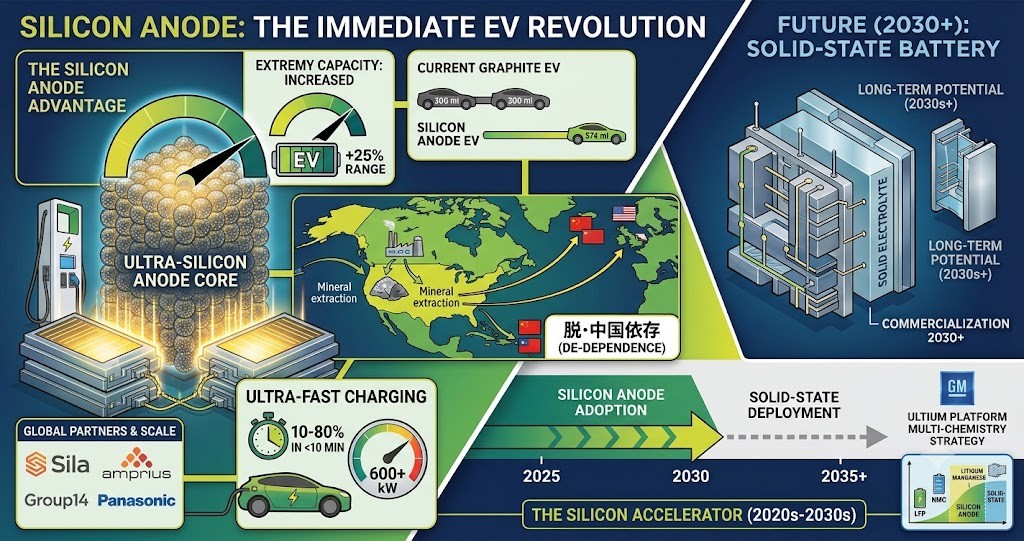
- 航続距離の大幅な向上: シリコンは黒鉛に比べて理論上の蓄電容量が極めて高いため、バッテリーパックのサイズを変えずに航続距離を伸ばせます。米スタートアップ企業Sila(シラ)は「航続距離を20%向上できる」としており、Amprius Technologies(アンプリウス・テクノロジーズ)は「従来のパックで航続距離310マイルのEVが、574マイルまで延伸可能」と主張しています。
- 圧倒的な超急速充電: メルセデス・ベンツの新型AMG GTに採用されたシリコン含有アノードでは、最大充電速度600 kWに対応し、わずか11分でバッテリー残量を10%から80%まで充電可能です。
- 脱・中国依存(経済安全保障): 現在、黒鉛の加工の90%以上が中国に集中しており、環境負荷の高い採掘も課題となっています。シリコンへの転換は、地政学的なサプライチェーンのリスク軽減につながります。
- 課題と対策: 純粋なシリコンは充放電時の体積膨張が激しいため、現在は安定性を担保するためにある程度の黒鉛とブレンドするなどのアプローチが取られています。
## 2. 【関連情報】先行するユースケースと量産体制の構築
シリコンアノードは単なる理論にとどまらず、すでに高性能ハイパーカーやスマートフォン等で実用化が始まっており、EV向けの大量生産(スケールメリットによるコスト削減)に向けたインフラ投資が加速しています。
- ハイパフォーマンス分野での実証: グッドウッドで記録を残した「マクマートリー・スピアリング・ハイパーカー」は、グループ14(Group14)社製のシリコンアノードを用いた台湾モリセル社製バッテリーを搭載。わずか1.55秒で時速60マイル(約96 km/h)に達する放電能力を証明しています。
- 北米での量産プラント稼働:
- Sila社: ワシントン州モーゼスレイクの工場が稼働しており、当初は年間最大5万台のEV向け材料を生産可能。将来的に250万台分への拡張を計画しています。すでにメルセデス・ベンツや、テスラの主要サプライヤーであるパナソニックとの供給契約を締結済みです。
- Group14社: 韓国のSKグループとの合弁工場を完全所有化し、最大10 GWh(EV 10万台分以上)の電池材料の生産を開始しています。
## 3. 自動車巨頭GMのマルチ化学戦略
ゼネラルモーターズ(GM)のバッテリーおよびサステナビリティ担当副社長であるカート・ケルティ氏は、「短中期的にシリコンアノードの採用率がさらに高まる」と述べ、同技術を本命視しています。しかし、GMは単一の技術に依存せず、用途や価格帯に応じて最適な化学組成を使い分ける戦略をとっています。
| バッテリーの種類 | 主な用途・特徴 |
| 高ニッケル系 | 現行のほとんどの主要車種に採用(高性能・高密度) |
| LFP(リン酸鉄リチウム) | シボレー・ボルトなどに採用(低コスト・高寿命) |
| シリコンアノード系 | 近中期の航続距離・充電性能向上の切り札(開発加速中) |
| リチウムマンガン系 | 2028年発売予定の大型SUV・ピックアップトラック向け(低コスト) |
| ナトリウムイオン | 大規模エネルギー貯蔵システム(ESS)向けに開発発表 |
| 全固体電池(全固体) | 研究所に多数の試作品があり試験進行中。「聖杯」として長期研究 |
## 結論
バッテリー開発競争は、かつての内燃機関が1世紀かけて進化したのと同様に、多角的な化学組成のブレンドによって長い道のりを歩んでいます。長期的には全固体電池が「聖杯」として君臨する可能性があるものの、2020年代後半の市場を実質的にリードし、EVの航続距離への不安や充電時間の課題を即座に解決するのは、量産化へのハードルをクリアしつつあるシリコンアノード技術と言えます。
出典:https://insideevs.com/news/799157/general-motors-silicon-anodes-solid-state-batteries/+
The EV Market Evolving Without Waiting for All-Solid-State Batteries: The Potential of “Silicon Anodes” as the Near-to-Mid-Term Optimal Solution
While “all-solid-state batteries” have long attracted attention as the next-generation battery for electric vehicles (EVs), many automakers project that their full-scale commercialization will not occur until the end of this century (the 2030s or later). Under these circumstances, “silicon anodes” have rapidly emerged as a groundbreaking technology ready to disrupt the market right now, with a development timeline that is significantly shorter than that of all-solid-state batteries. Supplementing relevant information such as the current state of the supply chain and comparisons with other technologies, this report outlines the outlook for the near-to-mid-term EV battery market, alongside the strategies of major manufacturers including General Motors (GM).
1. The Essence and Benefits of Silicon Anode Technology
Currently, graphite is used almost without exception for the negative electrode (anode) of lithium-ion batteries for EVs. Silicon anode technology involves replacing part or all of this graphite with silicon.
- Significant Extension of Driving Range: Because silicon has an extremely high theoretical energy storage capacity compared to graphite, it can extend the driving range without increasing the size of the battery pack. US startup Sila claims it can “increase range by 20%,” while Amprius Technologies asserts that an EV with a 310-mile range using a conventional pack could extend its range to 574 miles using their silicon anode battery.
- Overwhelming Ultra-Fast Charging: The silicon-containing anode utilized in Mercedes-Benz’s new AMG GT supports a maximum charging speed of 600 kW, enabling the battery to charge from 10% to 80% in just 11 minutes.
- Reducing Reliance on China (Economic Security): Currently, over 90% of graphite processing is concentrated in China, and its high-environmental-impact mining poses a challenge. Shifting to silicon will help reduce geopolitical supply chain risks.
- Challenges and Countermeasures: Because pure silicon undergoes severe volumetric expansion during charging and discharging, current approaches involve blending it with a certain amount of graphite to ensure stability.
2. Related Information: Pioneering Use Cases and Establishing Mass Production Systems
Silicon anodes are not just theoretical; they are already being commercialized in high-performance hypercars and smartphones, and infrastructure investment toward mass production for EVs (reducing costs through economies of scale) is accelerating.
- Demonstration in the High-Performance Sector: The McMurtry Spéirling hypercar, which broke records at the Goodwood Festival of Speed, features a battery from Taiwan’s Molicel that uses Group14’s silicon anode. It has demonstrated a discharge capacity sufficient to rocket from 0 to 60 mph (approx. 96 km/h) in just 1.55 seconds.
- Mass Production Plants Operating in North America:
- Sila: Its factory in Moses Lake, Washington, is already operational, with an initial capacity to produce battery materials for up to 50,000 EVs per year. Plans are in place to expand this to 2.5 million vehicles in the future. Supply agreements have already been signed with Mercedes-Benz and Panasonic, Tesla’s primary battery supplier.
- Group14: The company took full ownership of its joint-venture factory with South Korea’s SK Group and has commenced production of battery materials for up to 10 GWh (enough to power more than 100,000 EVs).
3. Automotive Giant GM’s Multi-Chemical Strategy
Kurt Kelty, Vice President of Battery and Sustainability at General Motors (GM), views silicon anode technology as a primary focus, stating that “the adoption rate of silicon anodes will increase further in the short to medium term.” However, rather than relying on a single technology, GM pursues a strategy of utilizing the optimal chemical composition based on the specific application and price range.
| Battery Type | Primary Application and Characteristics |
| High-Nickel | Adopted in most current major models (high performance, high density). |
| LFP (Lithium Iron Phosphate) | Adopted in models like the Chevrolet Bolt (low cost, long life). |
| Silicon Anode | The trump card for improving range and charging performance in the near-to-mid term (development accelerating). |
| Lithium-Manganese | Destined for large SUVs and pickup trucks scheduled for launch in 2028 (low cost). |
| Sodium-Ion | Development announced for large-scale Energy Storage Systems (ESS). |
| All-Solid-State | Numerous prototypes exist in the laboratory with testing underway. Long-term research continues as the “Holy Grail.” |
Conclusion
The battery development race is a long journey involving a blend of diverse chemical compositions, much like the evolution of the internal combustion engine over a century. While all-solid-state batteries may reign as the “Holy Grail” in the long term, it is silicon anode technology—which is steadily overcoming mass-production hurdles—that will practically lead the market in the late 2020s, immediately addressing consumer range anxiety and charging-time challenges.
コメント