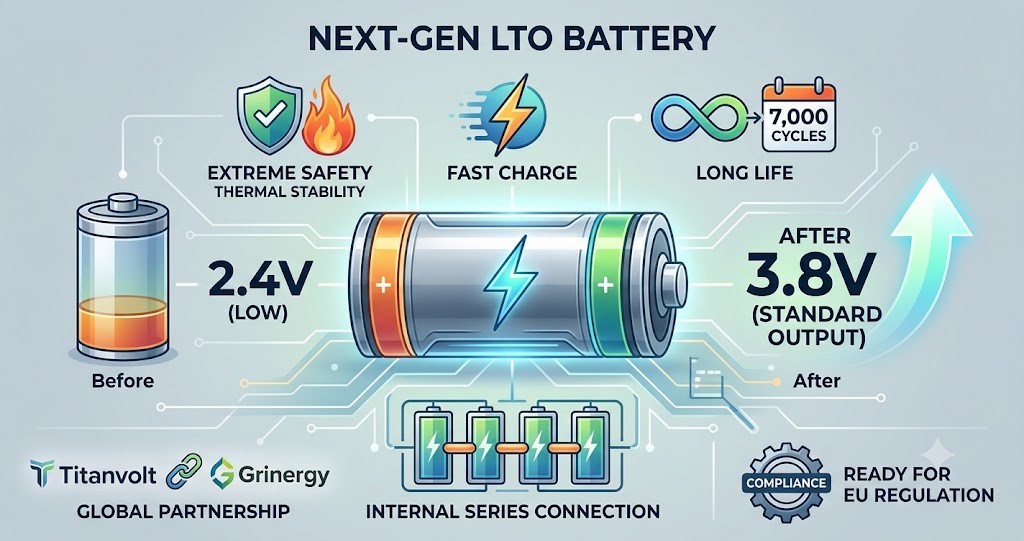
シンガポールを拠点とするTitanvolt社と、韓国の革新的なバッテリー企業Grinergy社が共同で開発した「リチウム二次電池」の特許が正式に承認されました。この技術は、安全性が高い一方で電圧が低いというチタン酸リチウム(LTO)電池の最大の弱点を克服し、業界標準である3.8Vの出力を実現する画期的なものです。
この発表の詳細と、背景にある市場トレンドなどの関連情報をわかりやすくまとめてお届けします。
ニュースの概要:LTO電池の常識を覆す「3.8V」の実現
LTO(チタン酸リチウム)電池は、極めて高い安全性、優れた低温性能、急速充電能力、そして圧倒的な長寿命を誇ります。しかし、単セルあたりの平均公称電圧が2.3V〜2.4Vと低く、標準的な電子機器(多くのバッテリーシステムが基準とする電圧帯)への導入が難しいという大きな制約を抱えていました。
今回特許を取得したアーキテクチャは、単一の筐体内部で電極アセンブリを直列に接続する構造を採用。これにより、パックを大型化することなく、業界標準を満たす定格公称電圧3.8Vを達成しました。
検証済みのパフォーマンス指標(特許文書データ)
- 定格公称電圧: 3.8V(一般的な電子機器に対応可能)
- 材料構成: 正極にリン酸鉄リチウム(LFP)活物質、負極にLTOを使用
- 寿命容量: 最大7,000回の充放電サイクルを維持
- 充電速度: 5Cの急速充電に対応
- 熱特性: 300℃を超える高温下でも構造的安定性を維持
- インテリジェントな自己バランス構造: 充電時の容量差は2%未満、放電時は1%未満
この技術がもたらす革新と重要性
1. 「安全性・長寿命」と「標準電圧」の両立
これまでは、主流であるNMC(ニッケル・マンガン・コバルト)やLFP(リン酸鉄リチウム)/グラファイトの持つ「標準的な電圧」を選ぶか、LTOの持つ「高い熱安定性や極低温性能、7,000サイクルの超寿命」を選ぶかというトレードオフが存在しました。 今回の内部直列設計により、筐体そのままで3.8Vを出力できるため、メーカーは安全性を妥協することなく、従来の主流バッテリーからそのまま置き換える(ドロップイン交換)選択が可能になります。
2. ライセンス契約から「技術パートナーシップ」への深化
この共同特許の承認により、TitanvoltとGrinergyの関係は、単なる技術ライセンスの供与から、知的財産(IP)を共有する「資産担保型のエンジニアリングパートナーシップ」へと移行します。両社はグローバルなIP基盤を確立し、商業市場への参入と地理的な成長を加速させます。
3. EUバッテリー規制など、国際規制への適合
欧州連合(EU)が推進する新しいバッテリー規制では、電子機器におけるバッテリーの容易な取り外しや交換、そして長寿命化と高い安全性が求められています。 発火リスクが極めて低く、300度Cの高温にも耐え、さらに従来の何倍も長持ちするこのLFP/LTOハイブリッドアーキテクチャは、これからの国際的な環境・安全規制をクリアする理想的な製品基盤となります。
【関連情報】LTO技術の背景と企業の動向
ニュースをより深く理解するために、技術的な背景と両社の位置づけを補足します。
チタン酸リチウム(LTO)電池の強みとは?
LTO電池は、一般的なリチウムイオン電池の負極に使われるグラファイトの代わりに「チタン酸リチウム」を使用します。 最大のメリットは「壊れない・燃えない」ことです。充放電時に物質の体積変化がほとんどないため、劣化しにくく数千回以上のサイクルに耐えます。また、リチウムデンドライト(ショートの原因となる結晶)が発生しにくいため、熱暴走のリスクが極めて低く、マイナス30度Cといった極寒の環境でも安定して動作します。今回の特許は、この最強の安全牌に「一般的な使いやすさ(3.8V)」を授けたことになります。
Titanvolt社とGrinergy社について
- Grinergy(グリナジー): 韓国発のベンチャー企業で、独自のLTO技術「XN-LTO」などを展開。防衛産業や過酷な産業環境向けに、超低温でも動作する高性能セルの開発で高い評価を得ています。
- Titanvolt(タイタンボルト): シンガポールを拠点とし、次世代クリーンエネルギー技術の商業化やインフラ展開、クリーンテック分野への投資・エンジニアリングを牽引する企業です。
今回の3.8VハイブリッドLTOバッテリーの登場により、これまでニッチな産業用途(大型重機やインフラ設備など)に限定されがちだったLTO技術が、一般の商業用ハードウェアや次世代の消費者向け電子機器へと一気に普及する可能性が高まっています。
出典:https://www.titanvolt.co.uk/news/titanvolt-and-grinergy-patent-next-generation-battery-architecture/
[Joint Patent] Titanvolt and Grinergy Secure Patent for New “3.8V” Architecture, Overcoming the Main Weakness of LTO Batteries
A patent for a “Lithium Secondary Battery,” jointly developed by Singapore-based Titanvolt and South Korea’s innovative battery company Grinergy, has been officially approved. This breakthrough technology overcomes the primary limitation of lithium titanate (LTO) batteries—their low voltage despite high safety—to deliver an industry-standard 3.8V output.
Below is an easy-to-understand summary of the announcement, along with relevant context regarding market trends and background information.
News Summary: Overturning Conventional Wisdom with a “3.8V” LTO Battery
LTO (Lithium Titanate) batteries are renowned for their exceptional safety, superior low-temperature performance, fast-charging capabilities, and overwhelmingly long cycle life. However, they have historically faced a significant integration barrier: a low average nominal voltage of 2.3V to 2.4V per cell, making them difficult to implement in standard electronic systems that rely on higher voltage baselines.
The newly patented architecture addresses this constraint by utilizing an internal series connection structure within a single enclosure. By connecting the electrode assemblies in series using overlapping tabs, the system achieves a rated nominal voltage of 3.8V without increasing the physical package size, meeting industry-standard power requirements.
Verified Performance Metrics (Patent Document Data)
- Rated Nominal Voltage: 3.8V (suitable for standard electronic devices)
- Material Composition: Combines a lithium iron phosphate (LFP) cathode active material with an LTO anode
- Cycle Life Capacity: Retains up to 7,000 charge-discharge cycles
- Charging Speed: Supports 5C fast charging
- Thermal Characteristics: Demonstrates structural stability even at temperatures exceeding 300 degrees C
- Intelligent Self-Balancing Structure: Capacity variance of less than 2% during charging and less than 1% during discharging
Innovations and Strategic Importance
1. Eliminating the Trade-off Between “Safety/Longevity” and “Standard Voltage”
Previously, manufacturers had to make a strict trade-off: choose mainstream chemistries like NMC or LFP/graphite for their standard system voltages, or select LTO for its thermal stability, sub-zero performance, and 7,000-cycle durability. This internal series design delivers a true 3.8V solution straight out of the enclosure. Consequently, manufacturers can perform direct “drop-in” replacements of conventional mainstream batteries without compromising on system safety or redesigning power electronics.
2. Deepening from a Licensing Agreement to an “Engineering Partnership”
With the official granting of this joint patent, the relationship between Titanvolt and Grinergy transitions from a traditional technology licensing arrangement to an asset-backed engineering partnership focused on shared intellectual property (IP). This establishes a robust global IP foundation for both companies, accelerating entry into commercial markets and expanding their geographical growth.
3. Compliance with International Regulations like the EU Battery Regulation
The European Union’s evolving battery regulations mandate that batteries in electronic devices must be easily removable and replaceable, while maintaining a significantly extended lifespan and minimal thermal risk. This LFP/LTO hybrid architecture boasts an extremely low risk of ignition, resists extreme temperatures up to 300 degrees C, and lasts several times longer than conventional batteries. This makes it an ideal, regulation-compliant hardware foundation for next-generation consumer and commercial products.
[Related Information] Background on LTO Technology and Company Profiles
To provide a deeper understanding of this milestone, here is additional context on the technology and the organizations involved.
What Makes Lithium Titanate (LTO) Batteries Unique?
LTO batteries substitute conventional graphite anodes used in standard lithium-ion cells with lithium titanate. Their greatest advantage is that they are inherently safe and highly durable. Because the material undergoes virtually no volume change during charging and discharging, it experiences minimal degradation over thousands of cycles. Furthermore, the chemistry is highly resistant to the formation of lithium dendrites (the microscopic crystals that cause internal short circuits), making the battery immune to thermal runaway and enabling stable operation in extreme cold down to minus 30 degrees C. This patent effectively equips an ultra-safe chemistry with standard, commercial usability (3.8V).
About Titanvolt and Grinergy
- Grinergy: A South Korean tech venture specialized in proprietary LTO frameworks, such as its “XN-LTO” technology. The company is highly regarded for developing high-performance cells that operate under extreme sub-zero temperatures, targeting defense and demanding industrial environments.
- Titanvolt: Headquartered in Singapore, Titanvolt is a driving force in the commercialization of next-generation clean energy technologies, infrastructure deployment, and engineering investments within the cleantech sector.
With the introduction of this 3.8V hybrid LTO battery, a technology previously confined to niche industrial applications (such as heavy machinery and grid infrastructure) is now uniquely positioned as a highly competitive alternative for mainstream commercial hardware and next-generation consumer electronics.

コメント