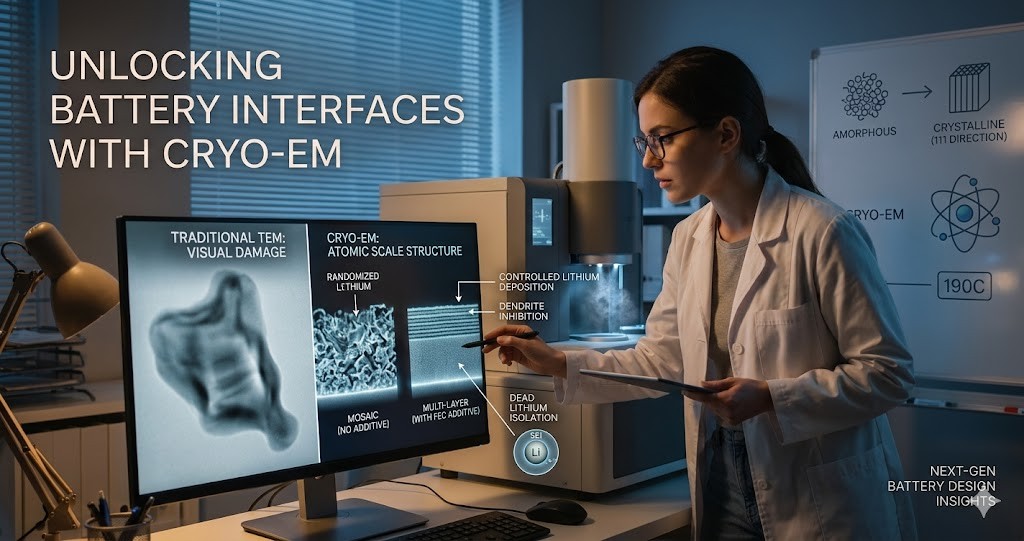
次世代電池の開発において、最大の難所は「充放電中に電極の表面で何が起きているか」を正確に捉えることです。特にリチウム金属やナトリウム金属は非常に反応性が高く、空気や電子ビームに触れるだけで構造が壊れてしまうため、これまでは「反応後の残骸」を推測するしかありませんでした。
本資料で解説する論文は、生物学の分野でノーベル化学賞を受賞した極低温電子顕微鏡(cryo-EM)を電池研究に転用し、これまでブラックボックスだった電極界面のナノ構造を「ありのまま」の状態で捉えることに成功した画期的な成果をまとめています。
極低温電子顕微鏡(cryo-EM)とは?
一言で言えば、「サンプルを瞬間冷凍して、生きたままの状態で観察する顕微鏡技術」です。
従来の電子顕微鏡との違い
通常の透過型電子顕微鏡(TEM)では、強力な電子ビームを照射するため、熱に弱いリチウム金属などはすぐに溶けたり変質したりしてしまいます。
cryo-EMの3つの特徴
- 瞬間凍結(ガラス化): 液体窒素などを用いてサンプルをマイナス190度以下で一瞬にして凍結させます。これにより、液体電解質の中の状態を維持したまま固定できます。
- ビーム損傷の抑制: 極低温下では原子の動きが抑制されるため、電子ビームによる材料の破壊(損傷)を劇的に抑えることができます。
- 原子レベルの解像度: 柔らかい材料や反応性の高い界面であっても、ナノメートルから原子スケールでの構造解析が可能です。
電池設計に直結する具体的知見のまとめ
論文から得られた、実用化に向けた重要な知見を整理しました。
1. SEI(固体電解質界面)の構造制御
- 添加剤の役割: FEC(フルオロエチレンカーボネート)等の添加剤を加えると、SEIが「モザイク構造(無機物がバラバラ)」から「多層構造(整列した層)」へ変化します。この多層構造がリチウムの均一な析出を助け、デンドライト(枝状結晶)を抑制します。
- 温度の影響: 60度などの高温環境では、より機械的に強固なSEI(Li2Oリッチな層)が形成され、これが充放電効率(CE)の向上に寄与することが視覚的に証明されました。
2. 金属析出(デンドライト)の成長法則
- 結晶方向の特定: リチウムデンドライトは特定の方向(111 方向)に伸びやすい性質があります。この特定の結晶面を狙って制御する界面設計が、短絡防止の鍵となります。
- 初期核の遷移: 金属が析出する極初期には、まず「無秩序(アモルファス)」な状態を経てから「結晶」へと変化します。この変化のタイミングを制御することで、緻密な電極を作れる可能性が示唆されました。
3. 「デッドリチウム」の正体
- 電気的隔離の証明: 電池の容量が減る主因は、リチウムが化学的に消えるのではなく、SEIの殻の中に閉じ込められて集電体から電気的に切り離される(孤立化する)ことにあると、3D画像(ET解析)によって判明しました。
金属種別の比較と開発のヒント
| 金属種 | 析出の特徴 | 界面(SEI)の性質 | 開発のポイント |
| リチウム (Li) | ウィスカー/デンドライト | 薄い(数〜数十nm) | 添加剤による多層化が有効 |
| ナトリウム (Na) | 粒径が大きく広がりやすい | 厚く、不均一になりがち | 表面移動度が高いため、強固な拘束が必要 |
| カリウム (K) | 断片化しやすく不安定 | 数百nmに達するほど厚い | 反応性が極めて高く、界面設計が最優先 |
| 多価金属 (Mg/Ca) | 多角形や球状の結晶 | 不均一な酸化物層 | イオン輸送性を阻害しない層の形成が重要 |
技術アドバイザーとしての総評
この解析手法の進歩により、材料開発は「試行錯誤」から「構造を見て設計する」フェーズに移行しています。貴社のLMFP Cathodeや次世代電池のプロジェクトにおいても、単なる化学分析(成分比)だけでなく、このようなナノスケールの形態制御の視点を取り入れることで、特許戦略や製品の安定性を一段上のレベルへ引き上げることが可能になると考えられます。
出典:https://pubs.rsc.org/en/content/articlelanding/2026/eb/d6eb00054a
Unveiling Nanostructures and Reaction Mechanisms at Metal Anode Interfaces via Cryogenic Electron Microscopy
In the development of next-generation batteries, the greatest challenge lies in accurately capturing exactly what occurs on the electrode surface during charging and discharging. Lithium and sodium metals, in particular, are highly reactive; their structures can be destroyed simply by exposure to air or an electron beam. Consequently, researchers previously had little choice but to speculate based on the “debris” left after reactions.
The paper discussed in this document summarizes breakthrough achievements in battery research by repurposing Cryogenic Electron Microscopy (cryo-EM)—a technology that earned the Nobel Prize in Chemistry for its impact on biology. This method has successfully captured the nanostructure of electrode interfaces, previously a “black box,” in their native, pristine state.
What is Cryogenic Electron Microscopy (cryo-EM)?
In short, it is a microscopy technique where samples are flash-frozen to be observed in their “living” or native state.
Differences from Conventional Electron Microscopy
In standard Transmission Electron Microscopy (TEM), the intense electron beam causes heat-sensitive materials like lithium metal to melt or alter almost instantly.
Three Key Features of cryo-EM
- Flash Freezing (Vitrification): Samples are frozen instantly to below -190°C using agents like liquid nitrogen. This fixes the structure while maintaining the state of the liquid electrolyte.
- Suppression of Beam Damage: Because atomic movement is inhibited at cryogenic temperatures, the destruction (damage) of materials caused by the electron beam is dramatically reduced.
- Atomic-Level Resolution: Even with soft materials or highly reactive interfaces, structural analysis is possible from the nanometer down to the atomic scale.
Key Insights for Battery Design
The following is a summary of crucial findings from the paper that directly impact practical battery implementation.
1. Structural Control of the SEI (Solid Electrolyte Interphase)
- Role of Additives: Adding substances like FEC (fluoroethylene carbonate) shifts the SEI from a “mosaic structure” (disordered inorganic components) to a “multilayer structure” (ordered layers). This multilayering facilitates uniform lithium deposition and suppresses dendrites.
- Temperature Effects: In high-temperature environments (e.g., 60°C), a mechanically more robust SEI (rich in Li2O) is formed. It has been visually proven that this contributes to improved Coulombic Efficiency (CE).
2. Growth Laws of Metal Deposition (Dendrites)
- Identification of Crystal Orientation: Lithium dendrites tend to grow in specific directions, notably the <111> direction. Interface designs targeting and controlling these specific crystal planes are key to preventing short circuits.
- Transition of Initial Nuclei: At the very early stages of deposition, the metal moves from a “disordered (amorphous)” state to a “crystalline” state. Controlling the timing of this transition suggests the possibility of creating dense electrodes.
3. The True Nature of “Dead Lithium”
- Evidence of Electrical Isolation: 3D imaging (ET analysis) revealed that the primary cause of capacity loss is not the chemical disappearance of lithium, but rather its isolation. Lithium becomes trapped inside SEI shells and electrically disconnected from the current collector.
Comparison by Metal Type and Development Hints
| Metal Type | Deposition Characteristics | SEI Properties | Key Development Point |
| Lithium (Li) | Whiskers / Dendrites | Thin (several to tens of nm) | Multilayering via additives is effective |
| Sodium (Na) | Large grain size, spreads easily | Thick and often non-uniform | Requires strong confinement due to high surface mobility |
| Potassium (K) | Prone to fragmentation, unstable | Very thick (up to several hundred nm) | Extreme reactivity; interface design is the top priority |
| Multivalent (Mg/Ca) | Polygonal or spherical crystals | Heterogeneous oxide layers | Formation of layers that do not inhibit ion transport is vital |
Technical Advisor’s Summary
With these advancements in analytical methods, material development is shifting from a phase of “trial and error” to one of “designing through structural observation.” In your company’s LMFP Cathode and next-generation battery projects, moving beyond simple chemical analysis (compositional ratios) to incorporate this perspective of nanoscale morphological control will be essential for enhancing both patent strategies and product stability.


コメント