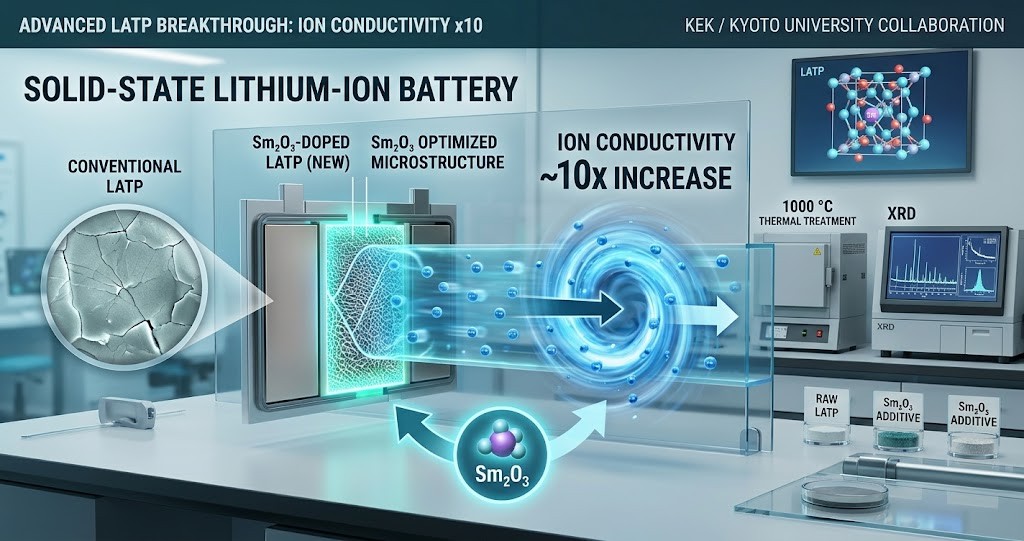
次世代蓄電池の本命として期待されている「全固体電池」ですが、実用化の最大のハードルとなっていたのが「固体電解質の中をリチウムイオンがどれだけスムーズに動けるか(イオン伝導率)」という問題でした。今回、高エネルギー加速器研究機構(KEK)と京都大学の研究グループが発表した成果は、安価な材料として注目される「LATP」の性能を劇的に引き上げるものであり、全固体電池のコスト削減と高性能化を同時に叶える画期的なアプローチとして大いに注目されています。
研究の概要と成果
高エネルギー加速器研究機構(KEK)物質構造科学研究所のソウ ホウシュウCIQuS博士研究員、森一広教授、京都大学大学院エネルギー科学研究科の高井茂臣准教授らの研究グループは、リチウムイオン導電性固体電解質である Li1.3Al0.3Ti1.7(PO4)3(LATP) に対し、イオン伝導率を約10倍に高める新しい手法を突き止めました。
- 課題の克服: LATPは原材料や製造コストが安いため、全固体リチウムイオン電池の低価格化に不可欠な材料とされてきましたが、従来はイオン伝導率の低さが実用化への課題でした。
- 新手法のポイント: 酸化サマリウム(Sm2O3)を焼結添加剤として加え、1000 ℃で熱処理を行うことで、微細構造や結晶構造を最適化しました。
- 劇的な性能向上: 酸化サマリウムを9 wt%添加したLATPは、無添加のものに比べて20 ℃でのイオン伝導率が約10倍に上昇しました。
イオン伝導率向上をもたらしたメカニズム
最先端の分析手法を駆使することで、原子レベルでの現象解明にも成功しています。
- 粒界伝導の改善: 電気化学インピーダンス分光法により、粒子同士の境界(粒界)における抵抗が大幅に減少し、イオン伝導がスムーズになったことが確認されました。
- 原子レベルの解析: 中性子回折法とX線回折法を併用し、LATP中のPO4イオンが酸化サマリウムと再結合して SmPO4相 や LiTiOPO4相 を生成していることを突き止めました。この化学反応がLATPの微細化を促し、結晶構造内のリチウム含有量に変化をもたらすことが伝導率向上につながっています。
関連情報:全固体電池と先端材料解析の展望
1. 全固体電池のメリットと市場へのインパクト
全固体電池は、従来の液体電解質(有機溶媒)の代わりに固体を使用するため、液漏れや発火のリスクが極めて低く、優れた安全性を誇ります。また、耐熱性やエネルギー密度にも優れているため、電気自動車(EV)の航続距離の大幅な延伸や、ドローン、ウェアラブル機器、医療機器などの次世代デバイスへの応用が期待されています。最大のネックである「コスト」と「性能(イオン伝導率)」を両立できるLATPの改良は、普及に向けた強力な後押しとなります。
2. 量子ビーム・中性子科学による材料開発の加速
今回の研究の裏側では、中性子回折法やX線回折法といった先端の量子ビーム施設を活用した解析が決定的な役割を果たしました。KEKのような研究機関が持つ大強度陽子加速器施設(J-PARCなど)の活用により、肉眼では見えない原子レベルでの挙動を解明できるようになったことが、今日の革新的な材料開発を支えています。今後は他の添加剤や組成の最適化が進むことで、さらなる性能向上の可能性も秘められています。
出典:https://eetimes.itmedia.co.jp/ee/articles/2611/04/news028.html
A Major Step Toward Practical, Low-Cost Solid-State Batteries: A New Method to Dramatically Improve LATP Solid Electrolyte Performance
“Solid-state batteries” are highly anticipated as the definitive next-generation energy storage solution. However, the biggest hurdle to their practical application has been how smoothly lithium ions can move through the solid electrolyte (ion conductivity). The recent findings announced by a research group from the High Energy Accelerator Research Organization (KEK) and Kyoto University present a breakthrough approach. It dramatically improves the performance of “LATP,” which is attracting attention as a low-cost material, and is drawing significant interest as an innovative method to simultaneously achieve cost reduction and high performance in solid-state batteries.
Research Overview and Results A research group including Dr. Pengshuo Song (CIQuS Postdoctoral Researcher) and Professor Kazuhiro Mori from the Institute of Materials Structure Science at KEK, and Associate Professor Shigeomi Takai from the Graduate School of Energy Science at Kyoto University, discovered a new method to increase the ion conductivity of the lithium-ion conducting solid electrolyte Li1.3Al0.3Ti1.7(PO4)3 (LATP) by approximately 10 times.
- Overcoming Challenges: Because LATP has low raw material and manufacturing costs, it has been considered an essential material for lowering the price of all-solid-state lithium-ion batteries. However, its low ion conductivity has traditionally been a challenge for practical use.
- Key Point of the New Method: By adding samarium oxide (Sm2O3) as a sintering additive and applying heat treatment at 1000 degrees Celsius, the microstructure and crystal structure were optimized.
- Dramatic Performance Improvement: LATP with 9 wt% Sm2O3 added showed an approximately tenfold increase in ion conductivity at 20 degrees Celsius compared to LATP without the additive.
Mechanism Behind Improved Ion Conductivity By utilizing state-of-the-art analytical methods, the team also succeeded in elucidating the phenomenon at the atomic level.
- Improvement in Grain Boundary Conduction: Electrochemical impedance spectroscopy confirmed that resistance at the boundaries between particles (grain boundaries) was significantly reduced, resulting in smoother ion conduction.
- Atomic-Level Analysis: Using a combination of neutron diffraction and X-ray diffraction, it was discovered that PO4 ions in LATP recombined with the Sm2O3 sintering additive to generate SmPO4 and LiTiOPO4 phases. This chemical reaction promotes the refinement of LATP and alters the lithium content within the crystal structure, leading to improved conductivity.
Related Information: Prospects for Solid-State Batteries and Advanced Material Analysis
1. Advantages and Market Impact of Solid-State Batteries Because solid-state batteries use a solid instead of the conventional liquid electrolyte (organic solvent), the risk of liquid leakage or ignition is extremely low, providing excellent safety. They also excel in heat resistance and energy density, which raises expectations for applications in next-generation devices such as drones, wearable devices, medical equipment, and significant extensions of the cruising range of electric vehicles (EVs). Improving LATP, which can resolve the major bottlenecks of “cost” and “performance (ion conductivity),” will be a strong boost toward widespread adoption.
2. Accelerating Material Development Through Quantum Beam and Neutron Science Behind this research, analysis utilizing advanced quantum beam facilities, such as neutron diffraction and X-ray diffraction, played a decisive role. The ability to elucidate atomic-level behavior invisible to the naked eye, thanks to the use of high-intensity proton accelerator facilities (such as J-PARC) held by research institutes like KEK, supports today’s innovative material development. Going forward, other additives and…


コメント