1. はじめに
次世代の二次電池として、リチウム金属負極は非常に高い理論容量(3860 mAh g-1)と低い電気化学ポテンシャル(標準水素電極に対して -3.04 V)を持つことから、現在のリチウムイオン電池のエネルギー密度限界を突破する切り札として注目されています。しかし、リチウム金属は充放電時に「デンドライト(樹枝状結晶)」と呼ばれる不均一な析出を起こしやすく、これがセパレータを貫通して内部短絡や熱暴走を引き起こすという深刻な課題があります。また、電解液の分解によって生じる「固体電解質界面(SEI)」の安定性や機械的特性、そして電解液の「塩濃度」が電池性能に与える影響については、これまで断片的な研究に留まっており、統一的な設計指針が不足していました。
本研究は、LiTFSI塩とEC/PC混合溶媒を用いたモデル電解液系において、塩濃度(0.5 Mから飽和濃度の約4.16 Mまで)が溶媒和構造、イオン輸送挙動、SEIの組成および機械的特性に与える影響を系統的に調査し、最適な電解液濃度を選択するための一般的な設計原理を提示したものです。
2. 論文の主要な知見とメカニズム
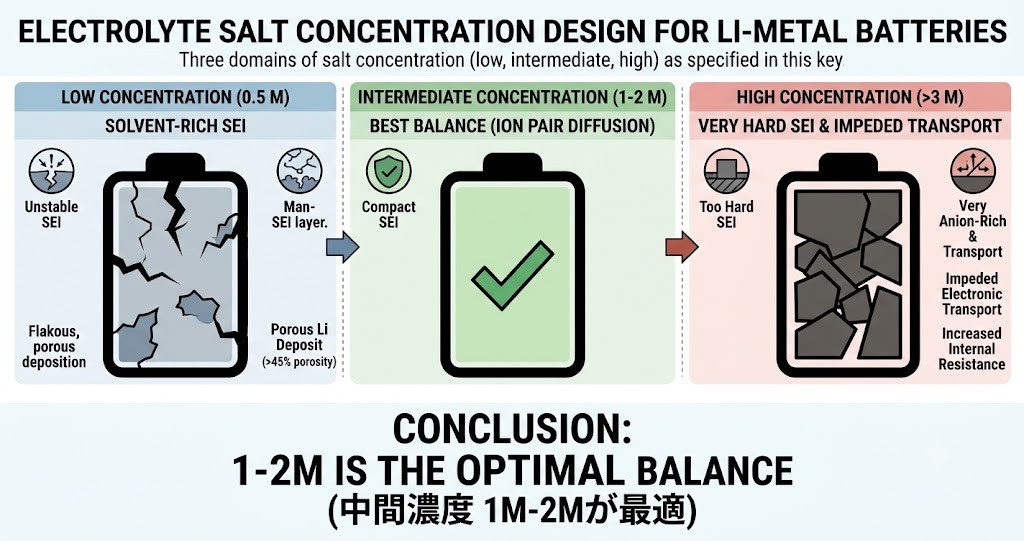
論文では、電解液濃度を「低濃度(0.5 M)」「中間濃度(1 M – 2 M)」「高濃度(3 M以上)」の3つの領域に分類し、それぞれの挙動を明らかにしています。
0.5 M(低濃度領域):溶媒由来の不安定なSEI
- 溶媒和構造と輸送: リチウムイオン(Li+)の周囲に多くの遊離溶媒分子(EC、PC)が存在する希薄な状態です。
- SEIの特徴: 溶媒分子が優先的に分解するため、フッ素(F)が少なく酸素(O)が豊富なSEI(F/O比が低い)が形成されます。
- 課題: 界面での電荷移動(リチウムイオンの受け渡し)が遅く、SEIの機械的強度(硬度や弾性)が裸のリチウム金属と同等に低いため、充放電の体積変化に耐えられず、微細で多孔質な(隙間だらけの)リチウム析出となり、電解液の継続的な分解(容量劣化)を招きます。
1 M – 2 M(中間濃度領域):相関イオン対拡散によるベストバランス
- 溶媒和構造と輸送: ラマン分光法およびPFG-NMR測定により、Li+イオンとTFSI-アニオンが直接配位した「接触イオン対(CIP)」が増加することが確認されました。特筆すべきは、7Liと19Fの自己拡散係数がほぼ同一になる点であり、これは「イオン対拡散の相関(Li+とアニオンがペアになって一緒に動く)」を示しています。
- SEIの特徴: アニオン由来のフッ素が適度に含まれ、ナノインデンテーション測定において「硬度対弾性率(H/E)比」が最も高くなりました。これは、界面層が硬いだけでなく、適度な柔軟性(変形追従性)を兼ね備えていることを意味します。
- 効果: 緻密な(多孔度が約45パーセント以下の)リチウム析出が実現し、過電圧が低く、高いクーロン効率と優れたサイクル特性(容量維持率)を示しました。輸送速度と機械的堅牢性のバランスが最も優れている領域です。
3 M以上(高濃度領域):極端に硬いSEIと電子輸送の阻害
- 溶媒和構造と輸送: 遊離溶媒がほぼ消失し、より大きなイオン凝集体(AGG)が形成されます。電解液の粘度が著しく上昇するため、イオンの全体的な拡散係数は低下します。
- SEIの特徴: LUMOエネルギーの低いアニオンが優先的に陰極分解するため、非常にフッ素が豊富な硬いSEIが形成され、界面電荷移動自体は促進されます。
- 課題: SEIが硬すぎる(柔軟性に欠ける)ため、リチウム析出の過程でSEI成分がバルク堆積物の内部に巻き込まれます。これがリチウム粒子間の電子輸送を阻害し、結果としてオーム抵抗(内部抵抗)を増大させ、大きな電圧ヒステリシスと容量劣化を引き起こします。
3. 関連情報・補足解説
論文の理解を深めるため、リチウム金属電池における各構成要素の役割と課題について関連情報を補足します。
主要構成要素の役割とプレーンテキスト解説
- LiTFSI(リチウム ビス トリフルオロメタンスルホニル イミド): 化学式は LiN(SO2CF3)2。リチウム金属電池で広く使われる代表的な支持塩です。アニオン(TFSI-)が大きく電荷が分散しているため解離しやすく、比較的高いイオン導電性を示します。また、分解時にフッ化リチウム(LiF)などの優れたSEI成分を形成しやすい特徴があります。
- EC(エチレンカーボネート)/ PC(プロピレンカーボネート): 高誘電率を持つ炭酸エステル系の有機溶媒です。ECは融点が高いため室温では固体ですが、PCと等体積で混合することで、室温でも均一な液体電解液として機能します。
- LiFePO4(リン酸鉄リチウム / LFP): 本研究で正極材料として使用されています。充放電時の体積変化が小さく、平坦な電圧プラトー(約 3.4 V5 vs Li/Li+)を持つため、負極側の挙動を正確に評価するための対極として非常に適しています。
- SEI(Solid Electrolyte Interphase / 固体電解質界面): 電解液と金属負極が接触した際に、初期の充電(還元)反応によって電解液成分が分解され、電極表面に形成されるナノメートルオーダーの不動態皮膜です。SEIは「電子は通さないが、リチウムイオンは通す」という性質を持つ必要があり、この皮膜の機械的強度や均一性がデンドライト抑制の鍵を握ります。
評価手法の補足
- ナノインデンテーション(H/E比): 極微小な圧子を材料表面に押し込み、その荷重と変位から硬度(H)と低減弾性率(E)を測定する手法です。H/E比(硬度/弾性率比)は、材料の「耐摩耗性」や「弾性ひずみエネルギーの貯蔵能力」の指標となり、これが高いほど、充放電に伴う激しい体積変化が起きてもひび割れ(亀裂)が生じにくい、強靭なSEIであることを示します。
- DRT(Distribution of Relaxation Times / 緩和時間分布)解析: 電気化学インピーダンス分光法(EIS)で得られた複雑なデータを分解し、どの周波数帯(時間スケール)でどのような反応(電荷移動、皮膜拡散、溶液抵抗など)が起きているかを視覚的に分離・比較しやすくする高度な解析手法です。
4. 結論
本論文は、「高濃度電解液(HCE)にすればSEIのフッ素濃度が上がって性能が良くなる」という従来の単純な経験則に対し、「高濃度すぎるとSEIが硬くなりすぎて内部に巻き込まれ、電子輸送を阻害する」という新しいデメリットを明確に示しました。 結果として、Li+とアニオンが相関して動く中間濃度領域(1 M – 2 M)が、輸送速度、機械的堅牢性(高いH/E比)、電子絶縁性のすべてにおいて最もバランスが取れた「スイートスポット」であるという統一的な設計指針を導き出しています。
出典:https://pubs.acs.org/doi/10.1021/acselectrochem.6c00140
Electrolyte Concentration Design for Balancing Transport Kinetics and Mechanical Stability of Lithium Metal Anodes
1. Introduction
As a next-generation rechargeable battery, the lithium metal anode is drawing significant attention as a breakthrough to overcome the energy density limits of current lithium-ion batteries, owing to its extremely high theoretical capacity (3860 mAh g-1) and low electrochemical potential (-3.04 V versus the standard hydrogen electrode). However, during charging and discharging, lithium metal is highly prone to non-uniform deposition known as “dendrites” (tree-like crystals). These structures can penetrate the separator, causing internal short circuits and thermal runaway, which remains a severe challenge. Furthermore, research on the stability and mechanical properties of the solid electrolyte interphase (SEI) formed by electrolyte decomposition, as well as the impact of the electrolyte “salt concentration” on battery performance, has remained fragmented, leaving a lack of unified design guidelines.
This study systematically investigates the effects of salt concentration (ranging from 0.5 M to a saturated concentration of approximately 4.16 M) on the solvation structure, ion transport behavior, and SEI composition and mechanical properties in a model electrolyte system using LiTFSI salt and an EC/PC mixed solvent. Through this work, the authors present a general design principle for selecting the optimal electrolyte concentration.
2. Key Findings and Mechanisms of the Paper
The paper classifies the electrolyte concentration into three distinct regions: “low concentration (0.5 M),” “intermediate concentration (1 M – 2 M),” and “high concentration (3 M and above),” and elucidates the behavior of each.
0.5 M (Low-Concentration Region): Solvent-Derived Unstable SEI
- Solvation Structure and Transport: A dilute state where a large number of free solvent molecules (EC, PC) surround the lithium ions (Li+).
- SEI Characteristics: Because solvent molecules decompose preferentially, an SEI rich in oxygen (O) and low in fluorine (F) is formed (low F/O ratio).
- Challenges: Interfacial charge transfer (the exchange of lithium ions) is slow. Moreover, because the mechanical strength (hardness and elasticity) of the SEI is as low as that of bare lithium metal, it cannot withstand the volume changes during cycling. This leads to fine, highly porous (void-filled) lithium deposits and causes continuous electrolyte decomposition, resulting in capacity fading.
1 M – 2 M (Intermediate-Concentration Region): Best Balance via Correlated Ion-Pair Diffusion
- Solvation Structure and Transport: Raman spectroscopy and PFG-NMR measurements confirm an increase in “contact ion pairs (CIPs)” where Li+ ions directly coordinate with TFSI- anions. Notably, the self-diffusion coefficients of 7Li and 19F become almost identical, indicating “correlated ion-pair diffusion” where Li+ and the anion move together as a pair.
- SEI Characteristics: The SEI contains a moderate amount of anion-derived fluorine and exhibits the highest hardness-to-modulus (H/E) ratio in nanoindentation measurements. This indicates that the interfacial layer is not only hard but also possesses adequate flexibility (ability to accommodate deformation).
- Effects: Relatively dense lithium deposits with a porosity of approximately 45 percent or less are achieved, showing low overpotentials, high coulombic efficiency, and excellent cycling stability (capacity retention). This region offers the best balance between transport kinetics and mechanical robustness.
3 M and Above (High-Concentration Region): Extremely Hard SEI and Hindered Electron Transport
- Solvation Structure and Transport: Free solvents almost completely disappear, and larger ion aggregates (AGGs) are formed. The viscosity of the electrolyte rises sharply, lowering the overall diffusion coefficients of the ions.
- SEI Characteristics: Anions with low LUMO energy levels preferentially undergo cathodic decomposition, forming an extremely hard, fluorine-rich SEI that promotes interfacial charge transfer itself.
- Challenges: Because the SEI is excessively hard and lacks flexibility, SEI components become incorporated into the bulk of the lithium deposits during deposition. This hinders electron transport between lithium particles, subsequently increasing the ohmic resistance (internal resistance) and causing large voltage hysteresis and rapid capacity degradation.
3. Related Information and Supplementary Explanation
To deepen the understanding of the paper, this section provides supplementary information regarding the roles and challenges of each component in lithium metal batteries.
Roles of Key Components and Plain-Text Explanations
- LiTFSI (Lithium bis(trifluoromethanesulfonyl)imide): Chemical formula is LiN(SO2CF3)2. It is a representative supporting salt widely used in lithium metal batteries. Because the anion (TFSI-) is large and its charge is highly delocalized, it dissociates easily and provides relatively high ionic conductivity. It is also known for readily forming excellent SEI components such as lithium fluoride (LiF) upon decomposition.
- EC (Ethylene Carbonate) / PC (Propylene Carbonate): Organic carbonate-based solvents with high dielectric constants. EC has a high melting point and is solid at room temperature, but mixing it with an equal volume of PC allows it to function as a uniform liquid electrolyte even at room temperature.
- LiFePO4 (Lithium Iron Phosphate / LFP): Used as the cathode material in this study. It features very small volume changes during charging and discharging and a flat voltage plateau (approximately 3.4 V versus Li/Li+), making it an excellent counter electrode for accurately evaluating the behavior of the anode side.
- SEI (Solid Electrolyte Interphase): A nanometer-scale passivating film formed on the electrode surface when the electrolyte comes into contact with the metal anode, created by the decomposition of electrolyte components during the initial charging (reduction) reaction. The SEI must be electronically insulating but ionically conducting, and its mechanical strength and uniformity are key to suppressing dendrite growth.
Supplementary Explanation of Evaluation Methods
- Nanoindentation (H/E Ratio): A technique that measures the hardness (H) and reduced elastic modulus (E) of a material surface by pressing a microscopic indenter into it and recording the load and displacement. A higher H/E (hardness-to-modulus) ratio serves as an index for wear resistance and elastic strain energy storage, indicating a tough SEI that resists cracking even under severe volume changes during cycling.
- DRT (Distribution of Relaxation Times) Analysis: An advanced analytical method used to deconvolve complex data obtained from electrochemical impedance spectroscopy (EIS). It visually separates and compares different reactions (such as charge transfer, film diffusion, and solution resistance) based on their specific frequency bands (time scales).
4. Conclusion
This paper clearly demonstrates a new drawback of over-concentrated electrolytes: “if the concentration is too high, the SEI becomes excessively hard and gets incorporated into the bulk structure, hindering electron transport.” This challenges the simple conventional empirical rule that “higher electrolyte concentrations (HCE) always improve performance by increasing the fluorine concentration in the SEI.”
As a result, the study concludes that the intermediate-concentration region (1 M – 2 M), where Li+ and anions move in a correlated manner, serves as the ideal “sweet spot” that simultaneously maximizes transport kinetics, mechanical robustness (high H/E ratio), and electronic insulation.

コメント