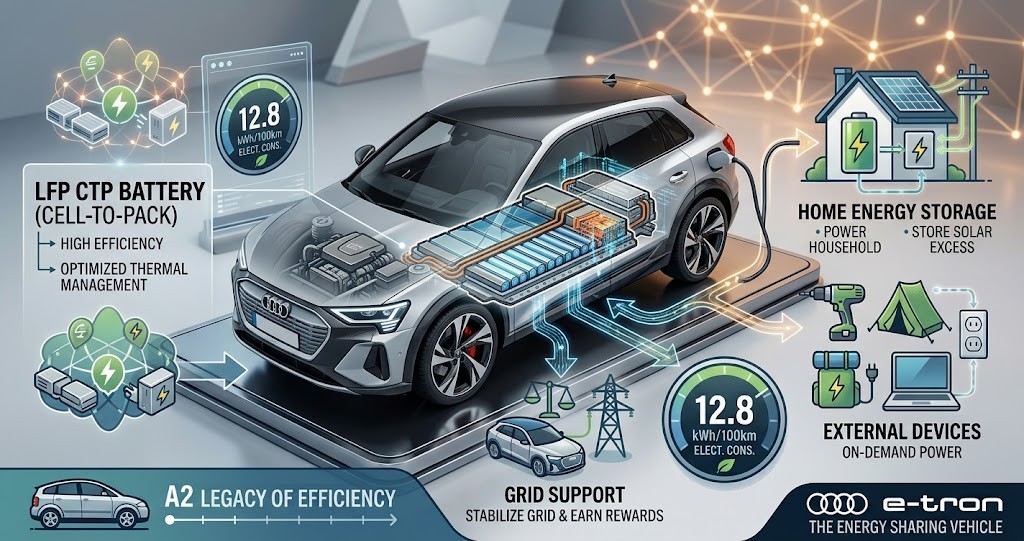
アウディは2026年秋のデビューに向けて、ブランドの電動化エントリーを担う新型コンパクトEV「A2 e-tron」を発表しました。かつて軽量アルミボディで時代を先取りした名車「A2」の名称を冠したこのモデルは、単なる移動手段にとどまらず、住居や外部機器とエネルギーを共有する「移動式蓄電池」としての役割を強化しています。
本記事では、発表されたA2 e-tronの技術概要に加え、導入されたLFPバッテリーの市場背景や双方向充電のメリットなどの関連情報をまとめて整理してお伝えします。
アウディは新型コンパクトEV「A2 e-tron」のバッテリー技術および効率性に関する詳細を公開しました。セル・トゥ・パック(CTP)構造のLFPバッテリー採用や最適化された熱管理システムにより、最高レベルの電費性能(12.8 kWh/100km)を達成したほか、V2X(双方向充電)機能を標準化し、車体をエネルギー貯蔵ユニットとして活用する設計が特徴です。
補足・関連情報
本ニュースの技術的・市場的背景をより深く理解するための関連データです。
1. LFP(リン酸鉄リチウム)バッテリーの採用トレンド
- プレミアムブランドへの波及: かつてLFPは「安価でエネルギー密度が低い」とされ低価格モデル中心の採用でしたが、近年は安全性の高さ、長寿命、希少金属(ニッケル・コバルト)不使用による環境・コスト面での優位性が評価され、アウディなどの欧州プレミアムブランドでも導入が進んでいます。
- 100%日常充電の強み: 従来のNMC(ニッケル・マンガン・コバルト)電池は劣化を防ぐため日常の充電を80%に制限することが推奨されますが、LFPは100%まで満充電しても劣化しにくいため、日常的な実用航続距離で大きな強みとなります。
2. CTP(セル・トゥ・パック)技術による空間・容量革新
- モジュールレス構造: 中間部材(モジュール)を省き、バッテリーセルを直接パックハウジングに配置することで、容積効率を高める技術です。
- 居住性と航続距離の両立: 薄型化が可能になるため、車内全高を抑えつつ足元空間を広く確保でき、コンパクトカーの車内居住性向上に直結します。
3. V2H(Vehicle to Home)とV2L(Vehicle to Load)の拡大
- 分散型エネルギー資源(DER): EVのバッテリーを家庭用蓄電池として利用するV2H(双方向充電)は、再エネ利用率の向上や災害時の非常用電源として世界的に普及が進んでいます。A2 e-tronもこの潮流に合わせた設計となっています。
主な発表内容の整理
1. 車両および電費性能
- 最高出力: 140 kW
- 電費性能: 12.8 kWh / 100 km(WLTP暫定値、オプションの効率パッケージ装着時)※アウディ史上最高効率
- 市場投入時期: 2026年秋にデビュー・受注開始、同年内に納車開始予定
2. バッテリー技術とセルの特徴
- バッテリータイプ: リン酸鉄リチウム(LFP)バッテリー
- 構造(CTP): セル・トゥ・パック方式により高エネルギー密度化と車内(足元)スペースの拡大を実現
- 急速充電: 105 kWのDC急速充電器にて26分で10%から80%まで充電可能(WLTP)
- 劣化・充電の耐久性: フラットな電圧曲線により残量が少なくても安定した出力を維持。日常的な100%満充電に対応
3. 熱管理(サーマルマネジメント)の進化
- 統合熱管理: セル化学、冷却・熱管理、充電エレクトロニクス、制御ソフトウェアを精密に連携
- 充電効率向上: 冷却システムの最適化により、AC(交流)充電時の効率が89.6%(従来比+1.3ポイント)に改善
4. 双方向充電(V2X)による多様な利点
- V2L(外部給電): 荷室ソケットやアダプター経由で電動自転車などの外部機器へ給電可能
- V2H(家庭への給電): 家庭用電力網(グリッド)へ電力を戻す蓄電ユニットとして機能
主な仕様・特徴のまとめ
| 項目 | スペック・技術概要 | 主なメリット |
| バッテリー種類 | LFP(リン酸鉄リチウム) | コバルト/ニッケル/稀少類不使用、劣化に強く常時100%充電が可能 |
| 構造 | CTP(セル・トゥ・パック) | 省スペース化による広い室内空間確保、エネルギー密度の向上 |
| 急速充電(DC) | 最大105 kW(10→80%:26分) | 安定した温度制御により短時間で確実な充電が可能 |
| AC充電効率 | 89.6%(従来比+1.3%) | 冷却システムの最適化によるエネルギー損失の低減 |
| 双方向給電 | V2L(家電/e-bike用) / V2H(家庭用電源) | 移動手段兼「家庭・レジャー用蓄電池」として機能 |
Audi Adopts LFP and CTP Technologies for the A2 e-tron: An Entry-Level EV That Doubles as a Mobile Energy Storage Unit
Ahead of its debut in autumn 2026, Audi has unveiled the all-new “A2 e-tron,” a compact EV that serves as the entry point to the brand’s electric lineup. Bearing the name of the iconic “A2″—which was ahead of its time with its lightweight aluminum body—this model goes beyond a mere means of transportation, strengthening its role as a “mobile energy storage unit” that shares energy with homes and external devices.
In addition to the technical overview of the announced A2 e-tron, this article provides a structured summary of related context, including the market background behind adopting LFP batteries and the advantages of bidirectional charging.
Overview and Key Points
Audi has disclosed detailed information regarding the battery technology and efficiency of the new A2 e-tron. By adopting LFP batteries with a Cell-to-Pack (CTP) structure and an optimized thermal management system, the vehicle achieves top-level energy efficiency (12.8 kWh/100 km). It also features standard V2X (bidirectional charging) capability, enabling the vehicle body to function as an energy storage unit.
Background & Related Information
1. Adoption Trends of LFP (Lithium Iron Phosphate) Batteries
- Expansion into Premium Brands: LFP batteries were previously considered “inexpensive with low energy density” and were mainly used in entry-level models. In recent years, however, their high safety, long service life, and environmental/cost advantages—due to not using rare metals like nickel or cobalt—have gained recognition, leading European premium brands like Audi to adopt them.
- Advantage of 100% Daily Charging: While conventional NMC (Nickel Manganese Cobalt) batteries are recommended to be capped at 80% daily charging to prevent degradation, LFP batteries resist degradation even when charged to 100% daily, offering a major advantage for practical, day-to-day driving range.
2. Spatial and Capacity Innovations via CTP (Cell-to-Pack) Technology
- Module-less Structure: This technology eliminates intermediate parts (modules) and places battery cells directly into the pack housing, increasing volumetric efficiency.
- Balancing Interior Space and Driving Range: Allowing for a thinner battery pack design lowers the overall floor height while securing generous footwell space, directly improving interior space in a compact car.
3. Expansion of V2H (Vehicle-to-Home) and V2L (Vehicle-to-Load)
- Distributed Energy Resources (DER): V2H (bidirectional charging), which utilizes an EV battery as a home energy storage unit, is expanding globally to boost renewable energy utilization and serve as emergency power during outages. The A2 e-tron is engineered in line with this trend.
Key Announcement Details
1. Vehicle Performance & Energy Consumption
- Maximum Output: 140 kW
- Energy Consumption: 12.8 kWh / 100 km (provisional WLTP, with optional efficiency package) *Most efficient Audi ever built
- Market Launch: World debut and order intake in autumn 2026, with first customer deliveries scheduled within the same year.
2. Battery Technology & Cell Features
- Battery Type: Lithium Iron Phosphate (LFP) battery
- Structure (CTP): Cell-to-Pack structure achieves higher energy density and expanded interior (footwell) space.
- Fast Charging: 10% to 80% charge in 26 minutes at a 105 kW DC fast-charging station (WLTP).
- Durability & Degradation: Flat voltage curve maintains stable power output even at low state-of-charge. Supports daily 100% full charging.
3. Evolution of Thermal Management
- Integrated Thermal Management: Precise coordination among cell chemistry, cooling/thermal management, charging electronics, and control software.
- Improved Charging Efficiency: Optimized cooling system improves AC charging efficiency to 89.6% (+1.3 percentage points compared to previous systems).
4. Various Benefits of Bidirectional Charging (V2X)
- V2L (External Power Supply): Supplies power to external devices, such as e-bikes, via luggage compartment sockets or charging port adapters.
- V2H (Home Power Supply): Functions as a home energy storage unit that feeds stored energy back into the home power grid.
Summary of Key Specifications and Features
| Item | Technical Overview & Specs | Key Benefits |
| Battery Type | LFP (Lithium Iron Phosphate) | Free of cobalt, nickel, and rare metals; highly durable against degradation, allowing continuous 100% daily charging. |
| Structure | CTP (Cell-to-Pack) | Space-saving design secures a spacious interior while increasing energy density. |
| DC Fast Charging | Up to 105 kW (10→80% in 26 min) | Stable temperature control ensures reliable, short charging sessions. |
| AC Charging Efficiency | 89.6% (+1.3% improvement) | Optimized cooling system minimizes energy loss. |
| Bidirectional Power Supply | V2L (Appliances / e-bikes) / V2H (Home Power) | Functions both as a means of mobility and a mobile energy storage unit for homes and leisure. |


コメント