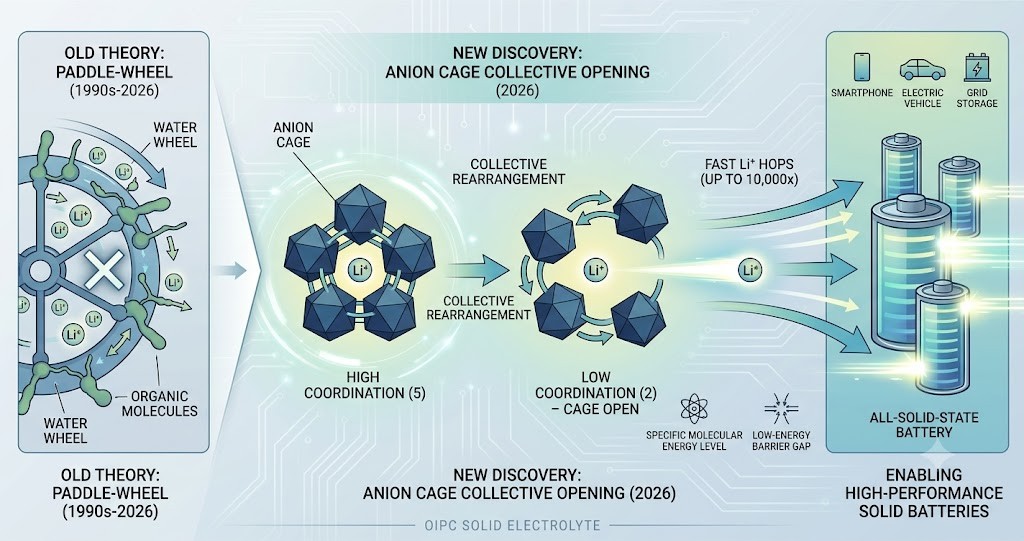
スマートフォンから電気自動車(EV)まで現代社会を支えるリチウムイオン電池ですが、可燃性の液体電解質に起因する発火・爆発リスクの克服が大きな課題となっています。この解として最も期待されているのが、不燃性の「固体電解質」を用いた全固体電池です。
中でも「やわらかい固体」として高い伝導性が期待される有機イオン性プラスチック結晶(OIPC)において、これまで25年以上信じられてきたイオン移動の定説「パドルホイール(水車)機構」を否定する衝撃的な研究成果が発表されました。分子科学研究所や西江大学校などの国際チームがスーパーコンピュータを駆使して解明したこの新メカニズムは、リチウムイオンのホップ速度を最大1万倍に引き上げる分子レベルの条件を明示し、全固体電池の材料設計に根本的なパラダイムシフトをもたらそうとしています。
- 1. 発見のハイライト:25年続いた「水車モデル」の否定
- 2. 新メカニズム:「陰イオンケージの協同開閉」と1万倍の加速
- 3. 従来理論と新理論の対比
- 4. 関連・補足情報(材料科学へのインパクトと今後の展望)
- 1. Highlights of the Discovery: Disproving the 25-Year-Old “Paddle-Wheel Model”
- 2. The New Mechanism: “Cooperative Opening of Anion Cages” and 10,000x Acceleration
- 3. Comparison Between Conventional and New Theories
- 4. Supplementary Information: Impact on Materials Science & Future Outlook
1. 発見のハイライト:25年続いた「水車モデル」の否定
- 旧定説(パドルホイール機構)の限界
- 従来の説: 結晶内の大きな有機分子やイオンの回転運動が「水車の羽根」のように働き、中心のリチウムイオンを物理的に押し出すと考えられていました。
- 新解析で判明した事実: 「ホップ関数解析」を用いてイオン個々のジャンプ事象をミクロに抽出した結果、周囲の分子の回転運動とリチウムイオンの跳躍には相関がほぼゼロ(無関係)であることが証明されました。
2. 新メカニズム:「陰イオンケージの協同開閉」と1万倍の加速
水車で押し出されるのではなく、リチウムイオンを包む「鳥かご(ケージ)」の扉が一瞬開くことが高速移動の真の正体でした。
協同的な配置換え(席替え)
- リチウムイオンを取り囲む4番目・5番目の隣接陰イオンが互いに位置を入れ替える(協同運動を行う)ことで、ケージの壁に一瞬「隙間」が生じます。
- 配位数「2」でホップ速度が最大約1万倍に
- リチウムイオンに配位(結合)する陰イオンの数が一時的に2個まで減少する「開いた状態」が形成されます。この瞬間に静電的拘束から解放され、ホップ速度が通常の束縛状態と比べて最大約1万倍に跳ね上がることが実証されました。
3. 従来理論と新理論の対比
| 比較項目 | 従来定説(パドルホイール機構) | 本研究の解明(ケージ協同開閉モデル) |
|---|---|---|
| 提唱・証明時期 | 25年以上支持されてきた定説 | 2026年(本研究による最新の計算科学的証明) |
| イオン移動の主要動因 | 周囲の構成分子・イオンの物理的回転運動 | 周囲の陰イオンによる「ケージ」の協同的な配置換え・開閉 |
| イオン周囲の局所状態 | 常に多配位で包まれ、回転により順次押し出される | 通常は強く拘束されているが、配位数が一時的に「2個」へ減少する |
| 設計時の狙い・指標 | マトリックス分子の「回転運動の活性化」 | 陰イオンケージの「開閉しやすさ・低エネルギー配置換え」 |
4. 関連・補足情報(材料科学へのインパクトと今後の展望)
本研究成果が全固体電池産業や材料開発に与える影響について解説します。
① 全固体電池の分類とOIPC(有機イオン性プラスチック結晶)の位置づけ
全固体電池の電解質材料は大きく「無機系」と「有機系」に分かれます。
- 硫化物系(無機): イオン伝導率が極めて高いが、水と反応して有毒な硫化水素を発生する(トヨタ等が注力)。
- 酸化物系(無機): 非常に安定で安全だが、固く硬質であるため電極との界面抵抗が大きい。
- OIPC(有機): プラスチックのような柔軟性を持ち、電極との密着性(界面抵抗の低減)と安全性を兼ね備える「やわらかい固体」。
今回の発見はOIPCを対象としたものですが、解析手法(ホップ関数解析)や「局所的な静電拘束の解除」という考え方は、無機系(硫化物・酸化物)やポリマー系電解質の開発にも広く応用可能です。
② 分子設計アプローチの全面刷新
- 「力ずくの流動性」から「局所構造の精密デザイン」へ 従来の「とにかく分子を激しく動かして流動性を出す」アプローチから、「イオン配位数を一時的に減らしやすい分子骨格をつくる」「隣接アニオンが少ないエネルギーで動ける隙間を設計する」という精密な化学合成理論へ転換します。
- マテリアルズ・インフォマティクス(MI)への貢献 AIや計算科学を用いた新材料の自動探索において、「ケージ開閉エネルギー」や「二配位状態の安定度」をスコア化することで、ハイスループットな高性能固体電解質のスクリーニングが可能になります。
③ 実用化に向けた課題(理論から実験・実証へ)
- 理想計算と実電池環境のギャップ シミュレーションは単結晶に近い理想状態で行われていますが、現実の電池セル内には「結晶粒界(多結晶の境界)」や「充放電に伴う膨張・収縮ストレス」「局所的な高電圧・強電界」が存在します。
- 合成と検証のハードル 理論上見出された「配位数2をつくりやすい陰イオンケージ構造」を、実際の化学合成プロセスで再現し、充放電サイクル寿命や実測伝導率として立証できるかが今後の最大の焦点となります。
出典:https://xenospectrum.com/beyond-paddle-wheel-oipc-lithium/
Latest Theoretical Research on Accelerating Lithium-Ion Transport in Solid Electrolytes
While lithium-ion batteries power modern society—from smartphones to electric vehicles (EVs)—overcoming the risks of fire and explosion associated with flammable liquid electrolytes remains a critical challenge. The most promising solution is the all-solid-state battery, which utilizes non-flammable “solid electrolytes.”
In particular, Organic Ionic Plastic Crystals (OIPCs) have garnered high expectations as “soft solids” capable of high conductivity. However, a groundbreaking study has recently been published that disproves the long-held “paddle-wheel mechanism”—a core theory of ion transport believed for over 25 years. Using supercomputers, an international research team from the Institute for Molecular Science, Sogang University, and other institutions uncovered a new mechanism that clarifies the molecular-level conditions capable of boosting lithium-ion hopping speeds by up to 10,000 times. This discovery promises a fundamental paradigm shift in material design for all-solid-state batteries.
1. Highlights of the Discovery: Disproving the 25-Year-Old “Paddle-Wheel Model”
- Limitations of the Old Theory (Paddle-Wheel Mechanism)
- Conventional View: It was believed that the rotational motion of large organic molecules or ions within the crystal matrix acted like paddle-wheel blades, physically pushing the central lithium ion forward.
- Findings from New Analysis: Using “hop function analysis” to extract individual ion jumping events at a microscopic level, the team demonstrated that the correlation between the rotation of surrounding molecules and the jumping of lithium ions is virtually zero (unrelated).
2. The New Mechanism: “Cooperative Opening of Anion Cages” and 10,000x Acceleration
Rather than being pushed by a paddle wheel, the true driver of high-speed transport is the momentary opening of the “cage” surrounding the lithium ion.
- Cooperative Rearrangement (“Seat Switching”)When the 4th and 5th nearest anions surrounding a lithium ion swap positions (cooperative motion), a momentary gap is created in the cage wall.
- 10,000x Hopping Speed Acceleration at Coordination Number 2An “open state” is formed where the number of anions coordinated (bound) to the lithium ion temporarily decreases to two. At this exact moment, the lithium ion is freed from electrostatic confinement, causing its hopping speed to surge by up to roughly 10,000 times compared to its standard bound state.
3. Comparison Between Conventional and New Theories
| Feature | Conventional Theory (Paddle-Wheel Mechanism) | New Discovery (Cooperative Cage Opening Model) |
| Period of Origin/Proof | Dominant consensus for over 25 years | 2026 (Latest computational science proof) |
| Primary Transport Driver | Physical rotation of surrounding matrix molecules/ions | Cooperative rearrangement and opening of “cages” by surrounding anions |
| Local Environment Around Ion | Continuously multi-coordinated, pushed sequentially by rotation | Normally strongly bound, but coordination number temporarily drops to 2 |
| Design Target & Metric | Activation of matrix molecule rotational motion | Ease of cage opening & low-energy structural rearrangement |
4. Supplementary Information: Impact on Materials Science & Future Outlook
Here is an analysis of how these findings will influence the battery industry and materials development.
① Classification of Solid Electrolytes & Position of OIPCs
Solid electrolytes are broadly divided into inorganic and organic types:
- Sulfide-based (Inorganic): Extremely high ionic conductivity, but reacts with moisture to generate toxic hydrogen sulfide gas (a focus for companies like Toyota).
- Oxide-based (Inorganic): Highly stable and safe, but very rigid, leading to high interfacial resistance with electrodes.
- OIPCs (Organic): “Soft solids” combining plastic-like flexibility with good electrode contact (low interfacial resistance) and safety.
Although this discovery focused on OIPCs, the analytical approach (hop function analysis) and the principle of “releasing local electrostatic confinement” can be broadly applied to inorganic (sulfide/oxide) and polymer electrolytes.
② Overhauling the Molecular Design Approach
- From “Brute-Force Fluidity” to “Precise Local Design”Materials synthesis shifts from trying to maximize overall molecular rotation to designing molecular frameworks that easily permit temporary reductions in coordination number and low-energy anion displacement.
- Contribution to Materials Informatics (MI)In automated AI/computational material discovery, scoring metrics such as “cage-opening energy” or “two-coordinate state stability” will enable high-throughput screening of high-performance solid electrolytes.
③ Challenges Toward Practical Application (From Theory to Experiment)
- Gap Between Ideal Calculations and Real Battery EnvironmentsSimulations model near-ideal single-crystal states. However, real battery cells involve grain boundaries, expansion/contraction stresses during charging/discharging, and intense local electric fields.
- Synthesis and Validation HurdlesThe main focus now shifts to whether anion cage structures prone to forming a coordination number of 2 can be reliably synthesized in the lab and proven to yield superior cycle life and measured conductivity.


コメント