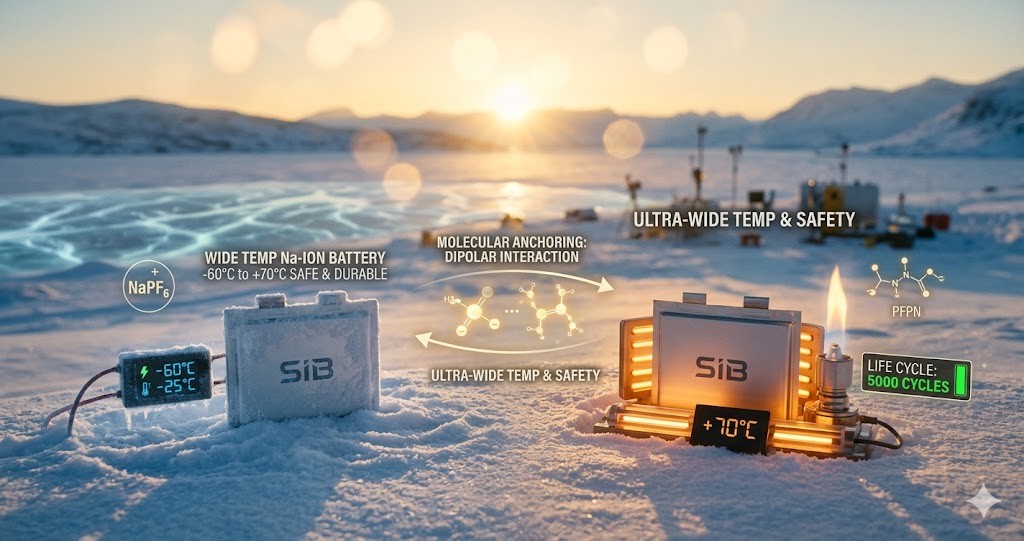
本研究は、ナトリウムイオン電池(SIB)の実用化を阻む「安全性」「寿命」「広温度域での作動」という課題を解決するため、新しい電解液設計指針を提案しています。
東北師範大学の研究チームは、双極子相互作用(Dipolar interaction)を利用して溶媒分子を固定(アンカリング)する電解液を開発しました。この電解液により、-60から+70℃という極めて広い温度範囲で、高い安全性と耐久性を両立させることに成功しています。
1. 開発された電解液の構成と具体的な化合物
研究チームは、性質の異なる3つの成分を組み合わせた「統合型溶媒システム」を設計しました。
| 成分の役割 | 具体的な化合物名 | 略称 | 化学式 |
| 強溶媒(高誘電率) | プロピレンカーボネート | PC | C4H6O3 |
| 弱溶媒(低融点) | エチレングリコールジエチルエーテル | DEE | C6H14O2 |
| 難燃剤・反溶媒 | エトキシ(ペンタフルオロ)シクロトリホスファゼン | PFPN | P3N3F5(OC2H5) |
| 支持塩 | ヘキサフルオロリン酸ナトリウム | NaPF6 | NaPF6 |
分子アンカリングの仕組み
通常、PCやDEEのような溶媒は揮発性や可燃性があり、高電圧で分解しやすい性質を持ちます。この研究では、PFPNという化合物がアンカー(錨)の役割を果たします。
- 双極子相互作用: 分子内の電荷の偏りδ+ Hとδ- F、δ+ Hとδ- O)を利用して、自由な溶媒分子をPFPNが捕まえます。
- 効果: これにより、溶媒の酸化分解が抑制され、燃えにくく、かつ極低温でも結晶化しにくい安定なネットワークが形成されます。
2. 主な成果と性能指標
開発された電解液(NDPPと命名)は、従来の電解液と比較して圧倒的な性能を示しました。研究では、開発した電解液の性能を多角的に検証するため、以下の3つの異なるセル構成で試験が行われています。
A. ハーフセル(評価用コインセル)
電解液の基礎特性や、正極・負極それぞれの耐久性を個別に評価するために使用されました。
- 構成: 正極材料 または 負極材料 || 金属ナトリウム(対極)
- 評価内容:
- 高電圧正極の評価: Na3V2(PO4)2O2F(NVPOF)を使用。4.2 V以上の高電圧環境下で、5000サイクルの超長寿命を確認。
- 既存正極の評価: Na3V2(PO4)3(NVP)や層状酸化物(NNMO)を用い、幅広い温度での作動を検証。
- 負極の評価: ハードカーボン(HC)を用い、負極表面に安定な保護膜が形成されるかを確認。
B. フルセル(コインセル型)
実用に近い形として、正極と負極の両方に実際の材料を組み合わせた構成です。
- 構成: ハードカーボン(負極) || NVPOF または 層状酸化物(正極)
- 評価内容: 25℃および50℃での長期間の充放電安定性を実証。
C. パウチセル(実用プロトタイプ)
研究室レベルを超え、実用化に近いラミネート袋型の大型セルです。
低温実証: -25℃、-40℃、さらには-60℃という極寒環境下でも、十分なエネルギーを取り出せることを確認。
構成: ハードカーボン(負極) || ナトリウム・ニッケル・鉄・マンガン酸化物(正極)
評価内容:
常温で1.25 Ahの放電容量と102.8 Wh/kgのエネルギー密度を達成。
高い耐久性と電圧安定性
- 長寿命: 高電圧リン酸塩正極(NVPOF)を用いた試験で、2 Cの高速充放電を5000サイクル繰り返した後も、87.6%という高い容量保持率を維持しました。
- 強固な界面: 電極表面にフッ素(F)や窒素(N)を含む緻密な保護膜(EEI)を形成し、電解液の無駄な分解を防ぎます。
驚異的な温度適応性
この電解液は、過酷な環境下でも作動します。
- 高温環境(70℃): 900サイクル後も95.2%の容量を維持。
- 極低温環境(-60℃): 多くの電池が凍結して動かなくなる -60℃においても、放電能力を保持しています。
安全性の向上
- 自己消火性: PFPNの難燃効果(窒素やリンによるラジカル捕捉メカニズム)により、火を近づけても燃え広がらない非燃焼性を実現しました。
この研究は、電解液の分子レベルでの相互作用を制御することで、ナトリウムイオン電池の商業化に向けた大きな一歩を踏み出したと言えます。
将来的にこの技術が普及すれば、気候変動が激しい地域でも安定して使える、安全で安価なエネルギー貯蔵システムが実現するかもしれません。
出典:https://www.nature.com/articles/s41467-026-71861-7
Operating from -60°C to 70°C: Design Guidelines for High-Safety, High-Durability Electrolytes for Next-Generation SIBs
This study proposes new electrolyte design guidelines to address the challenges of safety, lifespan, and wide-temperature operation that hinder the commercialization of sodium-ion batteries (SIBs).
A research team from Northeast Normal University has developed an electrolyte that “anchors” solvent molecules using dipolar interactions. This electrolyte successfully balances high safety and durability across an extremely broad temperature range from -60°C to +70°C.
1. Electrolyte Composition and Specific Compounds
The research team designed an “integrated solvent system” combining three components with distinct properties.
| Role | Compound Name | Abbreviation | Chemical Formula |
| Strong Solvent (High Dielectric) | Propylene Carbonate | PC | C4H6O3 |
| Weak Solvent (Low Melting Point) | Ethylene Glycol Diethyl Ether | DEE | C6H14O2 |
| Flame Retardant / Anti-solvent | Ethoxy(pentafluoro)cyclotriphosphazene | PFPN | P3N3F5(OC2H5) |
| Supporting Salt | Sodium Hexafluorophosphate | NaPF6 | NaPF6 |
Mechanism of Molecular Anchoring
Typically, solvents like PC and DEE are volatile, flammable, and prone to decomposition at high voltages. In this study, the compound PFPN acts as an “anchor.”
- Dipolar Interaction: PFPN captures free solvent molecules by utilizing charge imbalances within the molecules (delta+ H to delta- F and delta+ H to delta- O).
- Effect: This suppresses the oxidative decomposition of the solvents and forms a stable network that is flame-resistant and resistant to crystallization even at ultra-low temperatures.
2. Key Achievements and Performance Indicators
The developed electrolyte (named NDPP) demonstrated overwhelming performance compared to conventional electrolytes. The study verified its performance using three different cell configurations:
A. Half-Cells (Coin Cells for Evaluation)
Used to individually evaluate basic electrolyte characteristics and the durability of the cathode and anode.
- Configuration: Cathode or Anode material || Sodium metal (Counter electrode)
- Evaluation:
- High-Voltage Cathode: Using Na3V2(PO4)2O2F (NVPOF), an ultra-long life of 5,000 cycles was confirmed under high-voltage conditions (> 4.2 V).
- Existing Cathodes: Operations across wide temperatures were verified using Na3V2(PO4)3 (NVP) and layered oxides (NNMO).
- Anode: Using Hard Carbon (HC), the formation of a stable protective layer on the anode surface was confirmed.
B. Full-Cells (Coin-Type)
A configuration combining actual cathode and anode materials to simulate practical use.
- Configuration: Hard Carbon (Anode) || NVPOF or Layered Oxide (Cathode)
- Evaluation: Demonstrated long-term charge-discharge stability at 25°C and 50°C.
C. Pouch Cells (Practical Prototype)
Large-scale, laminate-type cells close to commercial application, moving beyond the laboratory level.
- Configuration: Hard Carbon (Anode) || Sodium Nickel Iron Manganese Oxide (NNFMO) (Cathode)
- Evaluation:
- Achieved a discharge capacity of 1.25 Ah and an energy density of 102.8 Wh/kg at room temperature.
- Low-Temperature Validation: Confirmed that sufficient energy can be extracted even in extreme cold environments of -25°C, -40°C, and even -60°C.
High Durability and Voltage Stability
- Long Life: Maintained a high capacity retention of 87.6% after 5,000 high-speed charge-discharge cycles at 2 C using the high-voltage phosphate cathode (NVPOF).
- Robust Interface: Forms a dense Electrode-Electrolyte Interphase (EEI) containing Fluorine (F) and Nitrogen (N) on the electrode surface, preventing wasteful decomposition of the electrolyte.
Remarkable Temperature Adaptability
The electrolyte remains functional under extreme conditions:
- High-Temperature (70°C): Maintained 95.2% capacity even after 900 cycles.
- Ultra-Low Temperature (-60°C): Retains discharge capability even at -60°C, where most batteries would freeze.
Enhanced Safety
- Self-Extinguishing: Due to the flame-retardant effect of PFPN (radical trapping mechanism by nitrogen and phosphorus), the electrolyte achieved non-flammable properties that prevent fire from spreading even when exposed to a flame.
This research represents a major step toward the commercialization of sodium-ion batteries by controlling molecular-level interactions within the electrolyte. If this technology becomes widespread, it could lead to safe, low-cost energy storage systems that operate reliably in regions with extreme climatic conditions.

コメント