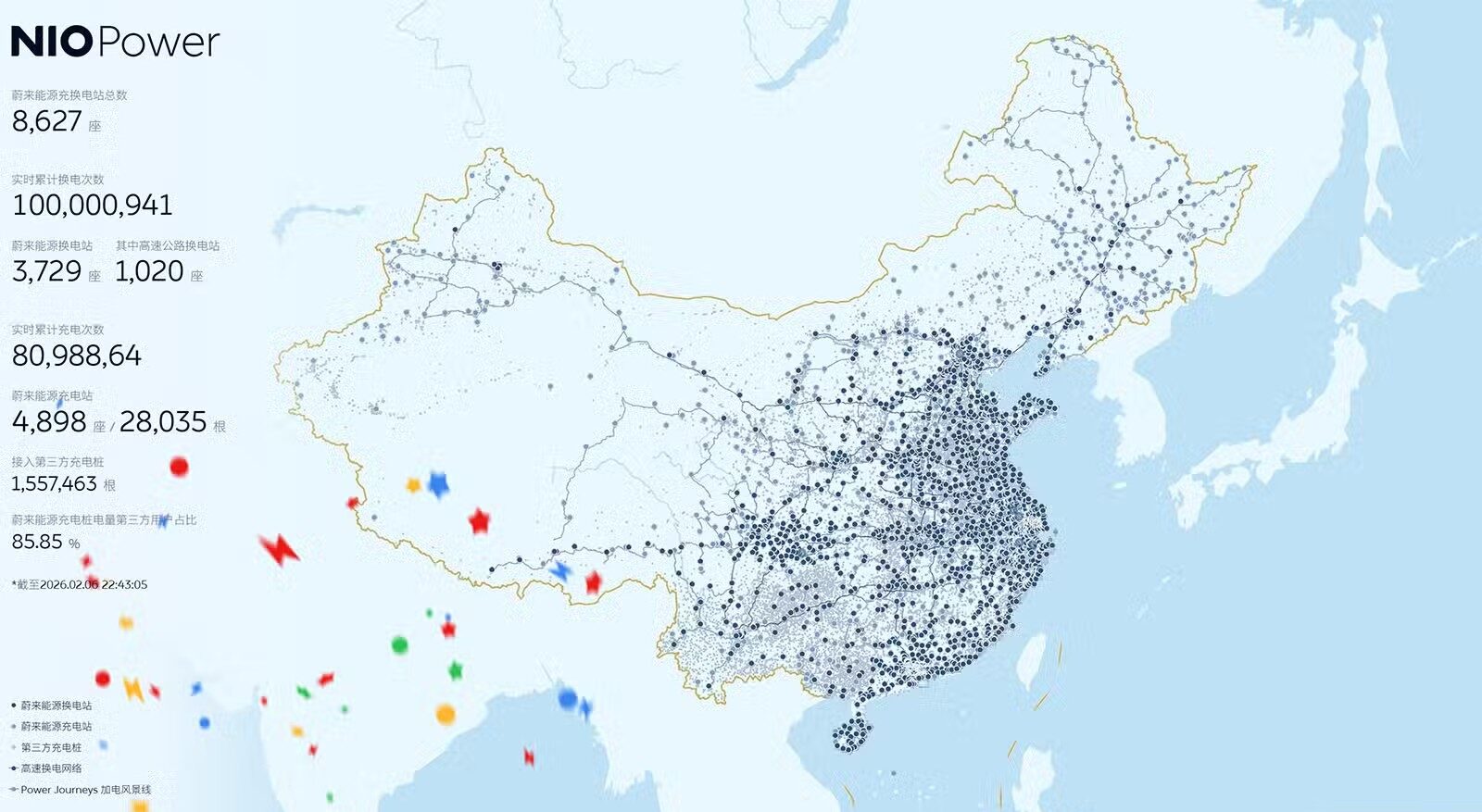
Nio Incは2026年2月6日、同社の代名詞であるバッテリー交換サービス(Battery Swap)の累計利用回数が1億回の大台を突破したと発表しました。2018年に広東省深セン市で第1号店をオープンしてから2819日目での快挙となります。
実績とユーザーへのメリット
- 時間節約: 充電と比較し、累計で8341万時間を節約(ユーザー1人あたり平均88時間)。
- コスト削減: ガソリン車と比較し、累計263億人民元の節約(ユーザー1人あたり平均2万7000人民元)。
- 環境貢献: CO2排出量を4170トン削減(樹木16.7万本の年間吸収量に相当)。
- 電力消費: 累計52.8億kWhを供給(264万世帯の年間電力使用量に相当)。
ネットワークの現状(2026年2月時点)
- 交換ステーション数: 中国全土で3729箇所(うち高速道路沿いが1020箇所)。
- 充電インフラ: 4898箇所の充電ステーション(2万8035基の充電台)も併設。
- 成長スピード: 最初の1000万回達成には約4年を要しましたが、直近では数ヶ月ごとに1000万回を上積みする急加速を見せています。
関連情報:Nioの「交換ビジネス」が成功した理由と今後の展望
今回の1億回達成という数字が持つ意味を理解するための背景情報を補足します。
1. BaaS(Battery as a Service)という革命
Nioの成功の鍵は、車両本体とバッテリーの所有権を切り離した「BaaS」モデルにあります。
- ユーザーはバッテリー代を除いた安価な価格で車両を購入し、バッテリーは月額サブスクリプションで利用します。これにより、EV購入時の高コストとバッテリー劣化によるリセールバリュー低下という2大懸念を解消しました。
2. 「バッテリー交換アライアンス」の拡大
当初、バッテリー交換はNio独自の「囲い込み技術」と見なされていましたが、現在は業界標準化への動きが加速しています。
- 中国の吉利汽車(Geely)、長安汽車、セレス(Seres)などの大手メーカーがNioの交換ネットワークへの参画を表明しています。このオープン化戦略により、ステーションの稼働率が上がり、収益性が改善しています。
3. 第4世代ステーションとV2G技術
現在導入が進んでいる第4世代ステーションは、交換時間の短縮だけでなく、電力網との調整機能(V2G: Vehicle-to-Grid)を備えています。
- ステーション自体が巨大な蓄電池として機能し、電力需要が少ない時に充電し、ピーク時に網へ供給することで、地域のエネルギーインフラとしての役割も担い始めています。
出典:https://cnevpost.com/2026/02/06/nio-reaches-100-million-battery-swap-services/
100 Million Swaps Achieved! Nio’s Milestone Proves the Convenience of the New EV Era
On February 6, 2026, Nio Inc. announced that its signature Battery Swap service has officially surpassed the cumulative milestone of 100 million swaps. This achievement comes 2,819 days after the company opened its very first station in Shenzhen, Guangdong Province, in May 2018.
Track Record and User Benefits
- Time Savings: Compared to conventional charging, the service has saved a cumulative 83.41 million hours (an average of 88 hours per user).
- Cost Reduction: Compared to gasoline vehicles, users have saved a cumulative 26.3 billion RMB (an average of 27,000 RMB per user).
- Environmental Contribution: Reduced CO2 emissions by 4,170 tons (equivalent to the annual carbon absorption of 167,000 trees).
- Energy Delivery: Provided a cumulative 5.28 billion kWh of electricity (equivalent to the annual electricity usage of 2.64 million households).
Network Status (As of February 2026)
- Battery Swap Stations: 3,729 locations across China (including 1,020 along highways).
- Charging Infrastructure: Operates 4,898 charging stations with 28,035 charging piles.
- Growth Momentum: While it took nearly four years to reach the first 10 million swaps, the pace has accelerated drastically, now adding 10 million swaps every few months.
Background: Why Nio’s “Swap Business” Succeeded and What Lies Ahead
To understand the significance of the 100 million milestone, here is some additional context:
1. The BaaS (Battery as a Service) Revolution
The key to Nio’s success lies in the “BaaS” model, which decouples the ownership of the vehicle body from the battery. Users can purchase the vehicle at a lower price (excluding the battery cost) and use the battery through a monthly subscription. This solves the two biggest concerns of EV buyers: high upfront costs and resale value depreciation due to battery degradation.
2. Expansion of the “Battery Swap Alliance”
Initially viewed as a proprietary “walled garden” technology, battery swapping is rapidly moving toward industry standardization. Major manufacturers like Geely, Changan Automobile, and Seres have joined Nio’s swap network. This open-platform strategy increases station utilization and improves overall business profitability.
3. Fourth-Generation Stations and V2G Technology
The currently deploying 4th-generation stations not only shorten swap times but also feature V2G (Vehicle-to-Grid) capabilities. By acting as massive energy storage units, these stations charge during low-demand hours and supply power back to the grid during peaks, evolving into critical local energy infrastructure.
コメント