自動車メーカー各社が開発に凌ぎを削る「全固体電池」。高いエネルギー密度と超急速充電性能、そして優れた安全性を兼ね備えた「夢の次世代電池」として期待が集まる一方で、車載化に向けたコストや耐久性の壁、さらには既存電池の目覚ましい進化によって、その立ち位置や導入ペースを見極める冷徹な視点も広がっています。
【解説】全固体電池は「夢の技術」か、それとも「過度な期待」か?
要点サマリー
- 実用化の現実: 2027年〜2030年にかけて各社から搭載BEVが登場する見込みだが、初期は1,000万円を超える高級車・特定モデルに限られる公算が大きい。
- ゲームチェンジャーへの壁: 技術的メリット(大容量・超急速充電・安全性)はあるものの、初期の「高価格」や「耐久性/界面接触の維持」といった課題が大きく、登場後すぐに既存BEVを置き換えるわけではない。
- 既存電池(液系LIB)の台頭: LFP(リン酸鉄リチウム)やハイニッケルNCMなどの既存リチウムイオン電池(LIB)のコスト低下と性能向上が著しく、「日常生活レベルでは既存電池で十分」という見方が強まっている。
1. 自動車各社のロードマップと適用製品の段階
主要メーカーは実証・パイロットラインの整備を進めており、市場投入時期の目標を定めています。
- トヨタ自動車: 出光興産等と協業し、2027年〜2028年の市場投入・量産化を目指す。
- 日産自動車: 横浜工場内にパイロットラインを設置し、2028年度までの量産化・車載化を推進。
- ホンダ: 栃木県さくら市に実証ラインを構築し、2020年代後半の市場投入を目標に開発。
- 小型・産業用領域: 小型電子機器や医療・産業用などの領域では、充放電に伴う体積変化の問題が限定的であるため、車載用に先行してすでに実用化が進行中。
2. 技術的・コスト的アスペクトの整理
| 評価軸 | 全固体電池(ポテンシャル) | 既存リチウムイオン電池(現在〜近未来) |
| エネルギー密度 | 非常に高い(航続距離1,000km超の実現性) | 中〜高(LFP等で実用域500〜700kmをカバー) |
| 充電速度 | 超急速充電(数分〜10分程度) | 急速充電(15〜30分程度) |
| 安全性 | 不燃性固形電解質のため極めて高い | 液体電解質使用のため保護回路・冷却構造が必要 |
| 技術課題 | 充放電時の体積変化(膨張・収縮)による界面剥離、デンドライト形成 | 高温時の安定性確保、過充電防止技術の成熟 |
| コスト/車両価格 | 極めて高額(初期車両価格は1,000万円超を予想) | 低コスト化が進展(LFPやナトリウムイオン電池の普及) |
3. 「ゲームチェンジャーになりきれない」とされる3つの背景
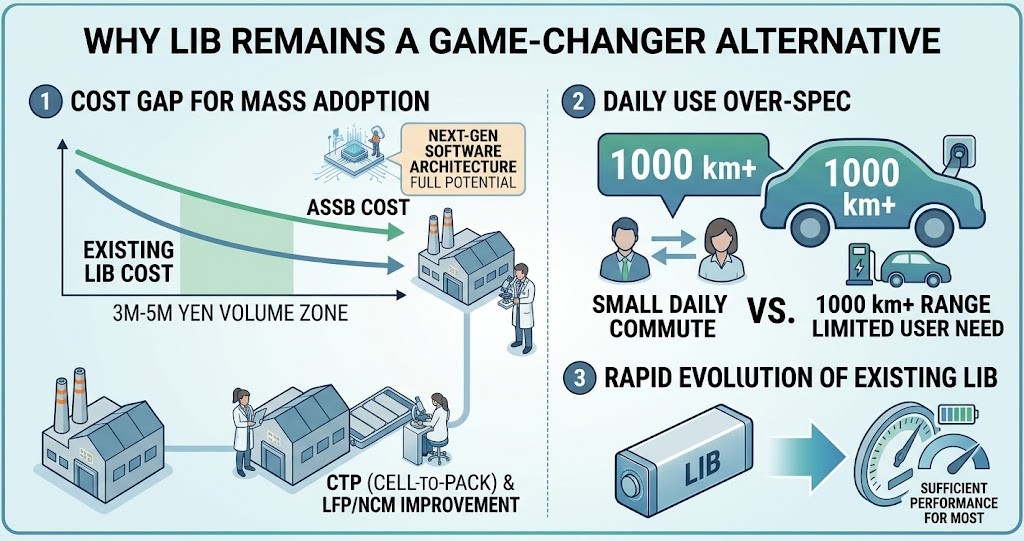
① コストパフォーマンスと大衆普及のギャップ
BEV普及の鍵を握るボリュームゾーン(300万〜500万円台)に全固体電池が降りてくるには、量産ラインの安定化や材料調達網の構築を含め、数年から10年単位の時間を要します。
② 日常利用における「過剰スペック」問題
一般ユーザーの1日あたりの平均走行距離や自宅充電を中心とする運用形態を考慮した場合、1,000km超の航続距離や極端な超急速充電の必要性が限定的であり、高額な車載コストに見合わない可能性があります。
③ 既存リチウムイオン電池(LFP/NCM)の進化スピード
全固体電池の研究開発が進む一方で、既存の液系リチウムイオン電池もセル・ツゥ・パック(CTP)構造の採用や化学組成の改良により、安価で安全かつ十分な性能を持つ製品へと急速に進化を遂げています。全固体電池が真価を発揮するには、高精度な自動運転(ADAS)や車載コンピューティングなど、超高消費電力・高出力特性を求める次世代ソフトウェア構造との連携が前提になると考えられます。
出典:https://carview.yahoo.co.jp/article/detail/c4daa5a647ba556672e656a9b8db7046fdbe0dff/
Are Solid-State Batteries an “Overhyped Expectation”? The Reality of Automotive Adoption Amid the Evolution of Conventional Lithium-Ion Batteries
As automakers actively compete in the development of all-solid-state batteries, expectations remain high for this “dream next-generation technology” that combines high energy density, ultra-fast charging capabilities, and exceptional safety. At the same time, sober perspectives are gaining traction—pointing to severe cost and durability barriers for automotive integration, alongside the remarkable evolution of conventional liquid-electrolyte batteries that challenges the timing and necessity of a rapid transition.
Commentary: Solid-State Batteries — A Breakthrough Technology or Overhyped Expectations?
Executive Summary
- Commercialization Timeline: While automakers aim to launch EVs equipped with solid-state batteries between 2027 and 2030, initial rollouts are expected to be strictly limited to high-end luxury vehicles and niche models priced well above 10 million JPY.
- Hurdles to Game-Changer Status: Despite technical merits (high capacity, ultra-fast charging, and inherently non-flammable safety), major obstacles—such as high initial costs and maintaining long-term interface contact—mean solid-state cells will not immediately replace existing BEVs.
- Rise of Conventional LIBs: Existing liquid lithium-ion batteries (LIBs), including LFP (lithium iron phosphate) and high-nickel NCM chemistries, have seen rapid cost reductions and performance gains. This fuels a growing consensus that conventional batteries are “more than sufficient” for everyday driving needs.
1. Automaker Roadmaps and Application Phases
Major automakers are building pilot production lines and establishing target timelines for market introduction:
- Toyota Motor: Collaborating with Idemitsu Kosan and other partners, targeting commercialization and mass production in the 2027–2028 timeframe.
- Nissan Motor: Operating a pilot line at its Yokohama Plant, driving toward mass production and vehicle integration by fiscal year 2028.
- Honda: Setting up a verification production line in Sakura City, Tochigi Prefecture, aiming for a late-2020s market launch.
- Small-Scale & Industrial Sectors: In small consumer electronics, medical devices, and aerospace, solid-state batteries are already entering practical use ahead of automotive applications, as volume expansion issues during charge-discharge cycles are far easier to manage in compact form factors.
2. Technical and Economic Comparison
| Feature / Metric | All-Solid-State Battery (Potential) | Existing Lithium-Ion Battery (Current to Near Future) |
| Energy Density | Exceptionally high (enables range exceeding 1,000 km) | Medium to High (LFP covers practical range of 500–700 km) |
| Charging Speed | Ultra-fast charging (few minutes to ~10 minutes) | Fast charging (15–30 minutes) |
| Safety | Extremely high due to non-flammable solid electrolyte | Requires protective circuits and cooling structures due to liquid electrolyte |
| Technical Challenges | Interface delamination caused by volume changes (expansion/contraction) during cycling; dendrite formation | High-temperature stability; maturing overcharge protection systems |
| Cost / Vehicle Price | Extremely high (initial vehicle price estimated to exceed 10M JPY) | Ongoing cost reductions (widespread adoption of LFP and sodium-ion batteries) |
3. Three Reasons Solid-State Batteries May Fall Short of Being an Immediate “Game-Changer”
1) Gap Between Cost Performance and Mass Adoption
For solid-state batteries to reach the volume market segment (3 million to 5 million JPY), which is critical for widespread BEV penetration, stabilizing mass production lines and establishing raw material supply chains will take anywhere from several years to a decade.
2) The “Over-Spec” Issue in Everyday Driving
Given average daily driving distances and the prevalence of overnight home charging, a range exceeding 1,000 km or extreme ultra-fast charging offers limited practical benefit to most drivers, making the high cost hard to justify.
3) Rapid Pace of Evolution in Existing LIBs (LFP / NCM)
While solid-state R&D progresses, liquid-electrolyte lithium-ion batteries continue to evolve rapidly through Cell-to-Pack (CTP) structural designs and refined chemistry, delivering safe, affordable, and fully adequate performance. For solid-state batteries to demonstrate their true value, they must be paired with next-generation vehicle architectures—such as advanced autonomous driving (ADAS) and high-power onboard computing—that demand high energy consumption and continuous high-power output.
コメント