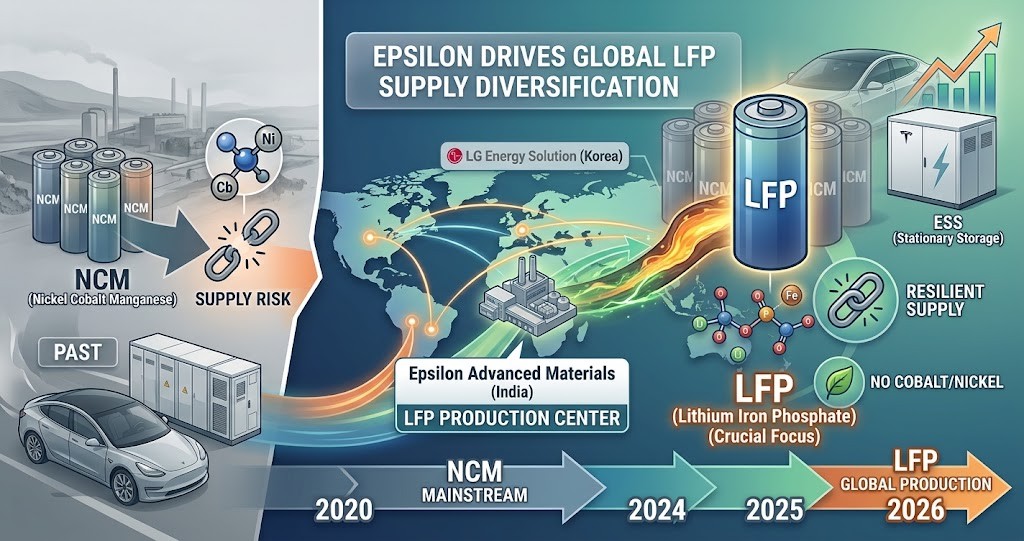
かつてEV市場では、エネルギー密度が高く航続距離を伸ばしやすいニッケル・コバルト・マンガン(NCM)をはじめとする三元系バッテリーが主流とされていました。しかし、製造コストの削減、希少金属(コバルトやニッケル)依存によるサプライチェーンリスクの回避、そして何より高い安全性の確保が最優先課題となる中、リン酸鉄リチウム(LFP)バッテリーが急速に存在感を高めています。
テスラをはじめとする大手EVメーカーがエントリーモデルを中心にLFPの採用を本格化させたことを皮切りに、現在では定置用エネルギー貯蔵システム(ESS)市場においてもLFPが標準となりつつあります。2026年現在、これまで中国企業が市場の大半を独占してきたLFPサプライチェーンに対し、印Epsilon CAMや韓国LG Energy Solution(LGES)といったグローバルプレイヤーが脱中国依存・供給網の多角化を目指して大規模な投資と技術検証を進めています。
以下に、最新の技術開発および企業の戦略的取り組みを関連情報を交えて解説します。
1. LFPバッテリーが市場で選ばれる理由
LFPバッテリーは、他のリチウムイオン電池化学組成と比較して以下の強みを持ちます。
- 安全性と高い熱安定性 結晶構造(オリビン構造)が非常に安定しているため、高温環境下や過充電・内部ショート時にも酸素を放出しにくく、熱暴走や発火のリスクを大幅に低減します。
- 高いコストパフォーマンス 高価なコバルトやニッケルを使用せず、地球上に豊富に存在する鉄(Fe)とリン酸(PO4)を主原料とするため、材料コストを大きく抑えられます。
- 長寿命(優れたサイクル特性) 充放電による構造劣化が少なく、数千サイクル以上の寿命を実現します。これにより、頻繁な充放電が繰り返される電力網(グリッド)向けESSや商用EVにおいて非常に高い経済性を発揮します。
【関連情報・補足】
近年では、LFPの弱点であった「エネルギー密度の低さ(航続距離の短さ)」や「低温時の性能低下」を克服するため、正極にマンガンを追加したLMFP(リン酸鉄マンガンリチウム)技術の開発や、パック構造の工夫(セル・トゥ・パック:CTP構造)によるモジュール無駄空間の排除など、システム全体の進化が並行して進んでいます。
2. 2026年における最新の進化と企業動向
■ Epsilon CAM:第3.0世代(Gen 3.0)LFP正極材のグローバル検証
インド系のEpsilon Group傘下であるEpsilon CAMは、開発した第3.0世代LFP正極材の顧客検証段階(グローバル大手電池メーカーによる実証テスト)に入りました。
- 性能スペック:放電容量 159 mAh/g、電極密度 2.51 g/cc 以上を達成。従来は中国メーカーが独占していた高密度・高性能水準に達しています。
- 開発・生産体制:ドイツのムースブルクにあるCathode技術センターが検証活動をバックアップしており、2028年までに年間2万トン(20,000 TPA)の生産能力を整備する計画です。
- 意義:グローバル顧客による厳しい実環境テストを通過することで、製品の信頼性と大量生産時の品質再現性が証明され、長期的な供給契約への道が開かれます。
■ LG Energy Solution:北米ESS市場を見据えた調達と生産網の拡大
韓国の電池大手LG Energy Solution(LGES)は、ESS用途を中心としたLFP生産の急拡大を進めています。
- Lopal Tech(常州リチウムソース / LBM)とのパートナーシップ:LGESは中国のLopal Techと3年間・約43億ドル規模のLFP正極材調達契約を締結。LBMのインドネシア工場は2028年までに年間24万トン(240000 TPA)の生産能力を目指しており、大規模な需要増に対応します。
- 北米市場への注力:LGESはミシガン州、オハイオ州、テネシー州、カナダなどにグローバル生産拠点を展開。2026年末までにESS向けバッテリーの生産能力を60 GWh以上に拡大する計画であり、そのうち50 GWh以上を北米地域が占めます。
【関連情報・補足】
米国のインフレ抑制法(IRA)などの地政学的リスクや政策変化に対応するため、LGESのようなグローバル電池メーカーは、中国国外(インドネシアなど)での正極材製造能力を活用しつつ、最終組み立てを北米内で行うことで、税制優遇の要件を満たしつつ安定供給を確保する戦略をとっています。
3. 今後の展望:強靭で多角化されたサプライチェーンの構築
これまでLFP市場は原材料採掘から加工、正極材製造、セル組み立てに至るまで中国企業が圧倒的なシェアを握ってきました。しかし、地政学的リスクの分散や経済安保の観点から、北米・欧州・アジアの主要各社は「サプライチェーンの脱中国依存(多角化)」を最優先課題として掲げています。
Epsilon CAMやLGESの取り組みは、単なる技術力向上にとどまらず、安定した材料供給網をグローバルに構築できるかどうかが今後の競争力を左右することを示しています。技術的リーダーシップと強靭な供給網の確立が組み合わさることで、今後のEVおよび再生可能エネルギー普及を支える持続可能なエネルギー基盤が整いつつあります。
Latest LFP Battery Trends 2026: Epsilon CAM and LGES Challenge the Next-Generation Supply Chain
Ternary batteries, such as Nickel Cobalt Manganese (NCM), were once the dominant choice in the EV market due to their high energy density and ability to extend driving range. However, with cost reduction, mitigating supply chain risks by avoiding dependence on critical minerals like cobalt and nickel, and above all, ensuring high safety becoming top priorities, Lithium Iron Phosphate (LFP) batteries are rapidly gaining prominence.
Triggered by major EV manufacturers like Tesla expanding their adoption of LFP primarily for entry-level models, LFP is now becoming the standard in the stationary Energy Storage System (ESS) market as well. As of 2026, against the LFP supply chain that Chinese companies have historically dominated, global players such as India’s Epsilon CAM and South Korea’s LG Energy Solution (LGES) are advancing large-scale investments and technical validation with the aim of reducing reliance on China and diversifying the supply chain.
Below is an overview of the latest technical developments and corporate strategic initiatives, incorporating relevant background information.
- Reasons LFP Batteries Are Chosen in the Market Compared to other lithium-ion battery chemistries, LFP batteries offer the following strengths:
- Safety and High Thermal Stability Because the crystal structure (olivine structure) is exceptionally stable, it releases little oxygen even under high-temperature conditions, overcharging, or internal short circuits, significantly reducing the risk of thermal runaway and fire.
- High Cost Performance By utilizing abundant and inexpensive iron (Fe) and phosphate (PO4) as primary raw materials instead of expensive cobalt or nickel, material costs can be substantially reduced.
- Long Service Life (Excellent Cycle Life) With minimal structural degradation from charging and discharging, LFP achieves a cycle life of several thousand cycles or more. This delivers outstanding economic performance in commercial EVs and grid-scale ESS that require frequent charge-discharge cycles.
[Related Information / Supplementary Note] In recent years, to overcome LFP’s traditional weaknesses—such as lower energy density (shorter driving range) and reduced performance at low temperatures—parallel advancements across the entire system have been underway. These include the development of LMFP (Lithium Manganese Iron Phosphate) technology, which adds manganese to the cathode, and structural innovations like Cell-to-Pack (CTP) design that eliminate wasted space in modules.
- Latest Advances and Corporate Trends in 2026
- Epsilon CAM: Global Validation of Gen 3.0 LFP Cathode Materials Epsilon CAM, a subsidiary of India-based Epsilon Group, has entered the customer validation phase (qualification testing by major global battery manufacturers) for its newly developed Gen 3.0 LFP cathode material.
Performance Specs: Achieves a discharge capacity of 159 mAh/g and an electrode density of over 2.51 g/cc. These metrics reach the high-density, high-performance standards previously dominated by Chinese manufacturers.
Development & Production Setup: The Cathode Technology Centre in Moosburg, Germany, supports validation activities, with plans to establish a production capacity of 20,000 TPA (tonnes per annum) by 2028.
Significance: Passing rigorous real-world testing by global customers proves product reliability and quality consistency in mass production, opening the path toward long-term supply agreements.
- LG Energy Solution: Procurements and Production Expansion Targeting the North American ESS Market South Korean battery maker LG Energy Solution (LGES) is driving a rapid expansion of LFP production focused on ESS applications.
Partnership with Lopal Tech (Changzhou Lithium Source / LBM): LGES signed a 3-year LFP cathode material supply contract worth approximately 4.3 billion USD with China’s Lopal Tech. LBM’s plant in Indonesia aims for a capacity of 240,000 TPA by 2028 to meet large-scale demand growth.
Focus on the North American Market: LGES operates global manufacturing bases in Michigan, Ohio, Tennessee, and Canada. By the end of 2026, the company plans to expand its ESS battery production capacity to over 60 GWh, with North America accounting for more than 50 GWh of that total.
[Related Information / Supplementary Note] To address geopolitical risks and policy changes such as the US Inflation Reduction Act (IRA), global battery manufacturers like LGES are pursuing a strategy of leveraging cathode manufacturing capacity outside China (such as Indonesia) while executing final cell assembly within North America to ensure stable supply while meeting tax credit requirements.
- Future Outlook: Building a Resilient and Diversified Supply Chain Historically, Chinese companies have held an overwhelming market share in the LFP sector, spanning raw material mining, refining, cathode manufacturing, and cell assembly. However, driven by economic security and geopolitical risk mitigation, major companies across North America, Europe, and Asia have prioritized supply chain diversification away from China.
The initiatives of Epsilon CAM and LGES demonstrate that future competitiveness depends not only on technological advancement, but also on the ability to build a stable global material supply network. The combination of technical leadership and a resilient supply chain is establishing a sustainable energy foundation to support the future adoption of EVs and renewable energy.
コメント