次世代のエネルギー貯蔵技術として期待される「全固体電池」の分野において、これまでの製造概念を覆す画期的なアーキテクチャが登場しました。
先進的バッテリーソリューションを提供する米国企業Solidion Technology(ソリディオン・テクノロジー)社は、2026年6月16日、AI支援による設計および製造技術を活用した、革新的な「バイポーラ(双極性)固体電池」のパフォーマンステクノロジーを発表しました。
空飛ぶクルマ(eVTOL)やドローン、ロボット、さらには宇宙インフラやAIデータセンターに至るまで、極限のエネルギー効率と軽量化が求められる最先端分野での活用が期待されています。
- 1. 従来の限界を打ち破る「BEEP」テクノロジー
- 2. 【関連補完情報】「バイポーラ構造」と「固体電池」の相乗効果
- 3. 次世代インフラ・輸送の要求に応える適応分野
- 4. Solidion Technology社の強みと保有資産
- 1. “BEEP” Technology: Breaking Through Traditional Limitations
- 2. [Supplementary Information] The Synergy Between “Bipolar Structure” and “Solid-State Batteries”
- 3. Application Fields Meeting Next-Gen Infrastructure and Transportation Demands
- 4. Strengths and Intellectual Property of Solidion Technology, Inc.
1. 従来の限界を打ち破る「BEEP」テクノロジー
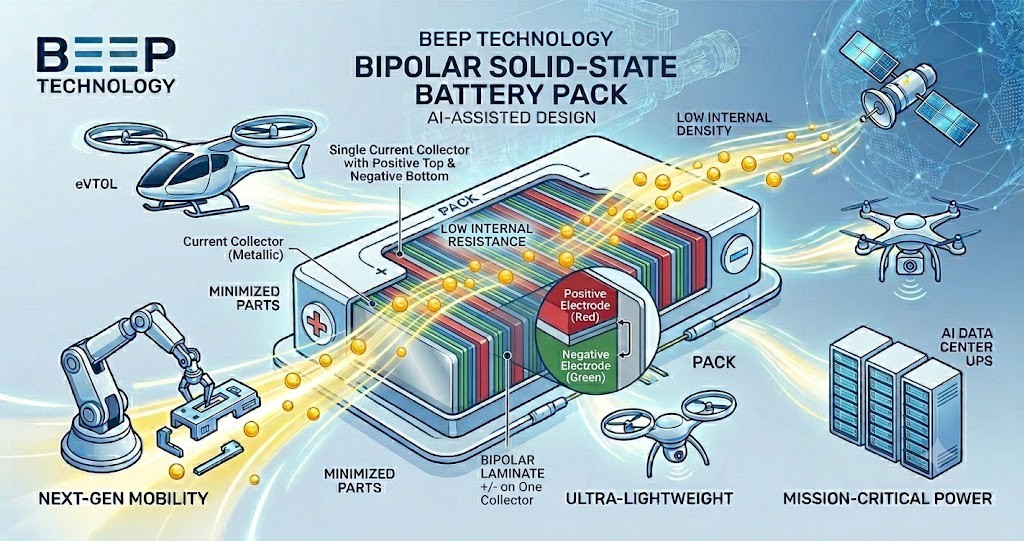
Solidion社が発表した特許取得済みの「バイポーラ電極-パック(BEEP)」技術は、従来のバッテリー製造とはアプローチが根本から異なります。
- 直接積層方式: 個々の「単電池セル」や「モジュール」を個別に製造して外部ケーブルで繋ぐのではなく、双極性電極と固体電解質層を直列および並列に直接積層・接続します。
- 圧倒的な部品削減: 従来のバッテリーパックは数百個もの筐体やコネクタ、複雑な火災対策システムを必要としていましたが、BEEP技術では「1つの筐体と少数のコネクタ」だけでシステムが完結します。
- 重量・容積・コストの同時削減: 冗長な保護部材や配線(コネクタ)を極限まで排除することで、デッドスペースを無くし、バッテリー全体の軽量化、小型化、そして製造コストの大幅な削減を達成しました。
2. 【関連補完情報】「バイポーラ構造」と「固体電池」の相乗効果
バイポーラ(双極性)構造とは?
1枚の集電体の表側に正極、裏側に負極を配置した電極(バイポーラ電極)を、電解質を挟んで何層も直列に積み重ねる構造です。従来のバッテリーのようにセル同士を外付けの配線で結ぶ必要がないため、内部抵抗が極めて小さくなり、大電流を一気に流せる「高出力密度」を実現できます。
なぜ固体電池だからこそ活きるのか?
従来の「液体」リチウムイオン電池でバイポーラ構造を作ろうとすると、内部で電解液が混ざり合ってショート(液絡現象)を起こすという重大な技術的課題がありました。しかし、電解質が「固体」である固体電池であれば液漏れの心配が一切ないため、バイポーラ構造の持つ「高電圧・高出力・省スペース」というメリットを100パーセント安全に活かしきることができます。
3. 次世代インフラ・輸送の要求に応える適応分野
Solidion社がターゲットとする領域は、限られたスペースと積載重量の中で最大限の電力が求められるミッションクリティカルな分野です。
- 航空・宇宙輸送: 航続距離と軽量化が直結する「空飛ぶクルマ(eVTOL)」、ドローン、宇宙船、有人・無人の宇宙インフラデバイス。
- 次世代ロボティクス: 長時間の稼働と瞬発的なパワーが必要な産業用・災害用ロボット。
- AIデータセンター: 膨大な電力を消費する最新データセンター向けの無停電電源装置(UPS)やバックアップシステム。
4. Solidion Technology社の強みと保有資産
テキサス州ダラスに本社を置くSolidion社(NASDAQ: STI)は、次世代バッテリーのパイオニアとして強固な技術基盤を持っています。
- 膨大な特許ポートフォリオ: 高容量でシランガスフリーの「グラフェン対応シリコンアノード」、バイオマス由来のグラファイト、先進的な「リチウム硫黄」や「リチウム金属」技術などを含む385件以上のグローバル特許を保有。
- 開発体制: オハイオ州デイトンに先進的な試作施設を擁し、新素材の開発からシステム統合まで垂直統合的なアプローチを行っています。
AIによる最適化設計と、バイポーラ構造×固体電池の融合により、同社は次世代エネルギー革命の最前線を走る企業の1つとして、その存在感を明確に示しています。
[Next-Gen Batteries] Summary of Benefits and Features of “BEEP,” the AI-Designed Bipolar Solid-State Battery
In the field of all-solid-state batteries—highly anticipated as the next generation of energy storage technology—a groundbreaking architecture has emerged that completely overturns conventional manufacturing concepts.
On June 16, 2026, US-based advanced battery solution provider Solidion Technology, Inc. announced an innovative “bipolar solid-state battery” performance technology utilizing AI-assisted design and manufacturing methods.
This technology is expected to be utilized in cutting-edge fields requiring extreme energy efficiency and lightweight structures, ranging from electric vertical takeoff and landing aircraft (eVTOLs), drones, and robotics to space infrastructure and AI data centers.
1. “BEEP” Technology: Breaking Through Traditional Limitations
The patented Bipolar Electrode-to-Pack (BEEP) technology announced by Solidion takes a fundamentally different approach compared to traditional battery manufacturing.
- Direct Stacking Method: Instead of manufacturing individual single-cell units or modules separately and connecting them with external cables, bipolar electrodes and solid electrolyte layers are directly stacked and connected in series and parallel.
- Drastic Reduction in Components: While conventional battery packs require hundreds of enclosures, connectors, and complex fire mitigation systems, the BEEP technology completes the entire system with just “one enclosure and a few connectors.”
- Simultaneous Reduction in Weight, Volume, and Cost: By eliminating redundant protective components and wiring (connectors) to the absolute limit, dead space is eradicated. This achieves a lighter weight, smaller footprint, and a massive reduction in manufacturing costs for the entire battery.
2. [Supplementary Information] The Synergy Between “Bipolar Structure” and “Solid-State Batteries”
What is a Bipolar (Dual-Polarity) Structure?
It is a structure where electrodes having a positive layer on one side of a current collector and a negative layer on the reverse side (bipolar electrodes) are stacked in series across electrolytes. Because there is no need to connect individual cells using external wiring as in conventional batteries, internal resistance is kept extremely low. This allows for a “high power density” capable of delivering large currents all at once.
Why Does It Truly Excel in Solid-State Batteries?
When attempting to build a bipolar structure using conventional “liquid” lithium-ion batteries, there was a severe technical challenge where the liquid electrolytes would mix internally and cause a short circuit (known as electrolyte leakage or cross-talk). However, since the electrolyte in solid-state batteries is completely “solid,” there is absolutely no concern over fluid leakage. This allows the benefits of a bipolar structure—namely high voltage, high power, and space efficiency—to be leveraged with 100 percent safety.
3. Application Fields Meeting Next-Gen Infrastructure and Transportation Demands
Solidion is targeting mission-critical domains where maximum power is required within severely limited spatial and weight constraints.
- Aviation and Space Transportation: Applications where range and weight reduction are directly linked, such as “flying cars” (eVTOLs), drones, spacecraft, and manned or unmanned space infrastructure devices.
- Next-Generation Robotics: Industrial and disaster-response robots that demand both long operational runtimes and instantaneous bursts of power.
- AI Data Centers: Uninterruptible power supply (UPS) systems and backup systems for state-of-the-art data centers that consume enormous amounts of electricity.
4. Strengths and Intellectual Property of Solidion Technology, Inc.
Headquartered in Dallas, Texas, Solidion (NASDAQ: STI) maintains a robust technological foundation as a pioneer in next-generation batteries.
- Massive Patent Portfolio: The company holds a global portfolio of over 385 patents, encompassing innovations such as high-capacity, silane-gas-free, “graphene-enabled silicon anodes,” biomass-derived graphite, and advanced “lithium-sulfur” and “lithium-metal” technologies.
- Development Infrastructure: Solidion operates an advanced prototyping facility in Dayton, Ohio, utilizing a vertically integrated approach from new material development to complete system integration.
Through the fusion of AI-optimized design and the integration of bipolar structures with solid-state batteries, the company is clearly establishing its presence as a leader at the forefront of the next-generation energy revolution.


コメント