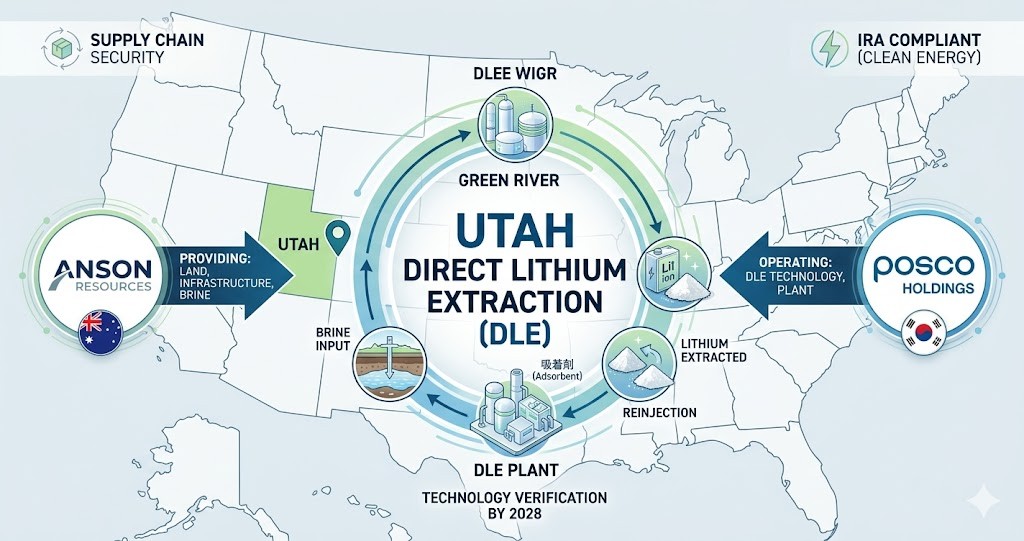
電気自動車(EV)市場の拡大に伴い、二次電池の核心素材であるリチウムの安定確保は、世界中の自動車・電池メーカーにとって最優先の課題となっています。特に米国では、インフレ抑制法(IRA)などの影響により、北米域内または自由貿易協定(FTA)締結国でのクリーンな素材調達が強く求められています。
こうした中、ポスコホールディングスはオーストラリアのアンソン・リソーシズと提携し、米国ユタ州で次世代のリチウム抽出技術である「直接リチウム抽出(DLE)」の実証プロジェクトに乗り出しました。これは、従来の鉱山採掘や自然蒸発法に代わる、環境負荷が低く効率的な供給源を北米本土に確保するための戦略的な一手です。
発表の主要ポイントとプロジェクト概要
今回の協定およびプロジェクトの具体的な内容は以下の通りです。
1. 提携内容と役割分担
- パートナーシップ: ポスコホールディングスと、オーストラリアの資源開発会社アンソン・リソーシズ(Anson Resources)が協力協定を締結。
- 場所: 米国ユタ州グリーンリバー(Green River)地域。
- ポスコの役割: 独自開発したDLE技術の商業化検証のため、実証プラント全体の設計、建設、運営を主導。
- アンソン社の役割: プロジェクト用地、インフラ、リチウムを含む塩水(ブライン)の提供、および現地での許認可取得の支援。
2. 今後のロードマップ
- 2027年まで: 実証プラントの建設および操業を開始。
- 2028年まで: 実際の現地の塩水を用いた技術検証を完了し、商業化(量産化)に向けた基盤を確立する。
直接リチウム抽出(DLE)技術の特徴とメリット
DLE(Direct Lithium Extraction)は、従来の塩湖でのリチウム生産プロセスを根本から変える革新的な技術です。
- 圧倒的なスピードと回収率: 天日乾燥による自然蒸発を待つ従来の手法(1年以上の期間が必要)とは異なり、特殊な吸着剤等を用いて塩水からリチウムのみを数時間から数日で選択的に抽出します。回収率も大幅に向上します。
- 気候変動リスクの回避: 天候や気温に左右される蒸発法とは違い、密閉されたプラント内で処理するため、安定した生産が可能です。
- 低濃度塩水への対応: これまで採算が合わなかった低濃度の塩湖や地下塩水からも経済的にリチウムを抽出できるため、調達可能な資源の選択肢が格段に広がります。
- 環境への配慮: リチウムを抽出した後の塩水は再び地下に戻すことができるため、周辺の地下水位や生態系への影響(環境汚染)が極めて低いとされています。
関連情報:背景にある北米戦略とリチウム市場の動向
ポスコがこの時期に米国での実証実験に踏み切った背景には、次のようなグローバルな地政学・産業トレンドがあります。
1. 米国IRA(インフレ抑制法)への対応
米国市場でEV税制優遇を受けるためには、中国などの「懸念される外国の事業体(FEOC)」から調達した重要鉱物を排除する必要があります。ポスコがアルゼンチンなどで培ったDLEノウハウを米国ユタ州に持ち込み、現地でリチウムを生産することは、自動車メーカー(クライアント)に対して「IRA適応セルの完全なサプライチェーン」を提示できる強力な武器になります。
2. ポスコの「総合素材メーカー」への変革
ポスコは鉄鋼メーカーから「二次電池材料のトップランナー」への転換を急いでいます。すでにアルゼンチンの塩湖(オムブレ・ムエルト)で大規模なリチウム開発を進めており、そこで培ったDLEのパイロットテストの成果(2016年からの技術蓄積)を今回、資源大国である米国へと水平展開する形になります。これにより、リチウムだけでなく、正極材や負極材までを一貫して供給できるバリューチェーンがより強固になります。
3. DLE市場における競合状況
DLE技術は現在、世界中のディープテック企業や資源大手が商業化を競っています。米国のエクソンモービル(ExxonMobil)などもアーカンソー州で大規模なDLEプロジェクトを進めており、ユタ州におけるポスコの参入は、北米のリチウム利権獲得レースにおいてアジアのプレイヤーが重要なポジションを確保したことを意味しています。2028年の技術検証完了に向け、低コストかつ高純度のリチウムをいかに安定して抽出できるかが今後の焦点となります。
出典:https://www.businesskorea.co.kr/news/articleView.html?idxno=271096
POSCO Commences Lithium Extraction Demonstration Project in the United States
With the expansion of the electric vehicle (EV) market, securing a stable supply of lithium—a core material for secondary batteries—has become a top priority for automakers and battery manufacturers worldwide. Particularly in the United States, driven by regulations like the Inflation Reduction Act (IRA), there is a strong demand for clean material sourcing within North America or from countries that have Free Trade Agreements (FTAs) with the US.
In this environment, POSCO Holdings has partnered with Australia-based Anson Resources to launch a demonstration project for Direct Lithium Extraction (DLE), a next-generation lithium extraction technology, in Utah, USA. This represents a strategic move to secure an efficient, low-environmental-impact supply source on the North American mainland as an alternative to traditional mining and conventional solar evaporation methods.
Key Highlights and Project Overview
The specific details of the agreement and the project are as follows:
1. Partnership and Division of Roles
- Partnership: POSCO Holdings and the Australian resource development company Anson Resources have signed a cooperation agreement.
- Location: Green River region, Utah, USA.
- POSCO’s Role: Lead the overall design, construction, and operation of the demonstration plant to thoroughly verify the commercial viability of its independently developed DLE technology.
- Anson’s Role: Provide the project site, infrastructure, and lithium-bearing brine, as well as support the acquisition of local permits and regulatory approvals.
2. Future Roadmap
- By 2027: Complete the construction of the demonstration plant and commence operations.
- By 2028: Finish technical verification using actual local brine to establish a solid foundation for commercialization (mass production).
Features and Benefits of Direct Lithium Extraction (DLE) Technology
DLE is an innovative technology that fundamentally transforms the traditional process of lithium production from salt lakes.
- Overwhelming Speed and Recovery Rates: Unlike conventional methods that rely on solar evaporation via open-air ponds (which require more than a year), DLE selectively extracts only lithium from brine using specialized adsorbents within a few hours to several days. Recovery rates are also significantly improved.
- Mitigation of Climate Change Risks: Unlike the evaporation method, which is highly vulnerable to weather and temperature fluctuations, DLE processes the brine inside a closed plant, enabling stable, consistent production.
- Viability for Low-Concentration Brine: DLE enables economic lithium extraction even from low-concentration salt lakes and underground brines that were previously deemed unprofitable, vastly expanding the options for sourceable resources.
- Environmental Considerations: Since the brine can be reinjected underground after the lithium is extracted, the impact on local groundwater levels and ecosystems (environmental pollution) is considered to be extremely low.
Related Information: Background on North American Strategy and Lithium Market Trends
POSCO’s decision to embark on this US-based demonstration project at this time is driven by the following global geopolitical and industrial trends:
1. Response to the US Inflation Reduction Act (IRA)
To qualify for EV tax incentives in the US market, companies must eliminate critical minerals sourced from “Foreign Entities of Concern” (FEOC), such as China. By bringing the DLE expertise it developed in regions like Argentina to Utah and producing lithium locally, POSCO gains a powerful competitive edge, enabling it to offer automakers (its clients) a fully IRA-compliant supply chain.
2. POSCO’s Transformation into an “All-Round Materials Producer”
POSCO is rapidly accelerating its transition from a traditional steelmaker into a top-tier supplier of secondary battery materials. The company is already advancing a large-scale lithium development project at the Hombre Muerto salt lake in Argentina. This new venture horizontally deploys the DLE pilot testing achievements and technical expertise accumulated since 2016 into the United States, a resource-rich nation. This further solidifies a comprehensive value chain capable of supplying not just lithium, but also cathode and anode materials.
3. Competitive Landscape in the DLE Market
Commercializing DLE technology has become a fierce race among deep-tech startups and resource giants worldwide. For instance, ExxonMobil is advancing a large-scale DLE project in Arkansas. POSCO’s entry into Utah highlights that Asian players are securing critical positions in the race for North American lithium rights. As the company moves toward completing technical verification by 2028, the key focus will be on how stably it can extract low-cost, high-purity lithium.

コメント