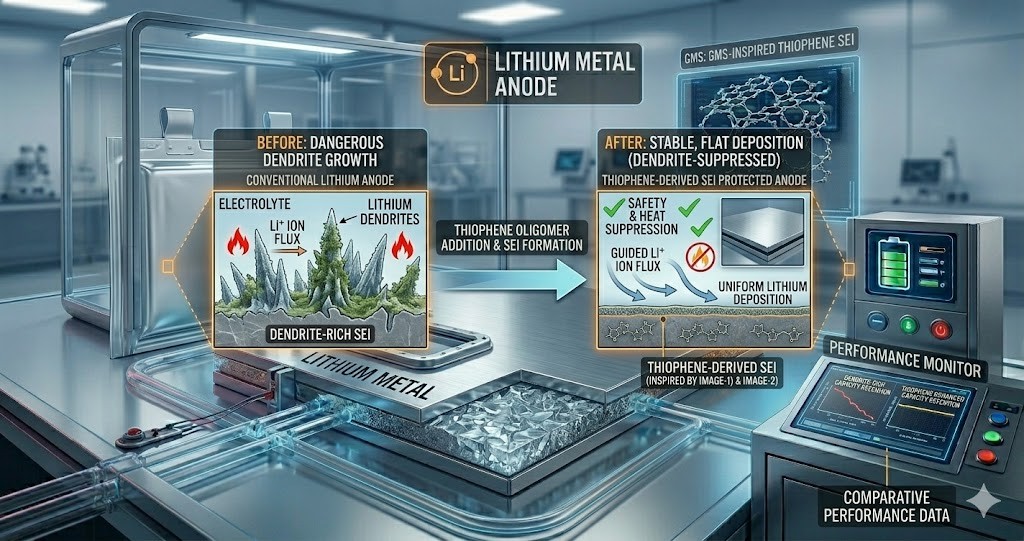
本研究は、リチウム金属電池(LMB)の実用化における最大の障壁である「高電流密度下での樹枝状リチウム(デンドライト)の成長」と「界面抵抗の増大」を、電解液へのチオフェン添加によって解決した画期的な成果です。
分子スケールの電子分極(軌道制御)を利用して、マクロな高速充放電安定性を実現する新たなパラダイムを提示しています。
1. 電解液の組成と設計思想
従来の無機物主体(LiFリッチ)な界面層(SEI)は、イオン伝導性が低く、高電流下での均一なリチウム析出を阻害していました。本研究では以下の組成を採用しています。
- ベースライン電解液: 3 M LiFSI / FSA (N,N-dimethylsulfamoyl fluoride)
- FSAは耐酸化性に優れ、高電圧(4.25 V)下での分解を抑制します。
- 最適化電解液: 3 M LiFSI / FSA + 1 wt% チオフェン (Thiophene)
- チオフェンの狭いエネルギーバンドギャップを利用し、正負両極に優先的に界面層を形成させます。
2. 界面層(SEI/CEI)の形成メカニズム
チオフェンは電気化学的な「その場(in-situ)重合」により、オリゴマー状の柔軟な界面層を構築します。
負極側:チオフェン埋め込みポリマー状SEI
- 構造: C-C結合カップリングによる共役π系オリゴマー。
- 動的極性切り替え: sp2混成軌道のpz軌道が、リチウムの析出・剥離に合わせて極性を反転させます。これにより、電子雲が動的に再配置され、Liイオンの引き付けと均一な拡散を促進します。
- 物性: 高いLiイオン伝導率(5 uS cm-1以上)と、極めて低い電子伝導率(2.7 pS cm-1)を両立。
正極側:Sベースのポリマー状CEI
- 役割: 高ニッケル正極(NCM90)表面での電解液分解を抑制。
- 安定化: 電子豊富なS(硫黄)部分が充電時の界面電荷を中和し、Ni2+の生成(相転移の原因)を抑制することで、構造的完全性を維持します。
3. 電池性能データ
チオフェン添加により、過酷な実用条件下でも優れたサイクル特性が確認されました。
高速サイクル性能(コインセル)
- 条件: NCM90正極(4.1 mAh cm-2)、電流密度 8.2 mA cm-2 (2 C)、希薄電解液(E/C比 1.5 g Ah-1)。
- 結果: 187.3 mAh g-1 という高い初期容量を維持し、容量劣化とクーロン効率(CE)の変動を大幅に抑制。
実用スケール性能(パウチセル)
- セル仕様: 1.04 Ah 大面積パウチセル、エネルギー密度 910 Wh L-1。
- 結果: 2.1 g Ah-1 という低電解液量においても、平均CE 99.94% という極めて高い可逆性を達成。
界面抵抗と活性化エネルギー
- イオン伝導率: 5 uS cm-1 以上(ベースラインやFEC添加系を圧倒)。
- 電荷移動: チオフェン由来のSEIは、リチウムの析出・剥離における活性化エネルギーを低減し、電荷移動速度を向上させました。
4. 結論
本研究は、単に「強い膜」を作るのではなく、「電子軌道レベルでリチウムイオンの動きを最適化する膜」を作るという新しいアプローチを証明しました。これにより、電気自動車(EV)やeVTOL等で求められる、高エネルギー密度かつ急速充電可能な次世代電池の開発に大きく貢献すると期待されます。
出典:https://onlinelibrary.wiley.com/doi/10.1002/inf2.70126
Uniform Lithium Deposition Technology via In-situ Polymerization of Thiophene under High Current Density
This research represents a breakthrough in overcoming the most significant barriers to the practical application of Lithium Metal Batteries (LMBs): “dendritic lithium growth under high current density” and “increased interfacial resistance,” achieved through the addition of thiophene to the electrolyte. It presents a new paradigm for achieving macroscopic high-rate charge/discharge stability by utilizing molecular-scale electronic polarization (orbital control).
1. Electrolyte Composition and Design Philosophy
Conventional inorganic-dominant (LiF-rich) Solid Electrolyte Interphases (SEIs) possess low ionic conductivity, which hinders uniform lithium deposition at high currents. This study employs the following compositions:
- Baseline Electrolyte: 3 M LiFSI / FSA (N,N-dimethylsulfamoyl fluoride). FSA exhibits excellent oxidation resistance and suppresses decomposition under high voltage (4.25 V).
- Optimized Electrolyte: 3 M LiFSI / FSA + 1 wt% Thiophene. By utilizing the narrow energy bandgap of thiophene, interfacial layers are preferentially formed on both the positive and negative electrodes.
2. Formation Mechanism of Interfacial Layers (SEI/CEI)
Thiophene constructs a flexible, oligomeric interfacial layer through electrochemical “in-situ polymerization.”
- Anode Side: Thiophene-Embedded Polymer-like SEI
- Structure: Conjugated pi-system oligomers formed by C-C bond coupling.
- Dynamic Polarity Switching: The pz orbitals of the sp2 hybridized carbons invert their polarity in synchronization with lithium deposition and stripping. This facilitates a dynamic redistribution of the electron cloud, promoting Li-ion attraction and uniform diffusion.
- Physical Properties: Achieves both high Li-ion conductivity (over 5 uS cm-1) and extremely low electronic conductivity (2.7 pS cm-1).
- Cathode Side: S-based Polymer-like CEI
- Role: Suppresses electrolyte decomposition on the surface of high-nickel cathodes (NCM90).
- Stabilization: Electron-rich S (sulfur) moieties neutralize interfacial charges during charging, maintaining structural integrity by inhibiting the formation of Ni2+ (the cause of phase transitions).
3. Battery Performance Data
The addition of thiophene confirmed superior cycling characteristics even under harsh practical conditions.
- High-Rate Cycling Performance (Coin Cell)
- Conditions: NCM90 cathode (4.1 mAh cm-2), current density 8.2 mA cm-2 (2 C), lean electrolyte (E/C ratio 1.5 g Ah-1).
- Result: Maintained a high initial capacity of 187.3 mAh g-1 and significantly suppressed capacity degradation and fluctuations in Coulombic Efficiency (CE).
- Practical Scale Performance (Pouch Cell)
- Cell Specifications: 1.04 Ah large-area pouch cell, energy density 910 Wh L-1.
- Result: Achieved an extremely high average CE of 99.94% and excellent reversibility even under a low electrolyte volume of 2.1 g Ah-1.
- Interfacial Resistance and Activation Energy
- Ionic Conductivity: 5 uS cm-1 or higher (overwhelming baseline and FEC-added systems).
- Charge Transfer: Thiophene-derived SEI reduced the activation energy for lithium deposition/stripping and improved charge transfer kinetics.
4. Conclusion
This study proves a novel approach: rather than simply creating a “strong film,” it creates a film that “optimizes Li-ion movement at the electronic orbital level.” This is expected to contribute significantly to the development of next-generation batteries with high energy density and fast-charging capabilities required for Electric Vehicles (EVs) and eVTOLs.

コメント