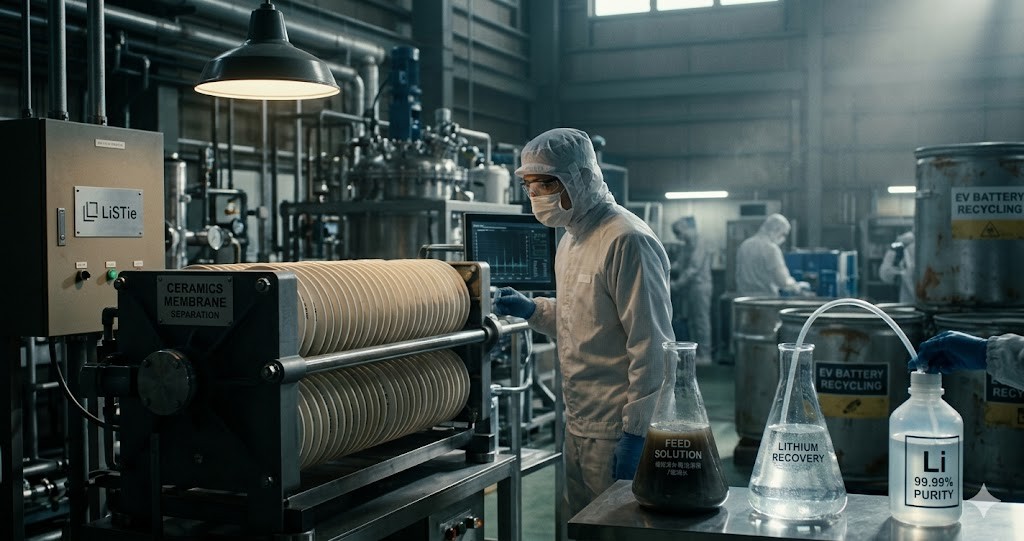
近年、電気自動車(EV)や再生可能エネルギーの普及に伴い、リチウムイオン電池の主原料である「リチウム」の需要が世界的に急増しています。供給源の偏りや環境負荷が課題となる中、日本のスタートアップが革新的な回収技術の実証に乗り出しました。
量子科学技術研究開発機構(QST)発のベンチャー企業「LiSTie(リスティー)」による、リチウム回収技術の概要と関連情報をまとめます。
LiSTieによるリチウム回収実証の概要
1. 革新的な「セラミックス膜分離技術」
LiSTieが開発した技術は、イオン導電体であるセラミックス膜を利用して、リチウムイオンのみを選択的に透過させるものです。
- 仕組み: リチウムイオンを含む溶液に電圧をかけることで、膜がナトリウムやマグネシウムなどの不純物をブロックし、リチウムイオンだけを抽出します。
- メリット: 有害な化学薬品を使用せず、工程がシンプルであるため、低コストかつ環境に優しいのが特徴です。
- 純度: 最終的に純度 99.99% という極めて高品質な水酸化リチウム粉末を回収可能です。
2. 実証実験と今後のロードマップ
耐火物メーカーのTYKと共同で実証プラントを稼働させ、商業化に向けたステップを進めています。
- 実証規模: 膜を9枚使用し、1日あたり約 1.5kg の水酸化リチウムを回収。
- 目標: 2027年の販売開始を目指し、将来的には膜を1000枚まで拡張。コンテナサイズの装置で年間 570トン の生産を計画しています。
- 適用範囲: 電池リサイクルだけでなく、従来は効率が悪かった塩湖からの回収への応用も期待されています。
関連情報:核融合発電への応用と経済安保
核融合燃料「トリチウム」の生成
この技術は、次世代のクリーンエネルギーとして期待される核融合発電とも深く関わっています。
- 核融合の燃料となる「トリチウム(三重水素)」は、リチウムに中性子を照射して生成されます。
- リチウムには同位体(質量が異なるもの)が存在し、今回の分離技術を応用すれば、効率的に特定の同位体を分離できる可能性があります。
- 政府もこの重要性を認め、日本版SBIR(中小企業技術革新制度)を通じて 15億円 の補助金を交付しています。
リチウムの経済安全保障
現在、リチウムの供給はオーストラリアやチリなどの特定の国に依存しており、精製工程の多くを中国が占めています。
- 都市鉱山: 使用済み電池からリチウムを国内で循環させる「リサイクル技術」の確立は、輸入依存度を下げ、供給リスクを回避するために不可欠です。
- カーボンゼロへの貢献: 採掘から輸送に伴うCO2排出を抑えるため、地産地消型のリサイクルモデルが世界中で求められています。
まとめ
LiSTieの技術は、単なるリサイクル効率の向上にとどまらず、「コスト・環境・安全保障」の3つの課題を同時に解決するポテンシャルを秘めています。2027年の実用化が実現すれば、日本の蓄電池産業および将来のエネルギー基盤において大きな強みとなるでしょう。
出典:https://www.nikkei.com/article/DGXZQOSG267MU0W6A320C2000000/
Streamlining Battery Recycling with Japanese Technology: LiSTie Begins Lithium Recovery Demonstration
In recent years, global demand for lithium—the primary raw material for lithium-ion batteries—has surged due to the widespread adoption of electric vehicles (EVs) and renewable energy. As concerns grow regarding concentrated supply sources and environmental impact, a Japanese startup has launched a demonstration of an innovative recovery technology.
The following is an overview of the lithium recovery technology developed by LiSTie, a venture originating from the National Institutes for Quantum Science and Technology (QST).
Overview of LiSTie’s Lithium Recovery Demonstration
1. Innovative Ceramic Membrane Separation Technology
The technology developed by LiSTie utilizes a ceramic membrane (an ionic conductor) that selectively allows only lithium ions to pass through.
- Mechanism: By applying voltage to a solution containing lithium ions, the membrane blocks impurities such as sodium and magnesium, extracting only the lithium ions.
- Advantages: The process is simple and does not use harmful chemicals, making it both low-cost and environmentally friendly.
- Purity: It is capable of recovering extremely high-quality lithium hydroxide powder with a purity of 99.99%.
2. Demonstration Trials and Future Roadmap
In collaboration with TYK, a manufacturer of refractory materials, LiSTie is operating a demonstration plant to move toward commercialization.
- Scale: Using 9 membranes, the plant recovers approximately 1.5kg of lithium hydroxide per day.
- Goals: The company aims to begin sales in 2027, with plans to expand to 1000 membranes. Future container-sized units are expected to produce 570 tons of lithium hydroxide annually.
- Applications: Beyond battery recycling, the technology is expected to be applied to lithium recovery from salt lakes, which was previously considered inefficient.
Related Information: Fusion Power and Economic Security
Generation of Tritium Fuel for Fusion
This technology is closely linked to nuclear fusion, a promising next-generation clean energy source.
- Tritium, a fuel for fusion, is produced by bombarding lithium with neutrons.
- Lithium has isotopes (variants with different masses). By applying this separation technology, it may be possible to efficiently separate specific isotopes required for fuel production.
- The Japanese government has recognized this importance, awarding a 1.5 billion yen grant through the Japanese version of the SBIR (Small Business Innovation Research) program.
Economic Security of Lithium
Currently, the supply of lithium relies on specific countries like Australia and Chile, while much of the refining process is dominated by China.
- Urban Mining: Establishing recycling technology to circulate lithium from used batteries domestically is essential for reducing import dependence and avoiding supply risks.
- Contribution to Carbon Zero: To suppress CO2 emissions associated with mining and transportation, there is a global demand for “locally produced, locally consumed” recycling models.
Summary
LiSTie’s technology goes beyond simply improving recycling efficiency; it holds the potential to simultaneously address three major challenges: cost, environment, and security.


コメント