世界の電気自動車(EV)市場が踊り場を迎える中、車載電池メーカーの勢力図が大きく塗り替わろうとしています。これまで圧倒的な低価格を武器に欧州市場を席巻してきた中国の電池メーカーに対し、韓国のサムスンSDIが猛烈な反撃を仕掛けています。
同社はメルセデス・ベンツ、BMW、現代自動車に続き、欧州最大の自動車メーカーであるフォルクスワーゲン(VW)グループから、次世代EVの命運を握る「統合型セル(Unified cell)」の大規模受注を獲得した模様です。EU(欧州連合)が進める経済安全保障政策の追い風を受け、ハンガリー工場を拠点に欧州EVインフラの心臓部を押さえにかかる同社の戦略と、VWの新しい電池規格について解説します。
- 1. ニュース概要:サムスンSDIがVWの「統合型セル」第3のサプライヤーへ
- 2. 関連情報:なぜVWは中国勢ではなく「韓国サムスン」を選んだのか?
- 3. 欧州市場の現状:大衆車(ボリュームゾーン)でのEV需要の底堅さ
- まとめ
- 1. News Summary: Samsung SDI to Become the Third Supplier for VW’s “Unified Cell”
- 2. Related Information: Why Did VW Choose South Korea’s Samsung Over Chinese Rivals?
- 3. European Market Outlook: Robust EV Demand in the Mass Market (Volume Segment)
- Conclusion
1. ニュース概要:サムスンSDIがVWの「統合型セル」第3のサプライヤーへ
韓国の電子部品専門メディア「THE ELEC」などの報道によると、サムスンSDIはフォルクスワーゲングループの標準EVバッテリーである「統合型セル」の量産に向け、ハンガリー工場のライン改造に着手しました。
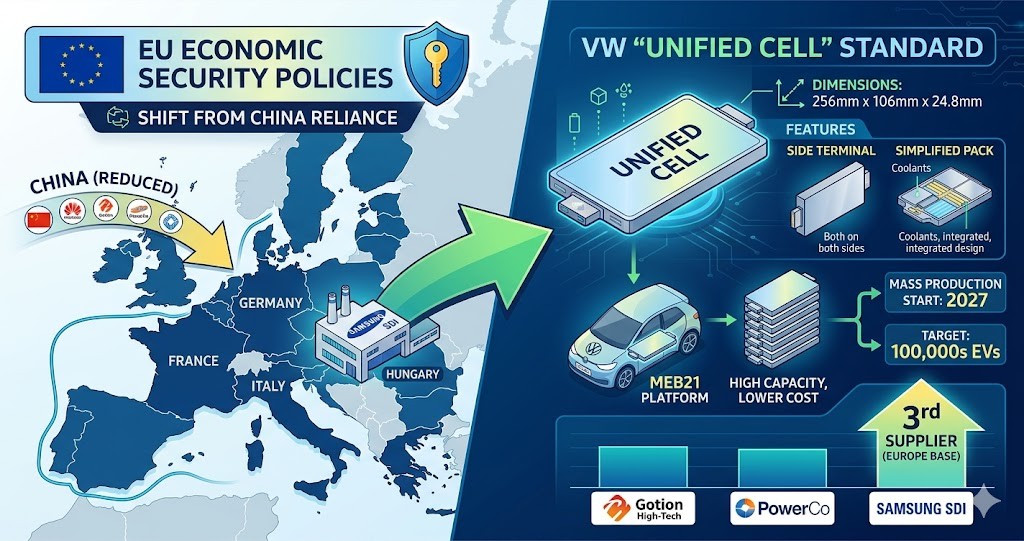
- 工場の仕様変更: ハンガリー・ゲード第1工場の2つの生産ラインについて、従来の「トップターミナル(上面端子)」方式から、VWの規格である「サイドターミナル(側面端子)」方式へと切り替える作業を進めており、すでに製造設備が搬入されています。
- 供給の規模と時期: 2027年からの量産開始が予想されており、具体的な生産能力は非公開ながら、2桁ギガワット時(GWh)規模(電気自動車数十万台分)の大規模な契約と推算されています。
- 主要サプライヤーへの名乗り: これによりサムスンSDIは、中国の国軒高科、VW傘下のパワーコ(PowerCo)に続き、統合型セルを供給する3番目の公式サプライヤーとなる見通しです。
フォルクスワーゲンの「統合型セル」とは?
VWが2021年のイベント「Power Day」で発表した標準規格の角型バッテリーです(横256mm、縦106mm、厚さ24.8mm)。
端子をセルの両側面に配置(サイドターミナル)したことで、パック内部の構造を簡素化し、冷却プレートを上下に配置できるのが特徴です。中身の材料がリチウムリン酸鉄(LFP)でも三元系(NCM)でも外形を共通化できるため、開発コストを劇的に抑えられます。今後、VWの新型「ID.Polo」やクプラ、スコダなどの大衆向け小型EVプラットフォーム(MEB21)に全面採用される予定です。
2. 関連情報:なぜVWは中国勢ではなく「韓国サムスン」を選んだのか?
VWはもともと、統合型セルの開発・生産において中国の国軒高科と深く協業しており、最初の量産も中国工場で開始されました。しかし、ここにきてサムスンSDIとの取引を大衆車ブランドにまで拡大した背景には、欧州の政治的・環境的な規制強化があります。
EUの「産業加速化法(IAA)」と原産地規則
EU執行委員会が発表した産業加速化法(IAA)では、公共調達や政府補助金を受ける条件として「EU域内での調達(EU原産地要件)」を厳格に求めています。EVバッテリーの場合、セルだけでなく陽極材やバッテリー管理システム(BMS)にいたるまで、段階的に欧州内での生産が義務付けられます。 現在、欧州域内における電池セルの生産能力の80%以上を韓国勢(サムスンSDI、LGエナジーソリューションなど)が占めており、地政学的リスクのある中国依存を減らしたい欧州自動車メーカーにとって、サムスンSDIのハンガリー工場は代替不可能な拠点となっています。
サムスンSDIの「米国と欧州」での二面戦略
サムスンSDIは、地域ごとに全く異なる投資戦略をとっています。
| 地域 | 主な戦略 | 具体的な動き |
| 米国市場 | EV向けから**ESS(エネルギー貯蔵装置)**へ軸足をシフト | ステランティスとの合弁工場(スタープラスエネルギー)の4ライン中3ラインをESS用に転換。NCA系およびLFP系のESSを順次稼働。 |
| 欧州市場 | EV向けバッテリーの受注拡大に集中 | ハンガリー工場を核心拠点とし、VWのほか、ベンツ、BMW、現代自動車、起亜(EV2やアイオニック3向け)への供給を一手に引き受ける。 |
3. 欧州市場の現状:大衆車(ボリュームゾーン)でのEV需要の底堅さ
直近のデータによると、フォルクスワーゲングループ全体のEV販売台数は、米国(関税の影響)や中国(現地メーカーとの競争激化)で大幅に減少しています。しかし、欧州市場単体では前年同期比12%増の17万6400台と、堅調な伸びを維持しています。
特に、クプラ・ラバルやVWのID.Poloといった「低価格な都心型小型EV」の需要が伸びており、サムスンSDIはこのボリュームセグメント(量販価格帯)の波を捉えることで、2026年下半期にはハンガリー工場の稼働率を70%以上に引き上げ、黒字転換を確実にする目標を掲げています。
まとめ
今回のサムスンSDIによるVWへの「統合型セル」供給は、単なる一企業の受注成功にとどまらず、欧州における「脱・中国依存」の動きが本番を迎えたことを象徴しています。
これまでアウディやポルシェといった高級車向けに限定されていたサムスンSDIの供給網は、VWの大衆車ブランドへ一気に拡大します。米国では手堅くデータセンターや電力網向けのESSに投資し、欧州では自動車メーカーの防波堤としてEV電池を供給する。柔軟な二面戦略を展開するサムスンSDIが、これからの欧州EVインフラにおいて極めて重要なプレーヤーになることは間違いありません。
出典:https://www.thelec.kr/news/articleView.html?idxno=57602
Samsung SDI Secures Order for VW’s Next-Gen “Unified Cell” EV Batteries! Becoming the Third Supply Network Following Chinese Competitors
As the global electric vehicle (EV) market enters a plateau, the landscape for automotive battery manufacturers is undergoing a massive realignment. Samsung SDI of South Korea is launching a fierce counteroffensive against Chinese battery manufacturers, who have long dominated the European market with their overwhelmingly low prices.
Following deals with Mercedes-Benz, BMW, and Hyundai Motor, Samsung SDI has reportedly secured a massive order from the Volkswagen (VW) Group—Europe’s largest automaker—for its “Unified Cell,” a technology critical to the fate of next-generation EVs. Fueled by the European Union’s economic security policies, this article explains Samsung SDI’s strategy to capture the heart of European EV infrastructure from its Hungary plant, alongside details on VW’s new battery standard.
1. News Summary: Samsung SDI to Become the Third Supplier for VW’s “Unified Cell”
According to reports from South Korean electronic components media outlet THE ELEC and other industry sources, Samsung SDI has begun retooling its factory lines in Hungary to mass-produce the Volkswagen Group’s standard EV battery, the “Unified Cell.”
- Factory Specification Changes: At the Hungary Göd Plant 1, the company is transitioning two production lines from the traditional “top terminal” format to the “side terminal” format required by VW’s standard. Manufacturing equipment has already been brought on-site.
- Supply Scale and Timeline: Mass production is expected to begin in 2027. While specific production capacities remain confidential, the contract is estimated to be a large-scale deal in the double-digit gigawatt-hour (GWh) range—enough to power hundreds of thousands of electric vehicles.
- Emerging as a Major Supplier: This move positions Samsung SDI to become the third official supplier of the Unified Cell, following China’s Gotion High-Tech (Guoxuan) and VW’s own battery subsidiary, PowerCo.
What Is Volkswagen’s “Unified Cell”?
First unveiled by VW at its “Power Day” event in March 2021, the Unified Cell is a standardized prismatic battery measuring 256 mm wide, 106 mm tall, and 24.8 mm thick.
Its defining feature is the placement of terminals on both sides of the cell (side terminal design), which simplifies the internal architecture of the battery pack and allows cooling plates to be positioned at both the top and bottom. Because the exterior dimensions remain identical whether the chemistry inside is Lithium Iron Phosphate (LFP) or Lithium Nickel Manganese Cobalt Oxide (NCM), development costs can be drastically reduced. It will be fully adopted for VW’s upcoming mass-market small EV platform (MEB21), which includes models like the new VW ID.Polo, Cupra Raval, and Skoda compact vehicles.
2. Related Information: Why Did VW Choose South Korea’s Samsung Over Chinese Rivals?
VW originally collaborated deeply with China’s Gotion High-Tech to develop and produce the Unified Cell, with the initial mass production launching at a Chinese facility. However, the decision to expand its partnership to Samsung SDI for its mass-market brands stems from tightening political and environmental regulations in Europe.
The EU’s Net-Zero Industry Act / Industrial Acceleration Act and Rules of Origin
Regulatory frameworks proposed by the European Commission, such as the Net-Zero Industry Act (often referred to in industrial contexts as industrial acceleration initiatives), strictly mandate EU localization requirements to qualify for public procurement and government subsidies. For EV batteries, this means major components—ranging from the cells themselves to cathode materials and Battery Management Systems (BMS)—will be phased into mandatory European production.
Currently, South Korean manufacturers (such as Samsung SDI and LG Energy Solution) account for more than 80 percent of the battery cell production capacity within the EU. For European automakers looking to mitigate geopolitical risks and reduce their reliance on China, Samsung SDI’s Hungary plant has become an irreplaceable hub.
Samsung SDI’s Dual-Front Strategy for the US and Europe
Samsung SDI is pursuing completely localized investment strategies tailored to each region:
| Region | Primary Strategy | Concrete Actions |
| US Market | Shifting focus from EVs to ESS (Energy Storage Systems) | Converting 3 out of 4 lines at its StarPlus Energy joint-venture plant with Stellantis for ESS use. Commenced operations for NCA-based ESS lines, with LFP-based ESS lines rolling out sequentially. |
| European Market | Concentrating on expanding EV battery order books | Utilizing the Hungary plant as a core hub to anchor supply chains for VW, Mercedes-Benz, BMW, Hyundai Motor, and Kia (destined for models like the Kia EV2 and Hyundai Ioniq 3). |
3. European Market Outlook: Robust EV Demand in the Mass Market (Volume Segment)
According to recent data, the Volkswagen Group’s overall EV sales have dropped significantly in the United States (due to tariff impacts) and China (amid intensifying competition from domestic automakers). However, the European market alone maintained steady growth, rising 12 percent year-on-year to 176,400 units.
Demand is growing specifically for low-cost, urban compact EVs like the Cupra Raval and the VW ID.Polo. By capturing this high-volume segment, Samsung SDI aims to push the utilization rate of its Hungary plant past 70 percent, targeting a definitive return to profitability.
Conclusion
Samsung SDI’s supply of the “Unified Cell” to VW goes beyond a single company’s contract win; it symbolizes that Europe’s movement to diversify away from Chinese supply networks has entered its main phase.
Samsung SDI’s supply network, previously confined to premium brands like Audi and Porsche, will now expand rapidly into Volkswagen’s high-volume mass-market brands. By prudently investing in ESS for data centers and power grids in the US while acting as a reliable shield for automakers in Europe via EV batteries, Samsung SDI is leveraging a flexible, dual-front strategy that cements its position as a critical player in Europe’s future EV infrastructure.
コメント