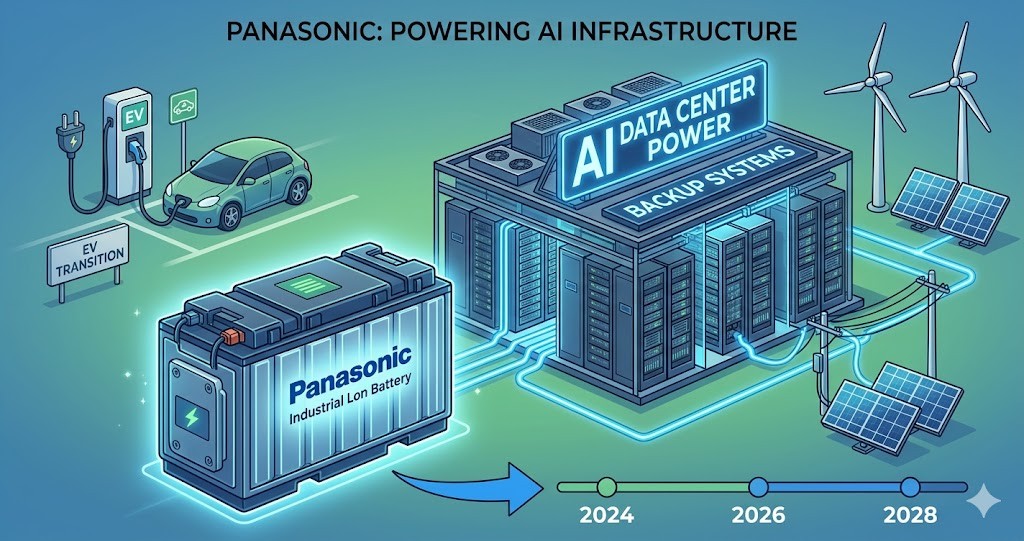
世界の自動車業界でEV(電気自動車)シフトの減速が指摘され、車載電池メーカー各社が投資計画の見直しを迫られる中、パナソニックホールディングス(パナソニックHD)が巨大な新市場への本格参入を表明しました。生成AI(人工知能)の急速な普及に伴い、世界中でデータセンターの建設が相次ぎ、その消費電力とバックアップ電源の確保が世界的な課題となってい
パナソニックHDは2026年6月8日、2028年度(2029年3月期)までに米国でデータセンター向けバッテリーセルの量産を開始する計画を発表しました。車載電池で培った高い技術力をバックアップ電源(エネルギー貯蔵システム)へと応用し、激変する市場環境に対応する同社の新たな成長戦略を解説します。
1. ニュース概要:2028年度までに米国でデータセンター向け電池を量産へ
パナソニックHDの電池事業を担うパナソニックエナジーは、AIインフラの急拡大を商機と捉え、北米での生産体制と投資計画を明らかにしました。
- カンザス工場での量産計画: 米国カンザス州に建設中の工場において、2028年度中にデータセンター向けのバッテリーセルの量産を開始します。
- 巨額の投資配分: 2026年度から2028年度にかけたAIインフラ投資の総額5,000億円のうち、約3,500億円(約21億8000万ドル)をテスラ等へ供給するエネルギー部門(車載中心)に割り当て、残る1,500億円をデータセンター向けなどの産業部門に投じます。
- メキシコ新工場の建設: 北米での供給能力をさらに高めるため、メキシコに「第3の工場」を建設する計画を策定。こちらも2028年度の量産開始を予定しています。
- 売上高1兆円超えへの野心: パナソニックエナジーの只信一生CEOは、2028年度におけるデータセンター関連のエネルギー貯蔵システム売上高目標である9,500億円について「最低限の目標」と言及し、1兆円を超える売上高を目指す方針を示しました。
2. 関連情報:なぜ今、データセンター向けバッテリーなのか?
パナソニックがこれほど強気な投資と高い売上目標を掲げる背景には、世界的なAIブームとそれに伴うエネルギーインフラの危機があります。
生成AIがもたらす「電力爆食い」の深刻化
生成AIの計算処理を行うデータセンターは、従来のデータセンターに比べて膨大な電力を消費します。国際エネルギー機関(IEA)などの試算によると、AI向けデータセンターの電力需要は数年で数倍に膨らむとされており、電力網(グリッド)への負荷が限界に達しつつあります。
一瞬の停電も許されないリスク管理
AIのディープラーニング(深層学習)やクラウドサービスが稼働するデータセンターにおいて、一瞬の停電はシステム崩壊や天文学的な経済損失につながります。そのため、停電時に数秒から数分で自家発電へとつなぐ、あるいは電力を平滑化するための「大容量・高出力のバックアップ用蓄電池(UPS:無停電電源装置)」の需要が世界中で爆発的に高まっています。
車載電池技術の応用と「脱・EV一本足打法」
データセンター向けの蓄電池には、長寿命であること、そして突発的な充放電に耐えられる高い安全性が求められます。パナソニックは、テスラとの協業などで長年培ってきた高い「エネルギー密度」と「安全性」を誇る円筒形リチウムイオン電池の技術をそのまま産業用に横展開できる強みを持っています。 また、世界的なEV需要の波に左右されやすい「車載向けオンリー」の収益構造から、安定した需要が見込める「ITインフラ向け」へとポートフォリオを分散させることで、経営の安定化を図る狙いもあります。
まとめ
今回のパナソニックの発表は、EV市場の普及の谷間(キャズム)を、活況を呈する「AIデータセンター市場」で補い、さらなる成長へとつなげる戦略的な転換点といえます。
これまでは自動車の動力源として注目されてきたリチウムイオン電池ですが、これからは国家や経済の心臓部である通信・AIインフラを支える「電源インフラ」としての重要性が一段と高まっています。米国カンザスやメキシコでの新工場稼働により、パナソニックが北米のAIインフラ市場で確固たる地位を築けるか、今後の動向が注目されます。
From EV Slowdown to AI Infrastructure: Panasonic Plans to Start Production of Data Center Storage Batteries at US Kansas Plant
While a slowdown in the global shift toward electric vehicles (EVs) has been widely noted, forcing automotive battery manufacturers to revise their investment plans, Panasonic Holdings Corporation (Panasonic HD) has announced its full-scale entry into a massive new market. With the rapid spread of generative artificial intelligence (AI), the consecutive construction of data centers worldwide has made securing their massive power consumption and backup power supplies a global challenge.
On June 8, 2026, Panasonic HD announced plans to launch the mass production of battery cells for data centers in the United States by fiscal year 2028 (the fiscal year ending March 2029). This article examines the company’s new growth strategy as it adapts to a drastically changing market environment by applying its highly advanced technology cultivated in automotive batteries to backup power supplies (energy storage systems).
1. News Summary: Mass Production of Data Center Batteries in the US by FY2028
Panasonic Energy, the battery arm of Panasonic HD, views the rapid expansion of AI infrastructure as a major commercial opportunity and has unveiled its production framework and investment plans for North America.
- Mass Production Plan at the Kansas Plant: The company will begin mass-producing battery cells for data centers within fiscal year 2028 at its factory currently under construction in Kansas, USA.
- Massive Capital Allocation: Out of a total 500 billion yen investment earmarked for AI infrastructure between fiscal years 2026 and 2028, approximately 350 billion yen (about 2.18 billion dollars) will be allocated to the energy segment, which primarily supplies automotive batteries to Tesla and others. The remaining 150 billion yen will be funneled into the industrial sector, including data center applications.
- Construction of a New Factory in Mexico: To further enhance its supply capacity in North America, Panasonic Energy has formulated plans to build a “third plant” in Mexico. Mass production at this site is also scheduled to commence in fiscal year 2028.
- Ambitions to Exceed 1 Trillion Yen in Revenue: Kazuo Tadanobu, President and CEO of Panasonic Energy, characterized the fiscal year 2028 sales target of 950 billion yen for data center-related energy storage systems as a “minimum commitment,” adding that the business will actively aim to lift sales beyond 1 trillion yen.
2. Related Information: Why the Sudden Pivot to Data Center Batteries?
The backdrop to Panasonic’s aggressive investment stance and lofty sales goals lies in the global AI boom and the resulting energy infrastructure crisis.
The Intensifying “Power Hunger” of Generative AI
Data centers that handle the computational processing for generative AI consume astronomical amounts of electricity compared to conventional data centers. According to estimates by organizations like the International Energy Agency (IEA), the power demand from AI-driven data centers is projected to multiply several times over within just a few years, pushing electricity grids to their absolute limits.
Risk Management Where Instantaneous Outages Are Unacceptable
For data centers running AI deep learning models and cloud services, even a momentary power outage can lead to system collapse and astronomical economic losses. Consequently, global demand is exploding for large-capacity, high-output backup storage batteries—known as Uninterruptible Power Supplies (UPS)—to seamlessly bridge the gap to internal power generation within seconds or minutes, or to smooth out power fluctuations.
Applying EV Battery Tech and “De-risking” the Portfolio
Storage batteries for data centers must possess a long lifespan and exceptional safety standards capable of enduring sudden, heavy charging and discharging cycles. Panasonic holds a distinct advantage here, as it can horizontally adapt its cylindrical lithium-ion battery technology—noted for its high energy density and safety built through years of collaboration with Tesla—directly into industrial applications. Furthermore, by diversifying its portfolio into the “IT infrastructure sector,” where demand is highly stable, Panasonic aims to reduce its reliance on a revenue structure solely tied to automotive supply, which is highly vulnerable to the shifting tides of global EV demand.
Conclusion
Panasonic’s latest announcement marks a strategic turning point, filling the temporary void left by the EV market’s “chasm” with the booming AI data center market to propel further growth.
While lithium-ion batteries have long captured the spotlight as the power source for vehicles, their importance as “power infrastructure” safeguarding the digital nervous system of nations and economies is taking center stage. With new production lines set to go live in Kansas and Mexico, all eyes will be on whether Panasonic can secure a dominant position in the North American AI infrastructure market.
コメント