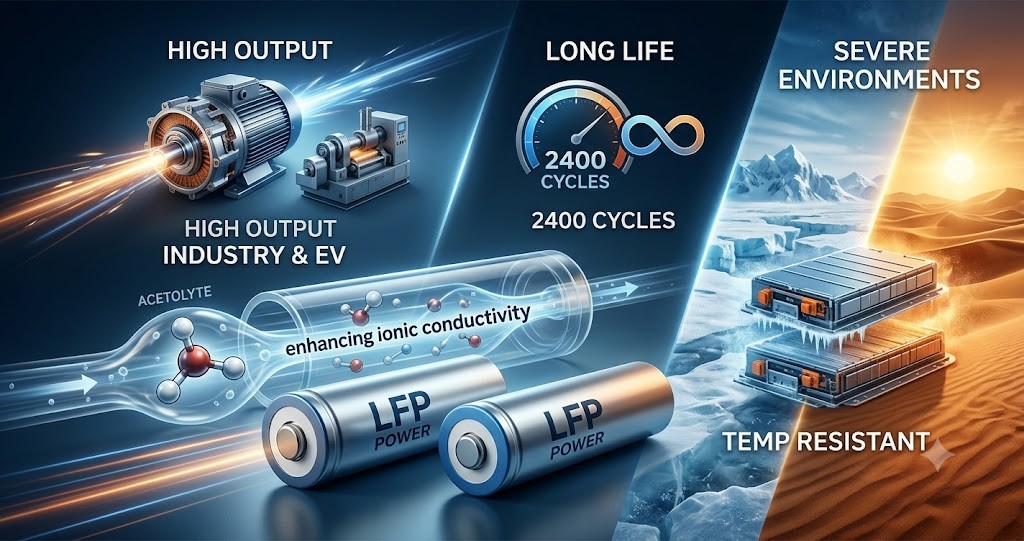
次世代のモビリティ(EVなど)や産業機器の普及に伴い、リチウムイオン電池には「高出力」「長寿命」「過酷な環境への耐性」が強く求められています。特に、安全性が高く安価な素材として注目されるリン酸鉄(LFP)リチウムイオン電池ですが、従来の電解液では出力特性や低温時の性能に課題がありました。こうした中、旭化成が開発した革新的な電解液技術「Acetolyte」と、ドイツの電池メーカーEAS Batteriesの技術が融合し、2400回という過酷な充放電でも劣化しにくい高出力な電池セルが誕生しました。本稿では、発表された製品の性能とその背景にある関連情報についてまとめます。
1. 発表の概要
旭化成は2026年6月2日、独自の超イオン伝導性電解液技術「Acetolyte」を採用した高出力LFPリチウムイオン電池セルが、ドイツのEAS Batteries社より2026年3月に発売されたことを発表しました。両社は2025年11月にライセンス契約を締結しており、今回の販売開始は旭化成のライセンシング戦略における重要なマイルストーンとなります。
2. 「Acetolyte」が実現した電池セルの卓越した性能
今回発売されたのは、公称容量22Ahの円筒形リチウムイオンLFP電池セルです。
- 劇的な出力向上: 連続放電時には、従来の電解液を使用したセルと比較して約60パーセント向上となる「2550 W/kg」の出力を達成しました。また、2秒間のパルス放電(瞬間的な大電流放電)においては「3760 W/kg」を示し、従来比で約10パーセントの出力を向上させています。
- 驚異的な長寿命(耐劣化性): 室温条件下において「5C/5C、100パーセント DoD(放電深度100パーセント)」という、電池にとって非常に負荷の高い条件で充放電を繰り返しても、2400回(サイクル)の充放電後に初期容量の80パーセントを維持します。従来の電解液では急激に劣化が進むような厳しい条件下でも、高い性能を維持できる点が最大の特徴です。
3. 【関連情報】技術的背景と「Acetolyte」の強み
- アセトニトリルの活用: 「Acetolyte」は、溶媒に「アセトニトリル」を含有している点が大きな特徴です。アセトニトリルは粘度が低く、介在するイオンが非常に動きやすい(高いイオン伝導性を持つ)という性質があります。これにより、電池の「内部抵抗」を大幅に低減させることが可能となり、上記のような超高出力が実現しました。
- 過酷な温度環境への強さ: 一般的なリチウムイオン電池は、極低温環境下で電解液の粘度が上がり、極端に出力が低下(あるいは充電不可に)するという弱点があります。しかし、アセトニトリルを用いた「Acetolyte」は融点が低く、厳しい温度条件下(特に低温環境)でも優れたイオン伝導性を維持するため、冬場のモビリティ使用や寒冷地での産業用途に大きなアドバンテージを持ちます。
- LFP(リン酸鉄リチウム)とのシナジー: LFP電池は、一般的に使われる三元系(NMCなど)電池に比べて「熱安定性が高く安全」「安価で寿命が長い」というメリットがある反面、「エネルギー密度や出力がやや劣る」という弱点がありました。「Acetolyte」はこのLFPの弱点である出力を劇的に補うため、安全で安価、かつ超高出力な電池という理想的な組み合わせを実現しています。
4. 今後の展望と拡大戦略
現在、各産業分野の顧客による評価が進められていますが、EAS Batteries社はさらなる市場拡大に向けて以下の戦略を推進しています。
- サブライセンスの展開: 他の電池メーカーや自動車OEM(自動車メーカー)へのサブライセンス契約を進めており、技術の普及を加速させています。
- 次世代「46xxxセル」への適用: 直径46mmの大型円筒型リチウムイオン電池セル(テスラなどが採用を進める大型規格と同等)への適用に向けた評価が進行中です。2026年中の製品化を目指して開発が進められており、既に試作用セルは提供可能な状態にあります。
この大型セルが実用化されれば、電気自動車(EV)をはじめとするモビリティ用途、さらには大型の蓄電システムなど、幅広い分野でのゲームチェンジャーとなることが期待されています。
出典:https://monoist.itmedia.co.jp/mn/articles/2606/03/news035.html
A 60 Percent Output Increase Compared to Conventional Cells! High-Output LFP Batteries Equipped with Asahi Kasei’s Innovative Electrolyte Finally Released by Germany’s EAS
With the widespread adoption of next-generation mobility (such as EVs) and industrial equipment, lithium-ion batteries are under strong demand for high output, long life, and resistance to harsh environments. In particular, lithium iron phosphate (LFP) lithium-ion batteries are drawing attention as highly safe and inexpensive materials. However, conventional electrolytes faced challenges in output characteristics and performance at low temperatures. Under these circumstances, Asahi Kasei’s innovative electrolyte technology “Acetolyte” has merged with the technology of German battery manufacturer EAS Batteries. This fusion has given birth to a high-output battery cell that resists degradation even after 2400 cycles of harsh charging and discharging. This article summarizes the performance of the announced product and the related background information.
1. Overview of the Announcement
On June 2, 2026, Asahi Kasei announced that a high-output LFP lithium-ion battery cell utilizing its proprietary ultra-ionic conductive electrolyte technology, “Acetolyte,” was released by Germany-based EAS Batteries in March 2026. The two companies signed a licensing agreement regarding the use of Acetolyte in November 2025. This commercial launch marks a major milestone in Asahi Kasei’s licensing strategy.
2. Outstanding Performance of the Battery Cell Enabled by “Acetolyte”
The newly released product is a cylindrical lithium-ion LFP battery cell with a nominal capacity of 22Ah.
- Dramatic Output Improvement: During continuous discharge, the cell achieved an output of 2550 W/kg, which is approximately a 60 percent increase compared to cells using conventional electrolytes. Furthermore, in a 2-second pulse discharge (instantaneous high-current discharge), it demonstrated 3760 W/kg, confirming an output improvement of about 10 percent over conventional cells.
- Incredible Longevity (Degradation Resistance): Even when repeatedly charged and discharged under highly stressful conditions of 5C/5C and 100 percent DoD (Depth of Discharge) at room temperature, the cell maintains 80 percent of its initial capacity after 2400 cycles. The biggest feature is its ability to maintain high performance under severe conditions where conventional electrolytes would degrade rapidly.
3. Related Information: Technical Background and Strengths of “Acetolyte”
- Utilization of Acetonitrile: A major feature of “Acetolyte” is that its solvent contains acetonitrile. Acetonitrile has low viscosity, allowing the intervening ions to move extremely easily (possessing high ionic conductivity). This makes it possible to significantly reduce the battery’s internal resistance, achieving the ultra-high output mentioned above.
- Resilience to Harsh Temperature Environments: Typical lithium-ion batteries suffer from a weakness where the viscosity of the electrolyte increases in extremely low-temperature environments, leading to a drastic drop in output or an inability to charge. However, “Acetolyte,” which uses acetonitrile, has a low melting point and maintains excellent ionic conductivity even under severe temperature conditions (especially low temperatures). This provides a massive advantage for winter mobility usage and industrial applications in cold regions.
- Synergy with LFP (Lithium Iron Phosphate): Compared to commonly used ternary batteries (such as NMC), LFP batteries offer benefits such as being highly thermally stable, safe, inexpensive, and long-lasting. On the flip side, they had weaknesses in having slightly lower energy density and output. “Acetolyte” dramatically compensates for this output weakness of LFP, achieving an ideal combination of a safe, affordable, and ultra-high-output battery.
4. Future Outlook and Expansion Strategy
While evaluations by customers in various industrial fields are currently underway, EAS Batteries is pursuing the following strategies for further market expansion:
- Deployment of Sub-licensing: The company is moving forward with sub-licensing agreements with other battery manufacturers and automotive OEMs (automobile manufacturers) to accelerate the widespread adoption of the technology.
- Application to Next-Generation “46xxx Cells”: Evaluation is underway for application to “46xxx cells,” which are large cylindrical lithium-ion battery cells with a diameter of 46mm (equivalent to the large-scale standards being adopted by companies like Tesla). Development is progressing with the goal of commercialization within 2026, and prototype cells are already available.
If these large cells are commercialized, they are expected to become a game-changer in a wide range of fields, including mobility applications such as electric vehicles (EVs), as well as large-scale energy storage systems.


コメント