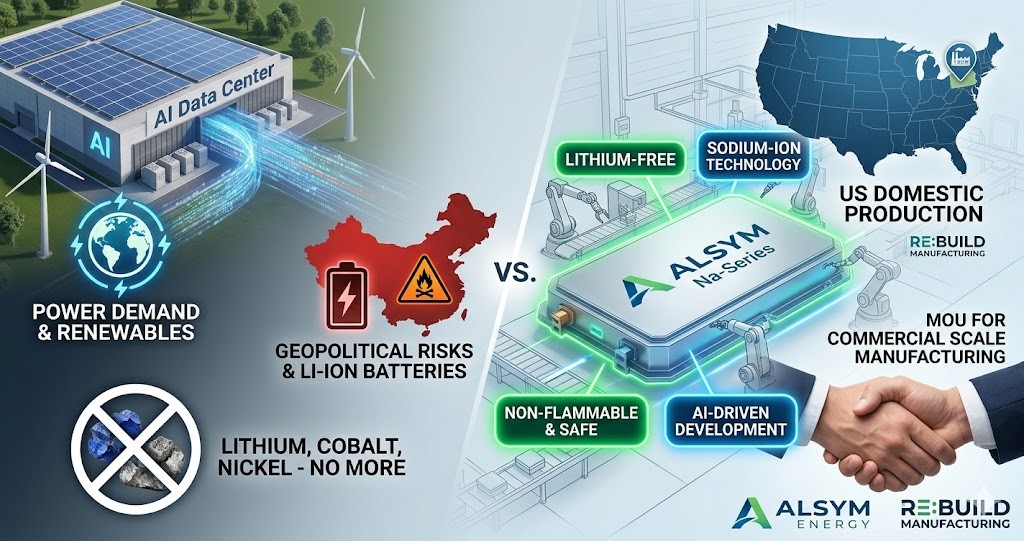
AIデータセンターの急増や再生可能エネルギーの普及に伴い、世界中で電力貯蔵(ストレージ)需要が爆発的に高まっています。現在、主流であるリチウムイオン電池は、発火リスクなどの安全性や、コバルト、ニッケル、リチウムといった特定鉱物のサプライチェーンが中国をはじめとする特定国に依存しているという地政学的リスクを抱えています。こうした中、米国マサチューセッツ州発のスタートアップAlsym Energyが、不燃性・非毒性でリチウムフリーの次世代「ナトリウムイオン電池」の国内商業生産に向けて本格始動しました。本稿では、同社が国内製造パートナーのRe:Build Manufacturingと結んだMOUの概要、製品の特徴、そして近年加速するビジネス展開について関連情報を交えてまとめます。
1. 発表の概要(米国国内での商業生産へ)
Alsym Energyと、先進的な国内製造を手がけるRe:Build Manufacturingは、米国内における商業規模のナトリウムイオン電池セル製造能力の構築に向けた覚書(MOU)を締結しました。
- 製造拠点の想定: 製造業の深い歴史と労働力を持つ、ピッツバーグ郊外のペンシルベニア州New KensingtonにあるRe:Buildの工場が予定されています。これにより、物流リードタイムや輸送コストの大幅な削減が見込まれます。
- 戦略的意義: 米国のFEOC(懸念外国事業体)規制に完全準拠し、税額控除や国防調達ルール(米国政府機関が調達する際の厳しい条件)に対応したサプライチェーンを国内で完結させることを目指しています。
2. 「Na-Series」バッテリーの特徴と革新性
Alsym Energyが開発する「Na-Series」は、リチウムイオン電池の弱点を克服するために設計された次世代バッテリーです。
- 高い安全性(不燃性・非毒性): セルレベルで「UL9540A認証(熱暴走火災試験の厳しい安全規格)」の取得を目指しています。リチウムイオン電池では達成が非常に困難な、発火しない極めて高い安全性を特徴としています。
- 脱・中国サプライチェーン: コバルト、ニッケル、リチウムを一切使用しません。原材料には、米国のワイオミング州で豊富に産出される炭酸ナトリウム(ソーダ灰)など、地球上に潤沢に存在する素材を活用することで、中国依存の供給網から脱却を図っています。
- AIを活用した超高速開発: 物理学に基づいた独自のAIプラットフォームを導入しており、従来比で約10倍の速度で電池開発を進める体制を整えています。
3. 【関連情報】ナトリウムイオン電池を取り巻く背景と需要の急増
- 【技術解説】ナトリウムイオン電池とは: リチウムの代わりに電荷の運搬体として「ナトリウムイオン」を使用する電池です。ナトリウムは海水や塩(塩化ナトリウム)、ソーダ灰などから容易に得られるため、リチウムに比べて原材料コストが劇的に安いというメリットがあります。エネルギー密度はリチウムイオン電池に一歩譲るものの、固定型の大型蓄電システム(データセンターや電力網)には最適な技術として世界中で開発競争が激化しています。
- AIデータセンターという巨大市場: 生成AIの爆発的な普及に伴い、データセンターの消費電力は桁違いに増加しています。24時間安定してクリーンな電力を供給するためのバッファーとして、安全かつ大量・安価に設置できる非リチウム系蓄電池へのニーズが、今まさに急拡大しています。
4. 加速する商業化への足跡
Alsym Energyは、MIT(マサチューセッツ工科大学)の機械工学教授であるKripa Varanasi博士らによって共同創業された技術志向のスタートアップです。2024年には7800万ドルのシリーズC資金調達を完了しており、直近でも以下のような大型のパートナーシップを連発しています。
- ESS Techとの合意(2026年5月): 8.5 GWh(ギガワット時)という大規模なナトリウムイオンセル・モジュールの供給に関する基本合意書を締結。
- Juniper Energyとの連携(2026年5月): カリフォルニア州の再生可能エネルギー開発会社と、500 MWh(メガワット時)のエネルギーストレージ展開に向けた戦略的連携を発表。
今回のRe:Build社との製造MOUは、これら膨大な供給契約を自国内で実際に生産・供給するための、極めて重要な「量産化ロードマップ」の確定を意味しています。
Moving Away from Lithium and China! Alsym Energy Launches Full-Scale Operations for Commercial Production of Sodium-Ion Batteries in the US
With the rapid surge in AI data centers and the widespread adoption of renewable energy, the demand for energy storage is exploding worldwide. Currently, mainstream lithium-ion batteries carry safety risks such as fire hazards. They also face geopolitical risks, as the supply chain for specific minerals like cobalt, nickel, and lithium depends heavily on certain countries, including China. Under these circumstances, Alsym Energy, a startup from Massachusetts, USA, has launched full-scale operations toward the domestic commercial production of its non-flammable, non-toxic, and lithium-free next-generation “sodium-ion batteries.” This article summarizes the overview of the MOU signed with its domestic manufacturing partner Re:Build Manufacturing, the product features, and its accelerating business development alongside related information.
1. Overview of the Announcement (Toward Commercial Production in the US)
Alsym Energy and Re:Build Manufacturing, a company specializing in advanced domestic manufacturing, announced the signing of a Memorandum of Understanding (MOU) to build commercial-scale sodium-ion battery cell manufacturing capacity in the United States.
- Prospective Manufacturing Site: Production is planned at Re:Build’s Pennsylvania facility in New Kensington, located just outside of Pittsburgh. This region possesses deep historical manufacturing expertise and an eager workforce. The two companies anticipate significant reductions in logistics lead times and transportation costs.
- Strategic Significance: The partnership aims to complete a supply chain entirely within the United States. This will ensure full compliance with US FEOC (Foreign Entity of Concern) regulations, qualify for tax credits, and meet strict national defense procurement rules for US government agencies.
2. Features and Innovation of “Na-Series” Batteries
The “Na-Series” developed by Alsym Energy is a next-generation battery designed to directly solve the major challenges faced by lithium-ion batteries.
- High Safety (Non-flammable and Non-toxic): The company aims to achieve UL9540A certification (a rigorous safety standard for thermal runaway fire testing) at the cell level. It features an extremely high level of safety by not catching fire, a feat that is very difficult to achieve with lithium-ion batteries.
- Moving Away from the China-Dependent Supply Chain: The battery uses zero cobalt, nickel, or lithium. By utilizing materials that are abundantly available on Earth, such as sodium carbonate (soda ash) which is heavily mined in Wyoming, the company is breaking away from the China-dependent lithium supply chain.
- Ultra-Fast Development Powered by AI: The company has introduced a proprietary physics-informed AI platform. This sets up a framework capable of developing batteries at approximately 10 times the speed of conventional methods.
3. Related Information: Background Surrounding Sodium-Ion Batteries and the Surge in Demand
- Technical Explanation: What is a Sodium-Ion Battery?: This type of battery uses “sodium ions” instead of lithium as the charge carrier. Since sodium can be easily obtained from seawater, salt (sodium chloride), or soda ash, its raw material costs are drastically cheaper than lithium. While its energy density is slightly lower than that of lithium-ion batteries, it is intensifying global development competition as an ideal technology for large-scale, stationary energy storage systems (such as data centers and power grids).
- A Massive Market in AI Data Centers: With the explosive growth of generative AI, the power consumption of data centers is increasing exponentially. There is a rapidly growing need for non-lithium batteries that can be installed safely, in large quantities, and at a low cost to act as buffers for providing stable, 24-hour clean energy.
4. Footsteps Toward Accelerated Commercialization
Alsym Energy is a technology-driven startup co-founded by Dr. Kripa Varanasi, a professor of mechanical engineering at MIT (Massachusetts Institute of Technology), and others. The company completed a 78 million dollar Series C funding round in 2024 and has recently announced a succession of large-scale partnerships:
- Agreement with ESS Tech (May 2026): Signed a letter of intent for the supply of a massive 8.5 GWh (gigawatt-hour) of sodium-ion cells and modules.
- Collaboration with Juniper Energy (May 2026): Announced a strategic alliance with the California-based renewable energy developer to deploy 500 MWh (megawatt-hour) energy storage systems.
This manufacturing MOU with Re:Build signifies the finalization of a crucial “commercialization roadmap” to actually produce and supply these massive contract volumes within the United States.

コメント