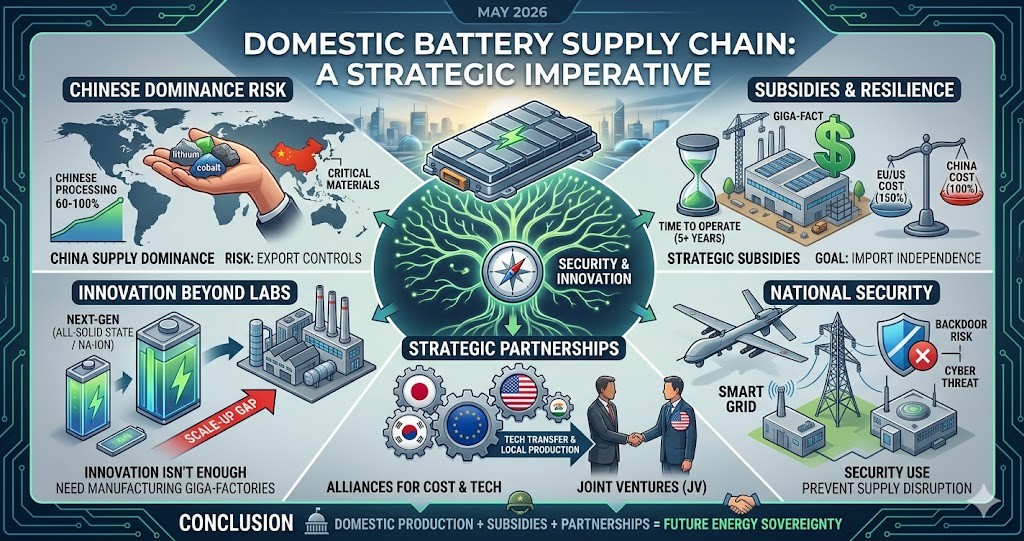
電気自動車(EV)や再生可能エネルギー貯蔵システム(BESS)の普及に伴い、バッテリーは現代の産業・安全保障の基盤となっています。国際エネルギー機関(IEA)の最新報告書は、中国が世界のサプライチェーンを圧倒的に支配する現状において、他国が国内生産能力を構築することの重要性を提起しています。本稿では、コスト面で圧倒的に不利な状況であっても、なぜ各国が国内バッテリー産業に投資すべきなのかという5つの重要な問いについて、現在の国際情勢や最新の業界動向を踏まえた関連情報を交えて解説します。
1. 中国のバッテリーサプライチェーンにおける支配力はなぜ懸念されるのか?
- 記事の要点: 中国は原材料加工、電池製造、リサイクルに至る全段階の60%からほぼ100%を支配しています。この過度な依存は戦略的リスクであり、中国による黒鉛(グラファイト)などの輸出規制は、他国の自動車メーカーやエネルギー企業の生産混乱とコスト増加に直結しています。
- 【関連情報】市場の現状と地政学リスク: 中国は、EVに不可欠なリチウムイオン電池の主要素材(リチウム、コバルト、ニッケル、黒鉛)の精錬事業で圧倒的なシェアを持っています。2023年末に中国政府が実施した黒鉛の輸出管理強化は、欧米の自動車メーカーにサプライチェーンの見直しを迫る決定打となりました。単一国への依存は、地政学的な緊張が高まった際に「エネルギーの武器化」を招くリスクがあるため、経済安全保障の観点から極めて危険視されています。
2. 補助金は戦略的レジリエンスの構築にどのように役立つのか?
- 記事の要点: 補助金は輸入依存を減らし、将来の戦略的強靭性(レジリエンス)を確保するために不可欠です。しかし、新規工場が安定稼働するまでに5年以上かかることがあり、税額控除や補助金があっても、欧米の生産コストは中国より最大50%高いままであるという長期的な持続可能性の課題があります。
- 【関連情報】欧米の政策とメーカーの直面する現実: 米国はインフレ抑制法(IRA)により、巨額の税額控除(1kWhあたり最大45ドル)を導入して国内生産を強力に後押ししています。一方、欧州ではエネルギーコストの高騰や補助金競争の激化により、地元スタートアップの経営が急速に悪化しています。記事中にある「モロー社(Morrow Batteries)」だけでなく、スウェーデンのノースボルト(Northvolt)などの有力企業も資金難や生産遅延に直面しており、中国の圧倒的な規模の経済(コスト競争力)に補助金だけで対抗することの難しさが浮き彫りになっています。
3. なぜ、たとえ小規模な国内生産であっても、国家安全保障にとって重要なのか?
- 記事の要点: バッテリーはEVだけでなく、電力網(グリッド)や防衛用途を支える21世紀の最重要技術です。安全かつ手頃な価格でのバッテリー供給は国家安全保障そのものであり、小規模でも国内に基盤を持つことで、地政学的混乱時にも致命的な供給途絶を防ぐことができます。
- 【関連情報】防衛・重要インフラへの応用: 軍事領域におけるドローン、通信機器、次世代戦闘車両、潜水艦、さらには重要インフラである大規模蓄電所(BESS)において、サイバーセキュリティやバックドア(不正プログラム)の混入を防ぐため、信頼できるサプライチェーンの確保が急務となっています。米国国防総省などはすでに、特定の国からのバッテリー調達を制限する動きを強めており、安全保障上の理由から「地産地消」または同盟国内での調達(フレンドショアリング)が義務付けられつつあります。
4. イノベーションだけで問題を解決できるのか?
- 記事の要点: 全固体電池(2027年から2030年市場投入予測)やナトリウムイオン電池などの次世代技術は有望ですが、既存の生産大手が新技術開発でも主導権を握っています。製造インフラやエコシステム(生態系)が国内にない国では、優れた技術があっても商業規模へ迅速に拡大(スケールアップ)できず、イノベーションだけに頼る戦略はリスクが高すぎます。
- 【関連情報】次世代電池の現状と製造の壁: ナトリウムイオン電池はリチウムを使わないため低コスト化が期待され、中国のCATLなどがすでに実用化を進めています。また、全固体電池は日本のトヨタ自動車などが主導して開発を進めていますが、大量生産(量産化)技術の確立には依然として高いハードルがあります。どれだけ革新的な研究所レベルの成果があっても、それを大量かつ均一に作るための「ギガファクトリー(大規模工場)」の製造ノウハウが国内になければ、最終的には再び製造を海外に依存することになります。
5. 戦略的パートナーシップはどのようにしてそのギャップを埋めることができるのか?
- 記事の要点: 日本や韓国など、すでに実績と高い技術力を持つアジアの老舗メーカーとの連携(合弁事業など)は、技術移転、コスト削減、生産の現地化を加速させます。自国の現状の能力と世界市場の需要とのギャップを埋めるための有効な現実解です。
- 【関連情報】グローバルなアライアンス(同盟)の動向: 北米市場では、GMとLGエナジーソリューション、フォードとSKオン、パナソニックとテスラやステランティスといった、自動車メーカーと日韓の電池メーカーによる共同投資(ギガファクトリー建設)が主流となっています。これにより、欧米側は高度な量産ノウハウを迅速に取り入れることができ、日韓側は現地の補助金(IRAなど)の恩恵を享受するという相乗効果(シナジー)が生まれています。自国単独での開発・製造にこだわらず、信頼できるパートナーとのエコシステム構築が現実的な路線となっています。
【結論・まとめ】
国内バッテリー生産の確保は、単なる経済的なコスト比較(損得勘定)の枠を超え、国家の「エネルギー安全保障」および「産業競争力」を左右する最重要課題となっています。 中国の圧倒的なコスト優位性とサプライチェーン支配に対抗するためには、
- 巨額の初期投資を支える長期的な「政府の補助金政策」
- 防衛や重要インフラを守るための「安全保障上の国内生産枠の維持」
- 日韓など実績のある先進メーカーとの「戦略的パートナーシップによる技術導入」 これらを組み合わせた断固たる行動と産業戦略が必要です。今下される決断が、将来のエネルギー主権を握れるかどうかの分岐点となります。
- 1. 中国のバッテリーサプライチェーンにおける支配力はなぜ懸念されるのか?
- 2. 補助金は戦略的レジリエンスの構築にどのように役立つのか?
- 3. なぜ、たとえ小規模な国内生産であっても、国家安全保障にとって重要なのか?
- 4. イノベーションだけで問題を解決できるのか?
- 5. 戦略的パートナーシップはどのようにしてそのギャップを埋めることができるのか?
- 【結論・まとめ】
- The Frontline of Energy Security: China’s Supply Chain Dominance and the Necessity of Domestic Battery Production
- Introduction
- 1. Why is China’s dominance in the battery supply chain a concern?
- 2. How do subsidies help build strategic resilience?
- 3. Why is even small-scale domestic production crucial for national security?
- 4. Can innovation alone solve the problem?
- 5. How can strategic partnerships bridge the gap?
- Conclusion
The Frontline of Energy Security: China’s Supply Chain Dominance and the Necessity of Domestic Battery Production
Introduction
With the widespread adoption of electric vehicles (EVs) and battery energy storage systems (BESS), batteries have become the foundation of modern industry and security. The latest report from the International Energy Agency (IEA) highlights the critical importance of other nations building domestic production capacity, especially given China’s overwhelming dominance over the global supply chain. This article addresses five critical questions on why countries must invest in their domestic battery industries despite facing significant cost disadvantages, integrating relevant information based on the current international landscape and the latest industry trends.
1. Why is China’s dominance in the battery supply chain a concern?
- Key Points: China controls between 60% to nearly 100% of all stages of the battery manufacturing supply chain, spanning from raw material processing to battery manufacturing and recycling. This over-reliance poses a strategic risk; China’s export restrictions on materials like graphite directly lead to production disruptions and cost increases for automakers and energy companies worldwide.
- [Related Information] Market Reality and Geopolitical Risks: China holds an overwhelming market share in the refining of key materials essential for lithium-ion batteries, including lithium, cobalt, nickel, and graphite. The Chinese government’s tightening of graphite export controls at the end of 2023 served as a turning point, forcing Western automakers to overhaul their supply chains. Relying on a single nation is highly dangerous from an economic security perspective, as it introduces the risk of the “weaponization of energy” during times of heightened geopolitical tension.
2. How do subsidies help build strategic resilience?
- Key Points: Subsidies are vital for reducing reliance on imports and securing future strategic resilience. However, new facilities often take over five years to reach steady operation. Even with tax credits and subsidies, production costs in the West remain up to 50% higher than in China, raising long-term sustainability concerns for subsidy-dependent production.
- [Related Information] Western Policies and the Reality Faced by Manufacturers: The United States is aggressively backing domestic production through the Inflation Reduction Act (IRA), which introduced massive tax credits of up to 45 dollars per 1kWh. Conversely, in Europe, soaring energy costs and intense subsidy competition are rapidly deteriorating the financial health of local startups. Beyond Morrow Batteries mentioned in the article, leading companies like Sweden’s Northvolt are facing severe funding shortages and production delays. This underscores the difficulty of competing against China’s massive economies of scale and cost advantages through subsidies alone.
3. Why is even small-scale domestic production crucial for national security?
- Key Points: Batteries are becoming the most critical technology of the 21st century, powering not only EVs but also power grids and defense applications. A secure and affordable battery supply is a matter of national security itself. Maintaining a domestic manufacturing base, even on a small scale, ensures access to critical technology during geopolitical disruptions and prevents catastrophic supply chain halts.
- [Related Information] Defense and Critical Infrastructure Applications: Securing a trusted supply chain has become an urgent priority to prevent cybersecurity threats and the introduction of malicious backdoors in hardware. This is especially true for military drones, communication equipment, next-generation combat vehicles, submarines, and critical infrastructure like large-scale battery energy storage systems (BESS). The US Department of Defense and other entities are already restricting battery procurement from specific countries. For security reasons, “local production for local consumption” or sourcing from allied nations (friend-shoring) is increasingly becoming mandatory.
4. Can innovation alone solve the problem?
- Key Points: Next-generation technologies such as solid-state batteries (expected to enter the market between 2027 and 2030) and sodium-ion batteries are promising, but relying solely on innovation is risky. The established manufacturing giants dominating lithium-ion production are also leading the development of these new technologies. Without an existing domestic manufacturing infrastructure or ecosystem, it is difficult for startups or new entrants to rapidly scale breakthroughs to a commercial level.
- [Related Information] Current Status of Next-Gen Batteries and Manufacturing Barriers: Sodium-ion batteries eliminate the need for lithium, offering promising cost reductions, and Chinese companies like CATL are already commercializing them. Meanwhile, solid-state batteries are being pioneered by companies like Toyota in Japan, but establishing mass-production technology remains a high hurdle. No matter how revolutionary a breakthrough is at the lab level, if a country lacks the manufacturing know-how of running a “gigafactory” to produce units uniformly and at scale, it will ultimately find itself dependent on overseas manufacturing once again.
5. How can strategic partnerships bridge the gap?
- Key Points: Collaborating with established Asian manufacturers from countries like Japan and South Korea through joint ventures accelerates technology transfer, reduces costs, and localizes production. This serves as a highly effective and realistic solution to bridge the gap between a nation’s current capabilities and the demands of the hyper-competitive global battery market.
- [Related Information] Trends in Global Alliances: In the North American market, joint investments to build gigafactories between automakers and Japanese or South Korean battery manufacturers have become the norm—examples include GM with LG Energy Solution, Ford with SK On, and Panasonic with Tesla or Stellantis. Through these alliances, Western companies can quickly adopt advanced mass-production expertise, while Asian manufacturers benefit from local subsidies like the IRA. Moving away from complete self-reliance and instead building an ecosystem with trusted partners has become the most viable path forward.
Conclusion
Securing domestic battery production transcends basic economic cost-benefit calculations; it has become a defining issue for a nation’s energy security and industrial competitiveness. To counter China’s overwhelming cost advantages and supply chain dominance, nations must implement decisive industrial strategies that combine:
- Long-term government subsidy policies to absorb massive initial capital expenditures
- The preservation of domestic production mandates for national security to protect defense and critical infrastructure
- Strategic partnerships with proven, advanced manufacturers from nations like Japan and South Korea to import manufacturing expertise
Decisive action is required. The choices made today will serve as the turning point for whether a nation can secure its future energy sovereignty.
コメント