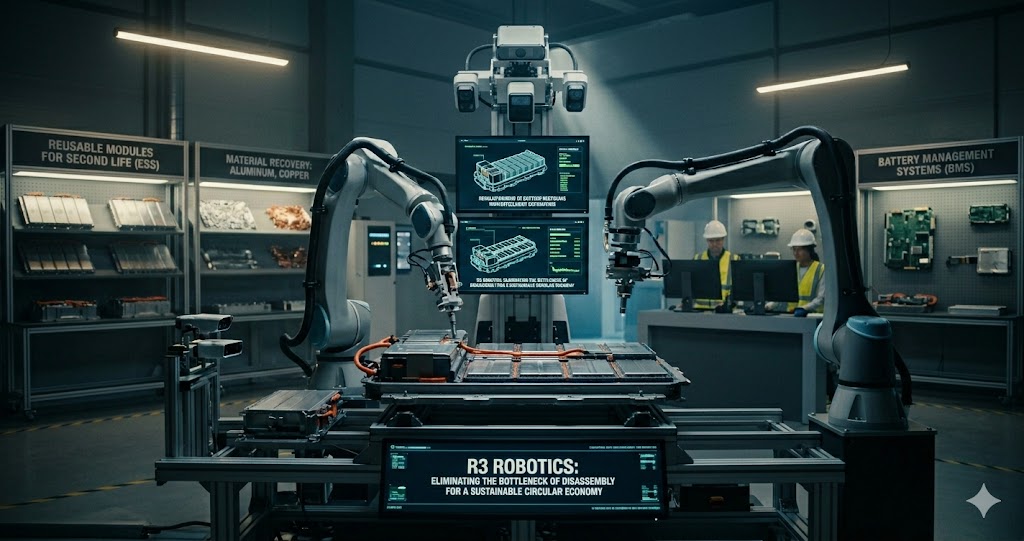
電気自動車(EV)の普及に伴い、使用済みバッテリーの処理は喫緊の課題となっています。これまでリサイクルの議論は、化学的な抽出プロセスやシュレッダー処理に集中しがちでしたが、実はその前段階である「解体(分解)」こそが、資源循環の質と経済性を決定づけるボトルネックとなっています。
本稿では、スタートアップ企業 R3 Robotics の取り組みを中心に、手作業の限界を打破する自動分解技術が、いかにしてバッテリーリサイクルを「持続可能な産業」へと変革しようとしているのかを解説します。
1. バッテリーリサイクルにおける「見えないボトルネック」
現在、バッテリーリサイクルは製錬や湿式冶金といった後工程に注目が集まっています。しかし、リサイクル効率を最大化するためには、シュレッダーにかける前に、モジュール、セル、回路基板、筐体(アルミニウムやプラスチック)を精密に分ける必要があります。
現状の3つの大きな課題
- 過酷な労働環境: バッテリーパックは巨大で重く、手作業による解体は肉体的に非常にハードです。
- 安全性のリスク: 高電圧システムを扱うため、常に感電や火災のリスクがつきまといます。
- 労働力不足: 専門知識を持つ熟練労働者が不足しており、手作業では急増する廃バッテリーの処理量に対応できません。
2. R3 Roboticsの革新:ソフトウェア対応ハードウェア
R3 Robotics は、この解体工程をロボットで自動化することを目指しています。彼らのアプローチの特徴は、単なる機械化ではなく「インテリジェントな自動化」にあります。
独自の技術アプローチ
- コンピュータビジョン: AIが搬入されたバッテリーの種類を自律的に認識します。
- エンドエフェクタ(スキル): ロボットアームの先端に取り付けるツールを独自開発し、ボルトの取り外しや接着剤の切断など、特定の構造に対応した「スキル」を四半期ごとに増やしています。
- デュアル構成: 異なる種類のバッテリーパックを同時に処理できる柔軟性を持ち、選別されていない混合状態の入荷にも対応可能です。
3. リサイクルの階層:セカンドライフを優先する
自動分解の最大のメリットは、部品を「壊さずに取り出せる」ことです。これにより、単純な材料リサイクル(シュレッダー処理)の前に、より価値の高い選択肢が生まれます。
資源循環の優先順位(サーキュラーエコノミー)
- リユース / セカンドライフ: 状態の良いモジュールを取り出し、太陽光発電の蓄電システム(ESS)などに再利用する。
- 部品回収: 銅線、アルミニウム、バッテリー管理システム(BMS)などを素材ごとに回収。
- マテリアルリサイクル: 再利用不能なセルのみをシュレッダーにかけ、リチウムやコバルトなどの「ブラックマス」を抽出。
事例:Amazonとの連携
Amazonの配送車両(Rivian製)から出たバッテリーを分解し、まだ使えるモジュールはAmazonの太陽光発電施設の蓄電池として活用されています。
4. 市場動向と規制のプレッシャー
欧州を中心に、バッテリーリサイクルを義務付ける規制が強化されています。
主要な数値と規制
- 市場予測: 2040年までに欧州だけで年間 6,000,000トン の使用済み電池が発生すると予測されています。
- EU電池規則(2023/1542): 2031年までにリチウムの 80%、コバルト・銅・ニッケルの 95% を回収することが義務付けられます。
- 再生材含有率: 将来的に、新品の電池には一定割合のリサイクル素材を使用しなければなりません。
| 資源名 | 2031年回収目標 | 新品への含有義務(2031年以降) |
| リチウム | 80% | 6% |
| コバルト | 95% | 16% |
| ニッケル | 95% | 6% |
| 銅 | 95% | なし |
5. 今後の課題:セル・トゥ・パック(CTP)への対応
技術が進歩する一方で、自動車メーカー(OEM)側もコスト削減のために設計を変更しています。その代表が Cell-to-Pack (CTP) 構造です。
- 課題: モジュールを介さずセルを直接パックに接着するため、分解が極めて困難になります。
- 解決策: R3 Robotics はOEMと協力し、最初から分解しやすい設計(Design for Disassembly)を提案しています。分解コストが高いパックは「廃棄費用」をメーカーが負担する仕組みになりつつあり、経済的な観点からも設計の見直しが進んでいます。
結論
バッテリーの解体は、単なる「ゴミ処理」のステップではなく、資源循環という物語の「始まり」です。R3 Robotics が推進する自動化技術は、安全性の向上、コスト削減、そしてクリーンな材料流の創出を同時に実現します。
欧州が規制を武器に先行する中で、この「シュレッダー処理前のインテリジェンス」をどれだけ確立できるかが、グローバルな原材料競争における自給自足の鍵となるでしょう。
Revolution Before the Shredder: R3 Robotics and the Future of Automated Battery Dismantling
With the rapid spread of electric vehicles (EVs), the disposal of end-of-life batteries has become an urgent challenge. Until now, discussions around recycling have often focused on chemical extraction processes and shredding. However, the preceding stage—dismantling—is the true bottleneck that determines the quality and economic viability of resource circulation.
This article highlights the efforts of the startup R3 Robotics and explores how automated dismantling technology, which overcomes the limits of manual labor, is transforming battery recycling into a sustainable industry.
1. The “Invisible Bottleneck” in Battery Recycling
Currently, much of the attention in battery recycling is directed toward downstream processes like smelting and hydrometallurgy. However, to maximize recycling efficiency, components such as modules, cells, circuit boards, and casings (aluminum and plastics) must be precisely separated before they ever reach the shredder.
Three Major Current Challenges:
- Harsh Working Environment: Battery packs are massive and heavy; manual dismantling is physically grueling work.
- Safety Risks: Handling high-voltage systems carries constant risks of electric shock and fire.
- Labor Shortage: There is a lack of skilled workers with specialized knowledge, making it impossible to scale manual operations to meet the surging volume of waste batteries.
2. R3 Robotics’ Innovation: Software-Enabled Hardware
R3 Robotics aims to automate this dismantling process using robotics. Their approach is characterized not just by mechanization, but by intelligent automation.
Unique Technical Approach:
- Computer Vision: AI autonomously recognizes the type of battery pack upon arrival.
- End-Effectors (Skills): The company develops proprietary tools for robotic arms. These “skills”—such as removing bolts or cutting through adhesives for specific architectures—are expanded every quarter.
- Dual Configuration: The system can process two different types of battery packs simultaneously, providing the flexibility needed to handle unsorted, mixed batches.
3. The Hierarchy of Recycling: Prioritizing Second Life
The greatest advantage of automated dismantling is the ability to remove components without damaging them. This creates high-value options that precede simple material recycling (shredding).
Resource Circulation Priorities (Circular Economy):
- Reuse / Second Life: Extracting healthy modules to be reused in stationary energy storage systems (ESS) for solar power, etc.
- Component Recovery: Separating copper wiring, aluminum, and Battery Management Systems (BMS) by material.
- Material Recycling: Shredding only the non-reusable cells to extract “black mass” containing lithium and cobalt.
Case Study: Partnership with Amazon
Batteries from Amazon’s delivery vehicles (manufactured by Rivian) are dismantled so that functional modules can be repurposed as backup batteries for Amazon’s solar power facilities.
4. Market Trends and Regulatory Pressure
Regulations mandating battery recycling are tightening, particularly in Europe.
Key Figures and Regulations:
- Market Forecast: It is estimated that 6,000,000 tons of used batteries will be generated annually in Europe alone by 2040.
- EU Battery Regulation (2023/1542): By 2031, manufacturers are mandated to recover 80% of lithium and 95% of cobalt, copper, and nickel.
- Recycled Content: In the future, new batteries must contain a minimum percentage of recycled materials.
| Resource | 2031 Recovery Target | Recycled Content Mandate (From 2031) |
| Lithium | 80% | 6% |
| Cobalt | 95% | 16% |
| Nickel | 95% | 6% |
| Copper | 95% | None |
5. Future Challenges: Adapting to Cell-to-Pack (CTP)
While technology advances, automakers (OEMs) are changing designs to reduce costs, most notably through Cell-to-Pack (CTP) structures.
- Challenge: CTP bonds cells directly to the pack without intermediate modules, making dismantling extremely difficult.
- Solution: R3 Robotics is collaborating with OEMs to propose Design for Disassembly. As packs that are difficult to dismantle incur higher “disposal fees” for the manufacturer, there is a growing economic incentive to rethink battery design.
Conclusion
Battery dismantling is not merely a “waste management” step; it is the beginning of the resource circulation story. The automation technology championed by R3 Robotics simultaneously improves safety, reduces costs, and creates clean material streams.
As Europe leads the way with regulation as its primary tool, this “intelligence before the shredder” will be the key to achieving raw material self-sufficiency in the global market.


コメント