1. はじめに
電気自動車(EV)の普及に伴い、数年後には大量の使用済みリチウムイオン電池が排出されることが予測されており、その持続可能な処理とリサイクル技術の確立は世界的な最優先課題となっています。現在主流のリサイクル手法は、バッテリーを完全に破壊して元素レベルで原材料を回収するものであり、莫大なエネルギーとコスト、そして環境負荷がかかるという欠点があります。
こうした中、コーネル大学の研究チームは、バッテリーを完全にリサイクル(分解・粉砕)するのではなく、劣化した電極を「直接再生」する画期的なアプローチを発表しました。初期の実験室試験において、劣化した電池の容量を元の最大95パーセントまで回復させることに成功し、世界の注目を集めています。本サマリーでは、この新技術の概要と関連情報をまとめて解説します。
2. ニュースの主要なポイント(まとめ)
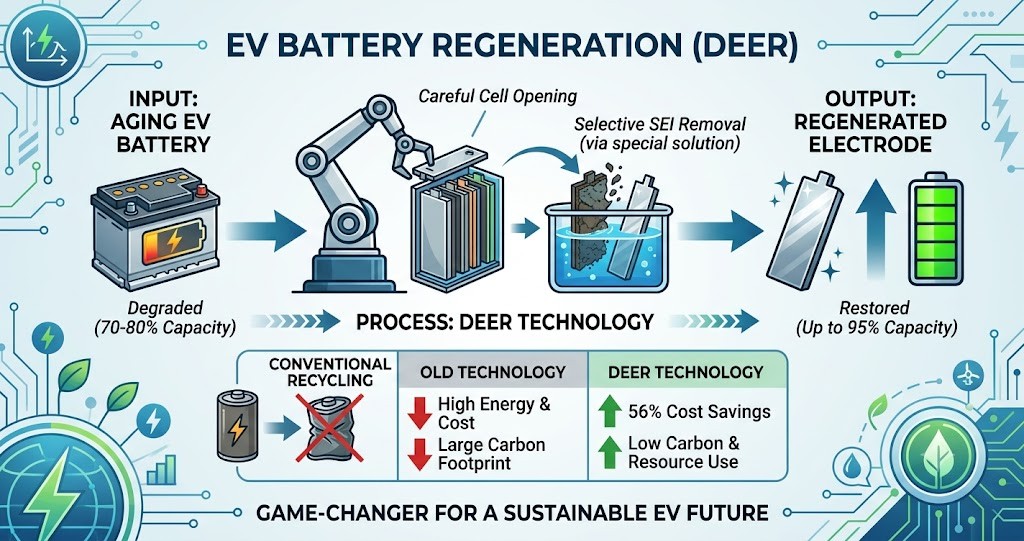
- 直接電極間再生(DEER)技術の開発: 研究チームが開発した「DEER(Direct Electrode-to-Electrode Regeneration)」と呼ばれる手法は、使用済みバッテリーのセルを慎重に開封して電極を取り出し、特殊な電気化学溶液で処理する技術です。2026年6月初旬、学術誌「Energy and Environmental Science」に詳細が発表されました。
- 動作原理と効果: バッテリーの充放電を繰り返すと、電極表面に「固体電解質界面(SEI)」と呼ばれる皮膜が過剰に形成され、これが内部抵抗を増加させて劣化の原因となります。DEER技術は、電極の骨格構造を傷つけることなく、この不要なSEI層のみを選択的に除去します。元の容量の70から80パーセントまで劣化した電池に適用したところ、初期容量の最大95パーセントまで回復させることに成功しました。
- 劇的なコスト・環境負荷の削減: 研究チームの技術経済分析によると、従来のリサイクル方法と比較して処理コストを56パーセントも削減できると結論付けられました。また、プロセスが簡略化されるため、水の使用量や大気汚染物質の排出量も大幅に削減できる可能性があります。
- 現時点での限界と今後の課題: 本技術はまだ実験室段階(ラボスケール)にあります。今後は工業用(実用サイズ)の大型バッテリーでの試験や、活性リチウムの損失といった別の劣化メカニズムへの対応が必要です。また、どのタイプの電池(化学組成)に適用できるか、構造破壊が進んだ末期の劣化電池にも経済的に適用できるか、そして工業規模へスケールアップできるかどうかが今後の焦点となります。
3. 関連情報・背景の補足解説
技術の意義をより深く理解するために、リサイクルの現状と技術的な背景を解説します。
従来のリサイクル手法(マテリアルリサイクル)とその課題
現在、使用済みリチウムイオン電池は主に以下のプロセスで処理されています。
- ブラックマス(Black Mass)の製造: バッテリーを安全に放電したあと、機械的に粉砕・選別して、活物質(リチウム、ニッケル、コバルト、マンガンなど)が含まれる黒い粉末(ブラックマス)にします。
- 冶金(やきん)プロセス: ブラックマスを酸などの化学薬品で溶かす「湿式冶金(ハイドロメタラジー)」や、高温の炉で溶かす「乾式冶金(パイロメタラジー)」によって、金属元素を単体として回収します。
- 課題: この手法は「一度バラバラにした元素を、もう一度莫大なエネルギーをかけて高価な電極材料へと合成し直す」必要があるため、二酸化炭素の排出量が多く、コスト高になるという構造的課題を抱えています。
DEER技術(ダイレクトリサイクル)が注目される理由
コーネル大学の手法は、専門用語で「ダイレクトリサイクル(直接リサイクル)」に分類されます。 最大の特徴は、「高価な電極の結晶構造や形状(カタチ)をそのまま維持して再利用する」点にあります。料理に例えるなら、一度作った料理を元素レベルまで化学分解して作り直す(従来法)のではなく、傷んだ表面だけをきれいに削ぎ落としてベースの食材をそのまま再利用する(直接再生)ようなものです。これにより、材料合成にかかる莫大なエネルギーとコストをスキップできるため、56パーセントという劇的なコスト削減が可能になります。
今後の実用化に向けた技術的ボトルネック
非常に魅力的な技術ですが、商業化に向けては以下の高いハードルが存在します。
- セルの解体自動化: 現在のEV用バッテリーパックは、非常に強固に接着・溶接されており、これを壊さずに「慎重に開封して電極を取り出す」のは手作業に頼る部分が多く、自動化(ロボット化)が極めて困難です。
- 多様な電池化学組成への対応: LFP(リン酸鉄リチウム)やNMC(ニッケル・マンガン・コバルト)、さらには全固体電池など、EVバッテリーの組成は多様化しています。特定の溶液がすべての化学組成に有効であるとは限らず、組成ごとの最適化が必要です。
4. 結論
コーネル大学が発表したDEER技術は、従来の環境負荷とコストが高いリサイクル産業の常識を覆す可能性を秘めた革新的なアプローチです。実験室からギガファクトリー規模へのスケールアップや、自動解体技術との連携など解決すべき課題は多く残されていますが、これが実用化されれば、EVの経済性と環境適合性を格段に高めるゲームチェンジャーとなるでしょう。
出典:https://batteryindustry.net/new-technology-could-regenerate-ev-battery-electrodes-without-recycling/
New Light on Low-Cost EV Battery Regeneration: Opportunities and Challenges of Direct Electrode Regeneration (DEER) Technology Toward Practical Application
1. Introduction
With the widespread adoption of electric vehicles (EVs), it is predicted that a massive volume of spent lithium-ion batteries will be discharged in the coming years, making the establishment of sustainable processing and recycling technologies a top global priority. Current mainstream recycling methods completely destroy the battery to recover raw materials at the elemental level, which has the drawbacks of consuming enormous amounts of energy, incurring high costs, and placing a heavy burden on the environment.
Under these circumstances, a research team at Cornell University has announced a groundbreaking approach that “directly regenerates” degraded electrodes rather than completely recycling (disassembling and crushing) the battery. In initial laboratory tests, the researchers successfully restored the capacity of degraded batteries up to 95 percent of their original value, attracting global attention. This summary outlines this new technology and provides relevant background information.
2. Key Points of the News (Summary)
- Development of Direct Electrode-to-Electrode Regeneration (DEER) Technology: The method developed by the research team, called “DEER,” is a technique where spent battery cells are carefully opened, the electrodes are extracted, and then treated with a special electrochemical solution. The detailed findings were published in the journal “Energy and Environmental Science” in early June 2026.
- Operating Principle and Effects: Repeated charging and discharging of a battery causes an excessive layer known as the “solid electrolyte interphase (SEI)” to form on the electrode surface, which increases internal resistance and drives degradation. DEER technology selectively removes only this unnecessary SEI layer without damaging the underlying framework structure of the electrode. When applied to batteries that had degraded to 70 to 80 percent of their original capacity, it successfully restored them up to 95 percent of their initial capacity.
- Dramatic Reduction in Cost and Environmental Impact: According to the research team’s techno-economic analysis, it was concluded that this method can reduce processing costs by 56 percent compared to conventional recycling methods. Furthermore, because the process is simplified, it has the potential to significantly reduce water consumption and air pollutant emissions.
- Current Limitations and Future Challenges: This technology is still in its early laboratory stage (lab scale). The next steps require testing with larger, commercial-sized industrial batteries and addressing other degradation mechanisms, such as the loss of active lithium. Future focus will also be placed on identifying which types of batteries (chemical compositions) are suitable for this process, whether it can be economically applied to end-of-life batteries with advanced structural damage, and whether the method can be successfully scaled up to an industrial volume.
3. Related Information and Supplementary Background Explanation
To gain a deeper understanding of the significance of this technology, this section explains the current state of recycling and its technical background.
Conventional Recycling Methods (Material Recycling) and Their Challenges
Currently, spent lithium-ion batteries are primarily processed through the following steps:
- Production of Black Mass: After safely discharging the battery, it is mechanically crushed and sorted into a black powder containing active materials such as lithium, nickel, cobalt, and manganese, known as “black mass.”
- Metallurgical Processes: The metallic elements are recovered as standalone materials through “hydrometallurgy,” which dissolves the black mass using chemicals like acids, or “pyrometallurgy,” which melts it in high-temperature furnaces.
- Challenges: This approach has structural drawbacks, including high carbon dioxide emissions and high costs, because it breaks down components into individual elements only to expend massive amounts of energy to synthesize them back into expensive electrode materials.
Why DEER Technology (Direct Recycling) is Drawing Attention
The method developed by Cornell University is classified as “direct recycling.” Its greatest feature is that it reuses the expensive electrodes while maintaining their crystalline structure and shape (morphology). To use a cooking analogy, instead of chemically breaking down a prepared dish into its atomic components to remake it from scratch (the conventional method), it simply scrapes away the spoiled surface to reuse the underlying base ingredients as they are. This skips the enormous energy and cost required for material synthesis, enabling a dramatic 56 percent cost reduction.
Technical Bottlenecks for Future Commercialization
While this technology is highly attractive, severe hurdles remain for commercialization:
- Automation of Cell Disassembly: Current EV battery packs are very firmly bonded and welded. Opening them carefully to extract the electrodes without causing damage relies heavily on manual labor, making automation (robotics) extremely difficult.
- Compatibility with Diverse Battery Chemistries: EV battery compositions are diversifying with options like LFP (lithium iron phosphate), NMC (nickel manganese cobalt), and even all-solid-state batteries. A specific solution may not be effective for all chemical compositions, meaning optimization is required for each specific chemistry.
4. Conclusion
The DEER technology announced by Cornell University is an innovative approach with the potential to overturn the conventional wisdom of the recycling industry, which has long suffered from high costs and heavy environmental impacts. Although many challenges remain to be solved—such as scaling up from the laboratory to gigafactory capacity and integrating the process with automated disassembly technologies—if commercialized, this method will become a game-changer that significantly enhances the economic viability and environmental compatibility of EVs.
コメント