脱リチウムイオン電池(LIB)の筆頭候補として、資源が豊富なナトリウム(Na)を用いたナトリウムイオン電池(NIB)の開発が世界中で加速しています。しかし、従来のハードカーボン負極は理論容量が300から350 mAh g-1程度と低く、エネルギー密度の向上が大きな課題でした。
LIBで実績のある高容量なシリコン(Si)やゲルマニウム(Ge)といった合金系負極材料をNIBに適用する試みもありますが、NaイオンはLiイオンに比べてイオン半径が大きく、結晶構造内での拡散速度が極めて遅いため、本来の理論容量を引き出すことが困難でした。
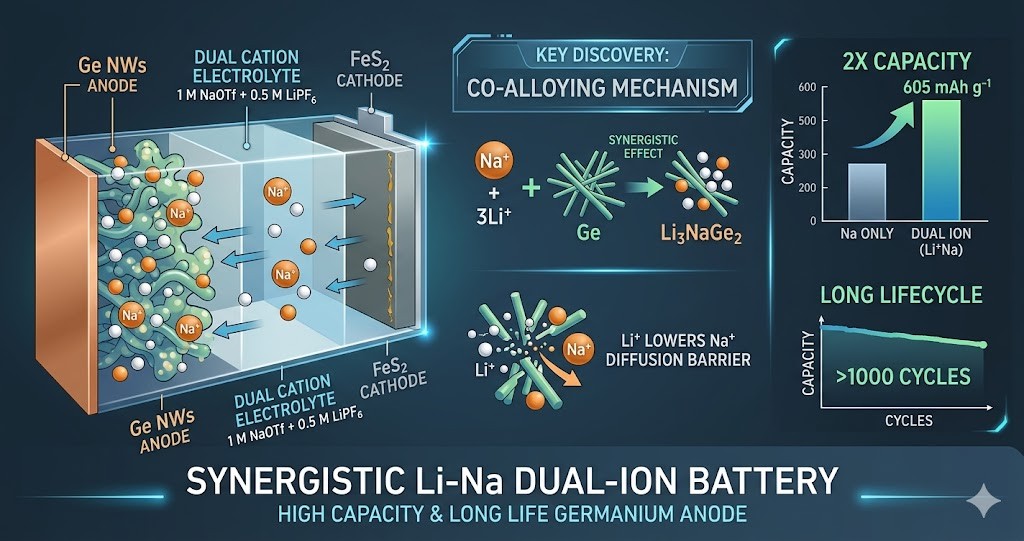
本研究は、この課題を解決するために「LiとNaの二元カチオン(デュアルアルカリイオン)電解質」を導入し、Geナノワイヤ負極においてLiとNaを相乗的に共合金化させる新しいメカニズムを解明したものです。これにより、従来のNa単独電解質と比較して容量を2倍に向上(605 mAh g-1)させ、優れた長寿命特性を達成することに成功しました。
- 充放電時における各極・電解液の構成物質
- 本研究のコア・メカニズムと主要な成果
- 関連情報・今後の展望(技術的背景の補足)
- Development of Dual-Alkali Ion Batteries via Synergistic Li-Na Co-Alloying
- Components of Each Electrode and Electrolyte During Charge and Discharge
- Core Mechanism and Key Achievements
- Related Information and Future Outlook (Supplementary Technical Background)
充放電時における各極・電解液の構成物質
本研究で実証されたデュアルアルカリイオン電池システム(フルセル構成)の主要構成物質は以下の通りです。
1. 正極(カソード)
- 使用物質: ナトリウム化された二硫化鉄(FeS2)
- 特徴: コストが安く持続可能な材料です。一般的な高価なリチウム系遷移金属酸化物(NMCなど)を使用しない構成を実現しています。なお、今後の候補としてNa3V2(PO4)3(NVP)やNa4Fe3(PO4)2(P2O7)(NFPP)などの高電圧正極の適用も示唆されています。
2. 負極(アノード)
- 使用物質: 化学的にアモルファス(非晶質)化されたゲルマニウムナノワイヤ(Ge NWs)
- 特徴: 銅(Cu)箔上にバインダーフリーで直接低温成長させた構造です。プレサイクル(事前の電気化学的充放電)を行う代わりに、無水メタノールとLi-(2-MBP)-DME溶液を用いた独自の化学処理によって事前に非晶質化(アモルファス化)されています。(2-MBP:2-メチルベンゾフェノン)
3. 電解液(エレクトロライト)
- 使用物質: 1 M NaOTf + 0.5 M LiPF6 / DEG DME(ジエチレングリコールジメチルエーテル)
- 特徴: ナトリウム塩(NaOTf)とリチウム塩(LiPF6)をエーテル系溶媒に溶解させた二元カチオン電解質です。Na単独の電解質(0.65 mS cm-1)と比較して、1.28 mS cm-1という高いイオン伝導率を示します。
本研究のコア・メカニズムと主要な成果
相乗的なLi-Na共合金化機構(三元相の形成)
第一原理ランダム構造探索(AIRSS)計算とICP-OES(誘導結合プラズマ発光分光分析)により、充放電中にこれまで報告されていなかった「LiNaGe3」や「Li3NaGe2」といった結晶性のない三元非晶質相を経由する多段階の共合金化反応が明らかになりました。
イオン半径の小さいLiイオンが先に挿入されることで、強固なGeのネットワークが破壊され、動きの鈍いNaイオンの拡散障壁が大幅に低減(固体拡散率が向上)します。
簡略化された充放電経路
- 合金化(充電)反応: Ge + Na+ + 3Li+ + 4e- -> Li3NaGe2 (約0.01 Vまで) ※この過程で、Naリッチ相とLiリッチ相が電圧に応じて段階的に形成されます。
- 脱合金化(放電)反応: 1段階目(約0.20 V):主にLiが脱離(Na+ + Li3NaGe2 -> 2NaGe + 3Li+ + 2e-) 2段階目(約0.59 V):主にNaが脱離(NaGe -> Ge + Na+ + e-)
優れた電気化学特性
- 比容量の大幅向上: Na単独電解質での充電容量(297 mAh g-1)に対し、デュアル電解質では605 mAh g-1(2サイクル目、0.1 mA cm-2)と2倍以上の高容量を達成しました。
- 圧倒的な寿命特性(ハーフセル): 1 mA cm-2の高電流密度において、1000サイクル後も84%の容量(366 mAh g-1)を維持しました。共合金化に伴う約143%の体積膨張は、Geナノワイヤが形成する多孔質メッシュ状の形態によって効果的に吸収されています。
- フルセルでの実証: 持続可能なFeS2正極と組み合わせたフルセル試験において、150 mA g-1で235 mAh g-1(正極質量基準)の容量を示し、200サイクル後も約70%の容量を維持できる堅牢性を確認しました。
関連情報・今後の展望(技術的背景の補足)
1. プレサイクルの省略と生産性向上の意義
シリコンやゲルマニウムなどの合金系負極は、結晶状態のままではNaイオンを受け入れにくいため、一度LIBなどの別セルで充放電を行って「アモルファス化(非晶質化)」させるプレサイクル処理が一般的でした。しかし、本研究が提案する「無水メタノール等の化学溶液に浸漬する化学的アモルファスプロトコル」は、セル組み立て前のロール・トゥ・ロール工程などに組み込みやすく、将来の大量生産において製造コストと工程を大幅に削減できる可能性を秘めています。
2. カチオン交換の熱力学的駆動力
DFT(密度汎関数理論)計算による三元相図の解析から、NaGe相とLi3NaGe2相の間のエネルギー的な「谷(安定領域)」の存在が明らかになりました。これが、充放電時にLiとNaが自発的に交換・共存する熱力学的な原動力(ドライブフォース)となっています。
3. バッテリー分野における今後の波及効果
これまでの多価イオン・ハイブリッドシステム(Li-Mgなど)の研究は、主に腐食性の高い複雑な電解質を用いた「正極材料の活性化」に限定されていました。本研究は、一般的なエーテル系汎用電解質を用い、「負極(アノード)側の容量と動力学を劇的に改善するために二元イオン戦略を用いた初のケース」です。
今後は、さらに安価なシリコン(Si)負極への水平展開や、局所構造を解析するためのPDF(ペア分布関数)解析、固体NMR(核磁気共鳴)を用いたさらなるメカニズムの深掘りが期待されます。
出典:https://www.sciencedirect.com/science/article/pii/S221128552500802X
Development of Dual-Alkali Ion Batteries via Synergistic Li-Na Co-Alloying
As the leading candidate for post-lithium-ion batteries (LIBs), the development of sodium-ion batteries (NIBs) utilizing resource-abundant sodium (Na) is accelerating worldwide. However, conventional hard carbon anodes suffer from a low theoretical capacity of approximately 300 to 350 mAh g-1, making the enhancement of energy density a major challenge.
Although attempts have been made to apply high-capacity alloy-type anode materials with proven track records in LIBs, such as silicon (Si) and germanium (Ge), to NIBs, it has been difficult to extract their inherent theoretical capacities. This is because Na ions have a larger ionic radius compared to Li ions, resulting in an extremely slow diffusion rate within the crystal structure.
To resolve this issue, this study introduces a “Li and Na binary cation (dual-alkali ion) electrolyte” and elucidates a novel mechanism that synergistically co-alloys Li and Na within a Ge nanowire anode. Consequently, the system successfully doubled the capacity to 605 mAh g-1 compared to conventional Na-only electrolytes and achieved excellent long-life characteristics.
Components of Each Electrode and Electrolyte During Charge and Discharge
The primary components of the dual-alkali ion battery system (full-cell configuration) demonstrated in this study are as follows:
1. Positive Electrode (Cathode)
- Material used: Sodiumated iron disulfide (FeS2)
- Characteristics: A low-cost and sustainable material. It achieves a configuration that eliminates the need for common, expensive lithium-based transition metal oxides (such as NMC). Furthermore, the application of high-voltage cathodes such as Na3V2(PO4)3 (NVP) and Na4Fe3(PO4)2(P2O7) (NFPP) has been suggested as future candidates.
2. Negative Electrode (Anode)
- Material used: Chemically amorphousized germanium nanowires (Ge NWs)
- Characteristics: A binder-free structure grown directly on copper (Cu) foil at low temperatures. Instead of undergoing pre-cycling (prior electrochemical charge/discharge), it is pre-amorphousized through a unique chemical treatment using anhydrous methanol and a Li-(2-MBP)-DME solution. (2-MBP: 2-Methylbenzophenone)
3. Electrolyte
- Material used: 1 M NaOTf + 0.5 M LiPF6 / DEGDME (Diethylene glycol dimethyl ether)
- Characteristics: A binary cation electrolyte prepared by dissolving a sodium salt (NaOTf) and a lithium salt (LiPF6) in an ether-based solvent. It exhibits a high ionic conductivity of 1.28 mS cm-1, compared to 0.65 mS cm-1 for the Na-only electrolyte.
Core Mechanism and Key Achievements
Synergistic Li-Na Co-Alloying Mechanism (Formation of Ternary Phases)
Ab initio random structure searching (AIRSS) calculations and ICP-OES (inductively coupled plasma optical emission spectroscopy) revealed a multi-step co-alloying reaction that proceeds via previously unreported non-crystalline ternary amorphous phases, such as “LiNaGe3” and “Li3NaGe2”, during charging and discharging.
The prior insertion of Li ions, which have a smaller ionic radius, disrupts the robust Ge network. This significantly reduces the diffusion barrier for the slower-moving Na ions, thereby enhancing solid-state diffusivity.
Simplified Charge/Discharge Pathways
- Alloying (Charge) Reaction: Ge + Na+ + 3Li+ + 4e- -> Li3NaGe2 (down to approximately 0.01 V) Note: During this process, Na-rich and Li-rich phases form in a stepwise manner depending on the voltage.
- Dealloying (Discharge) Reaction:
- 1st Step (around 0.20 V): Predominantly Li extraction (Na+ + Li3NaGe2 -> 2NaGe + 3Li+ + 2e-)
- 2nd Step (around 0.59 V): Predominantly Na extraction (NaGe -> Ge + Na+ + e-)
Outstanding Electrochemical Properties
- Substantial Increase in Specific Capacity: Compared to the charge capacity in the Na-only electrolyte (297 mAh g-1), the dual electrolyte achieved a capacity of 605 mAh g-1 (2nd cycle at 0.1 mA cm-2), representing a more than twofold increase.
- Overwhelming Cycle Life (Half-Cell): At a high current density of 1 mA cm-2, it maintained 84% capacity (366 mAh g-1) even after 1000 cycles. The volume expansion of approximately 143% associated with co-alloying is effectively absorbed by the porous, mesh-like morphology formed by the Ge nanowires.
- Full-Cell Demonstration: In a full-cell test paired with a sustainable FeS2 cathode, it delivered a capacity of 235 mAh g-1 (based on cathode mass) at 150 mA g-1 and demonstrated robustness by retaining approximately 70% of its capacity after 200 cycles.
Related Information and Future Outlook (Supplementary Technical Background)
1. Significance of Omitting Pre-Cycling for Productivity Enhancement
Alloy-type anodes such as silicon and germanium are inherently unreceptive to Na ions in their crystalline state. Therefore, it has been conventional practice to perform a pre-cycling treatment—charging and discharging the material in a separate cell like an LIB—to induce “amorphousization.” However, the “chemical amorphousization protocol via immersion in chemical solutions like anhydrous methanol” proposed in this study can be easily integrated into roll-to-roll processes prior to cell assembly. This holds great potential for significantly reducing manufacturing costs and processing steps in future mass production.
2. Thermodynamic Driving Force of Cation Exchange
Ternary phase diagram analysis via DFT (density functional theory) calculations revealed the existence of an energetic “valley” (stable region) between the NaGe phase and the Li3NaGe2 phase. This serves as the thermodynamic driving force that enables Li and Na to spontaneously exchange and co-exist during cycling.
3. Future Ripple Effects in the Battery Field
Previous research on multivalent-ion hybrid systems (such as Li-Mg) has been largely confined to the “activation of cathode materials” using highly corrosive and complex electrolytes. This study represents the first case of utilizing a binary ion strategy with a common, general-purpose ether electrolyte to drastically improve the capacity and kinetics on the negative electrode (anode) side.
Moving forward, horizontal expansion into even more cost-effective silicon (Si) anodes is highly anticipated, along with deeper mechanistic insights utilizing PDF (pair distribution function) analysis and solid-state NMR (nuclear magnetic resonance) to analyze local structures.


コメント