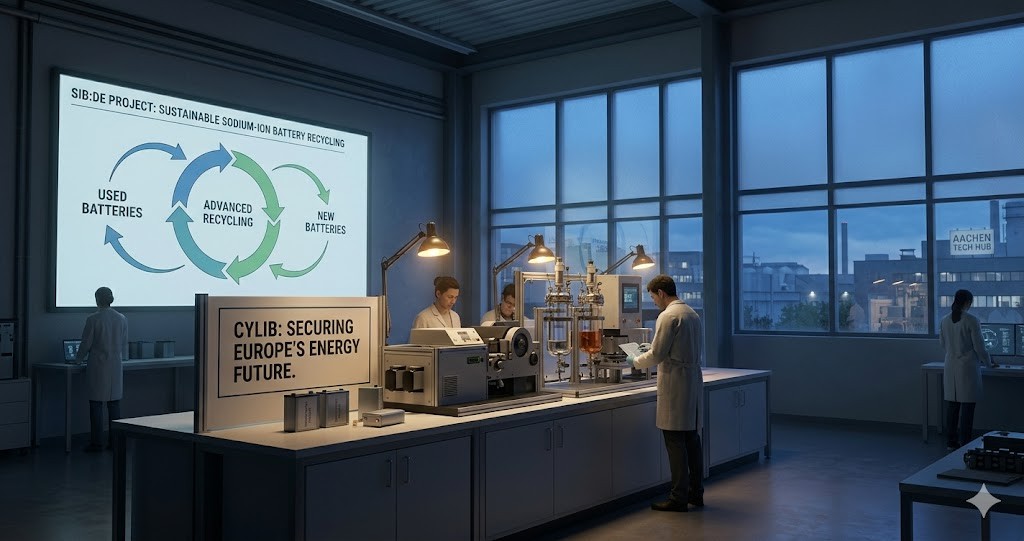
ドイツのアーヘンに拠点を置くスタートアップ、cylib(サイリブ)が、次世代電池の持続可能性を確実なものにするための野心的なプロジェクトを始動させました。
リチウムに代わる安価で豊富な資源として期待される「ナトリウムイオン電池」の普及を見据え、同社は製品が市場に溢れる前からそのリサイクル・インフラを確立しようとしています。産学官が連携するドイツ最大級のコンソーシアムにおける彼らの取り組みは、欧州のエネルギー自給と循環型経済の未来を占う重要な試みです。
以下に、プロジェクトの詳細と関連情報をまとめました。
1. プロジェクトの概要:SIB:DE
cylibは、ドイツの大手メーカーや研究機関25社で構成されるコンソーシアム SIB:DE に加盟しました。このプロジェクトは、欧州初となるナトリウムイオン電池の工業用リサイクルプロセスの開発を目的としています。
- プロジェクト期間: 2026年3月 ~ 2029年2月
- 総予算: 1,450万ユーロ(約24億円相当)
- 支援機関: ドイツ連邦教育研究省(BMBF)
- 主な参加組織: VARTA、EDAG、UniverCell、フラウンホーファー研究所(8か所)、アーヘン工科大学、ミュンヘン工科大学、ブラウンシュバイク工科大学など
2. cylibの戦略的役割
cylibは、ブラウンシュバイク工科大学とともにリサイクル部門の作業パッケージを主導します。同社の戦略は、「使用済み電池が大量発生する前にリサイクル技術を完成させる」という先行投資型のアプローチです。
開発される2つのリサイクルルート
- 標準ルート: 従来の機械的処理と湿式冶金(ハイドロメタラジー)を組み合わせたプロセス。
- 直接リサイクルルート: 材料を化学的に完全分解せず、活性物質をそのまま電池製造工程に戻す革新的手法。特に製造時のスクラップ再利用において、コスト削減と品質維持が期待されており、2029年初頭にパイロット実証を予定しています。
3. 関連情報:なぜナトリウムイオン電池なのか?
ナトリウムイオン電池(SIB)は、リチウムイオン電池の補完または代替として急速に注目を集めています。
- 資源の豊富さ: 高価なリチウムやコバルトの代わりに、塩の主成分である「ナトリウム」を使用するため、地政学的な供給リスクを低減できます。
- 安全性と低温特性: 熱暴走のリスクが低く、マイナス20度などの低温環境下でも性能が落ちにくい特徴があります。
- 主な用途: 安価な電気自動車(EV)のエントリーモデル、家庭・産業用の定置用蓄電池、電動バイクなどへの採用が進んでいます。
4. cylib社の背景と実績
2022年にアーヘン工科大学の研究者らによって設立されたcylibは、すでにリチウムイオン電池リサイクルの分野で高い評価を得ています。
- 大規模施設の建設: 1億4000万ユーロ以上の資金を調達し、ドルマーゲンのCHEMPARKに年間最大6万トンの処理能力(EV用バッテリー14万個分)を持つ施設の建設準備を進めています。
- 独自技術(OLiC): 水ベースのプロセスを用いて、リチウム、グラファイト、ニッケル、コバルトなどを90%以上の効率で回収。従来の採掘と比較して、二酸化炭素排出量を80%削減します。
5. 今後の展望
今回のプロジェクトを通じて、電池メーカーから自動車メーカー、リサイクル業者までがバリューチェーン全体で連携することで、ナトリウムイオン電池は「製造からリサイクルまで」が一貫した循環型モデルとして市場に投入されることになります。
リリアン・シュウィッチ博士(共同CEO)のコメント: 「使用済み電池が蓄積されるのを待つのではなく、最初から循環型技術を設計に組み込んでいます。これがナトリウムイオン電池を持続可能で拡張性のあるものにする鍵です。」
次世代電池の普及とリサイクル技術の開発を同期させるこの取り組みは、欧州がクリーンエネルギー分野で主導権を握るための重要な布石となります。
“Building Infrastructure Before the Boom”: cylib’s Circular Strategy for Sodium-Ion Batteries
Based in Aachen, Germany, the startup cylib has launched an ambitious project to secure the long-term sustainability of next-generation batteries.
Anticipating the rise of Sodium-Ion Batteries (SIB)—highly expected to be a low-cost, abundant alternative to lithium—the company is establishing a recycling infrastructure before these products flood the market. As part of Germany’s largest consortium of industry, academia, and government, their efforts represent a pivotal step for Europe’s energy self-sufficiency and the future of the circular economy.
Below is a summary of the project details and related information.
1. Project Overview: SIB:DE
cylib has joined SIB:DE, a consortium of 25 leading German manufacturers and research institutions. This project aims to develop Europe’s first industrial-scale recycling process for sodium-ion batteries.
- Project Period: March 2026 – February 2029
- Total Budget: 14.5 million EUR (approx. 2.4 billion JPY)
- Supporting Agency: Federal Ministry of Education and Research (BMBF)
- Key Partners: VARTA, EDAG, UniverCell, 8 Fraunhofer Institutes, RWTH Aachen University, Technical University of Munich, TU Braunschweig, Karlsruhe Institute of Technology, etc.
2. cylib’s Strategic Role
cylib leads the recycling work package alongside TU Braunschweig. Their strategy is a “pre-emptive investment” approach: perfecting recycling technology before spent batteries are generated in mass quantities.
Two Recycling Routes Under Development
- Standard Route: A process combining traditional mechanical treatment with hydrometallurgy.
- Direct Recycling Route: An innovative method that returns active materials directly to the cell production process without complete chemical decomposition. This approach is expected to significantly reduce costs and maintain material quality, particularly for manufacturing scrap. A pilot demonstration is scheduled for early 2029.
3. Context: Why Sodium-Ion Batteries?
Sodium-ion batteries (SIB) are rapidly gaining attention as a complement or alternative to lithium-ion batteries.
- Abundant Resources: By using sodium (the main component of salt) instead of expensive lithium or cobalt, geopolitical supply chain risks are minimized.
- Safety and Low-Temperature Performance: They have a lower risk of thermal runaway and maintain performance even in environments as cold as -20°C.
- Primary Applications: Entry-level electric vehicles (EVs), residential and industrial stationary energy storage, and electric motorbikes.
4. cylib’s Background and Track Record
Founded in 2022 by researchers from RWTH Aachen University, cylib has already earned high acclaim in the field of lithium-ion battery recycling.
- Large-Scale Facility: Having raised over 140 million EUR in funding, the company is preparing to build its first industrial facility at CHEMPARK Dormagen. It will have a capacity of up to 60,000 tons per year (equivalent to 140,000 EV batteries).
- Proprietary Technology (OLiC): Their water-based OLiC (Optimized Lithium-graphite Recovery) process recovers lithium, graphite, nickel, cobalt, and manganese with over 90% efficiency. It reduces CO2 emissions by 80% compared to primary mining.
5. Future Outlook
Through this project, the entire value chain—from battery and car manufacturers to recyclers—will collaborate to ensure sodium-ion batteries enter the market with a “cradle-to-cradle” circular model already in place.
Dr. Lilian Schwich (Co-CEO): > “Instead of waiting for spent sodium-ion batteries to accumulate, we are integrating circular technology into the design from the very beginning. This is the key to making this technology truly sustainable and scalable.”
By synchronizing the adoption of next-generation batteries with the development of recycling technology, this initiative serves as a crucial foundation for Europe to take a leading role in the clean energy sector.


コメント